'Smart Glasses' Could Help Blind People Navigate

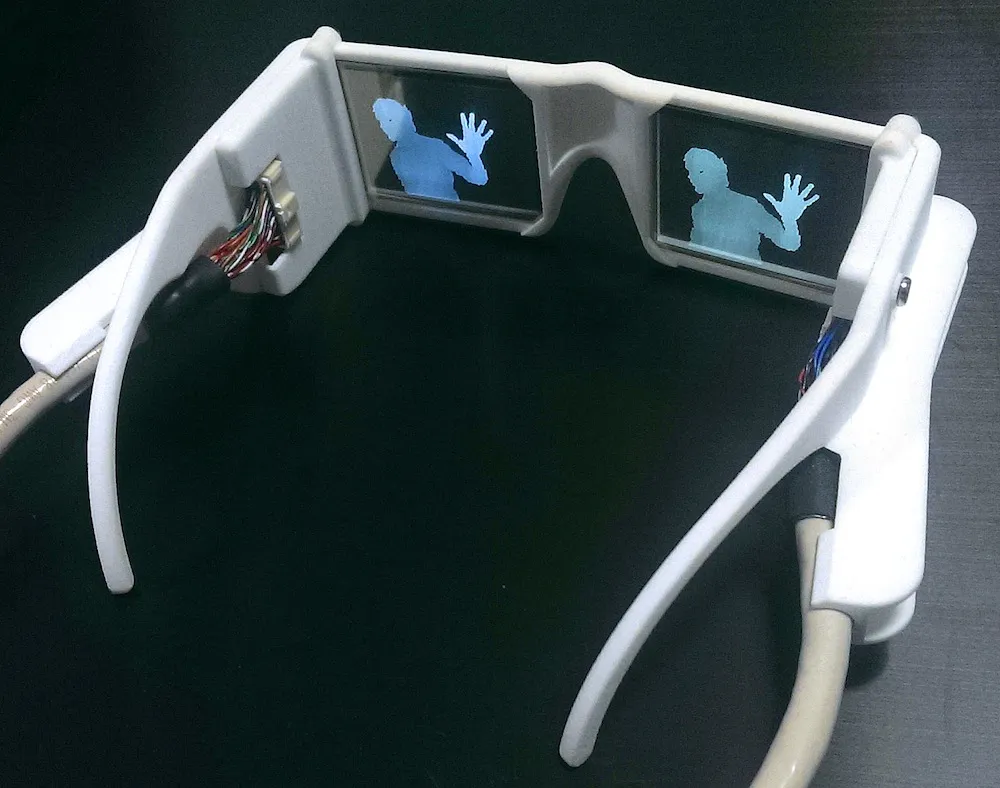
A pair of "smart glasses" might help blind people navigate an unfamiliar environment by recognizing objects or translating signs into speech, scientists say.
The majority of registered blind people have some residual ability to perceive light and motion. But assistive technologies for the visually impaired have been limited.
Now, researchers from Oxford University in England are developing a set of sophisticated glasses that use cameras and software to detect objects and display them on the lenses of glasses. The team recently won an award from the Royal Society to continue this work. [Bionic Humans: Top 10 Technologies]
Article continues below"This is the beginning of a golden age for computer vision," study researcher Stephen Hicks said in a statement. "The Royal Society's Brian Mercer Innovation award will allow us to incorporate this research into our glasses to help sight-impaired people deal with everyday situations much more easily."
Here's how the smart glasses work: Two small cameras mounted on the corners of the glasses capture two different pictures, just as human eyes do. The spectacles display information from the cameras on transparent LED displays on the lenses, so the wearer can see an enhanced image as well as use their remaining sight. Comparing the distance between the cameras reveals how far the object is from the wearer.
A set of headphones takes text and translates it into speech to provide directions or read signs aloud.
The glasses are also equipped with a compass, a GPS and a gyroscope, a tool that measures the orientation of the glasses.
Get the world’s most fascinating discoveries delivered straight to your inbox.
In the United Kingdom, where the research is taking place, more than 2 million people have impaired vision, and more than 300,000 are registered as blind, due to diseases such as macular degeneration, glaucoma and diabetic retinopathy.
Moving forward, the researchers hope to develop software to provide a range of different functions that testers of the glasses say would be useful.
For example, the glasses could use levels of brightness to show depth. They could detect if a person is present based on his or her movement. In addition, the glasses might be able to read the locations or numbers of buses and provide GPS directions via the headphones.
Follow Tanya Lewis on Twitter and Google+. Follow us @livescience, Facebook & Google+. Original article on LiveScience.
