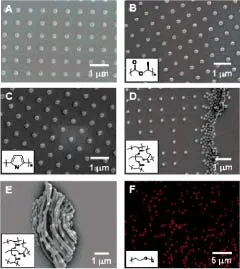
Scientists who have created the smallest precisely crafted organic particles are billing their breakthrough as a potential boon to medicine and technology.
The tiny structures could one day be used as vehicles for delivering drugs or genes into the human body or perhaps imaging you from the inside-out, the researchers said today. They might also find uses in electronics.
The nanotechnology industry has long been making strong claims, and this latest process is in its infancy. And it is no longer a big feat to make small things. Other scientists have created molecule-sized structures and even microscopic motors in the nanometer range. A nanometer is a billionth of a meter.
But traditional nano-products are made mostly of metals and other inorganic materials that must be baked, etched or processed with solvents that would destroy fragile DNA or drugs.
The new structures are made of organic materials without all the harsh treament and can be constructed as spheres, rods, cones, or trapezoids. They could be made biodegradeable to disintigrate after insertion into the body.
"We believe that the particles will offer breakthroughs in the delivery of therapeutic, detection and imaging agents for the diagnosis and treatement of disease," one of the study's leaders, Joseph DeSimone of the University of North Carolina at Chapel Hill, told LiveScience. "In the elctronics industry, we believe we can make new materials for high speed, high-resolution optical displays."
The new manufacturing process is called Particle Replication in Nonwetting Templates, or PRINT, and was detailed in a recent issue of the Journal of the American Chemical Society. The work was supported by the National Science Foundation.
Sign up for the Live Science daily newsletter now
Get the world’s most fascinating discoveries delivered straight to your inbox.
DeSimone and his colleagues have formed a new company, called Liquidia, to attempt to commercialize the discovery.
Robert is an independent health and science journalist and writer based in Phoenix, Arizona. He is a former editor-in-chief of Live Science with over 20 years of experience as a reporter and editor. He has worked on websites such as Space.com and Tom's Guide, and is a contributor on Medium, covering how we age and how to optimize the mind and body through time. He has a journalism degree from Humboldt State University in California.