














Lightning Strike Sparks Virginia Wildfire

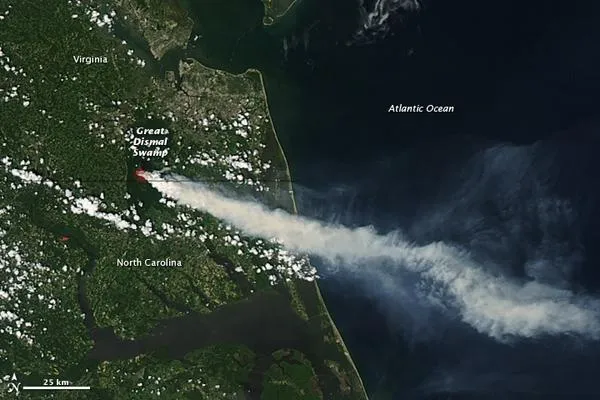
When lightning struck in the Great Dismal Swamp National Wildlife Refuge on August 4, 2011, it hit land primed for wildfire. A previous fire in 2008 had killed trees and brush, leaving dead fuel in its wake. Grass and brush began to re-grow over the old burn scar, but in 2011, drought dried the plants and soil. And so, when lightning struck on August 4, it ignited the steadily growing Lateral West fire in southern Virginia.
This image, taken by the Moderate Resolution Imaging Spectroradiometer (MODIS) on NASA's Aqua satellite on August 8, shows that the fire is producing dense smoke as it burns in the swamp. The fire is burning through dry grass and brush, dead vegetation left by the 2008 fire, and pine forest, but the worst of the smoke comes from the burning soil.
Extreme heat and unusually dry weather dried the soil, which is made up of partially decomposed plant matter. This peat soil is highly flammable when dry, and it produces thick smoke as it burns. Fine particles and gases inside smoke pose a risk to human health. Smoke irritates the eyes and the respiratory system. It can cause bronchitis or even aggravate heart or lung disease.
The Lateral West fire is likely to produce a great deal of smoke over the coming weeks. Peat fires burn deep in the soil, making them very hard to contain. High temperatures, low humidity, and difficult terrain will make this fire even more difficult to manage. Fire fighters estimate that the fire will be contained on August 31. As of August 9, the Lateral West fire has burned 2,000 acres.
- Satellite Sees Burn Scars of Wallow Fire
- Weather & Wildfire: What Fueled Arizona's Monster
- In Images: Texas Wildfires
Get the world’s most fascinating discoveries delivered straight to your inbox.
