















Lightning Remains Huge Mystery

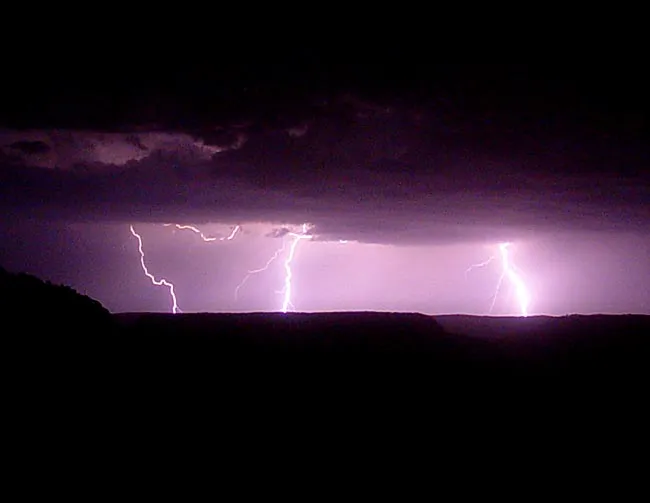
As common as lightning is, it still sparks considerable confusion among scientists.
Many of the basics are understood, but researchers admit they don't really understand how lightning gets from there to here. And they're totally baffled by lightning's link to X-rays, a discovery made back in 2001.
"Nobody understands how lightning makes X-rays," says Martin Uman, a professor of electrical and computer engineering at the University of Florida. "Despite reaching temperatures five times hotter than the surface of the sun, the temperature of lightning is still thousands of times too cold to account for the X-rays observed."
That said, Uman added, "It's obviously happening. And we have put limits on how it's happening and where it's happening."
In new research, Uman and colleagues have taken a step forward in their understanding:
As lightning comes down from a cloud, it moves in steps, each 30 to 160 feet long. In this "step leader" process, X-rays shoot out just below each step millionths of a second after the step completes, the researchers learned.
The finding, based on lightning created in a lab and detailed online this week in the journal Geophysical Research Letters, could eventually lead to better predictions of lightning.
Get the world’s most fascinating discoveries delivered straight to your inbox.
"A spark that begins inside a thunderstorm somehow manages to travel many miles to the ground, where it can hurt people and damage property," said Uman's colleague Joseph Dwyer, a professor in the department of physics and space sciences at Florida Institute of Technology. "Now, for the first time, we can actually detect lightning moving toward the ground using X-rays. So just as medical X-rays provide doctors with a clearer view inside patients, X-rays allow us to probe parts of the lightning that are otherwise very difficult to measure."
But challenges remain.
"From a practical point of view, if we are going to ever be able to predict when and where lightning will strike, we need to first understand how lightning moves from one place to the other," Dwyer said. "At present, we do not have a good handle on this. X-rays are giving us a close-up view of what is happening inside the lightning as it moves."
The lab research will continue, and one thing they want to look into: whether lightning strikes to airplanes could produce X-rays harmful to passengers.
- 101 Amazing Earth Facts
- The World's Weirdest Weather
- Gallery: Electric Earth

Robert is an independent health and science journalist and writer based in Phoenix, Arizona. He is a former editor-in-chief of Live Science with over 20 years of experience as a reporter and editor. He has worked on websites such as Space.com and Tom's Guide, and is a contributor on Medium, covering how we age and how to optimize the mind and body through time. He has a journalism degree from Humboldt State University in California.