















Embryos Like to Be Rocked Like Babies
Like babies that can be lulled to sleep with swaying, embryos also prefer to be rocked.
By gently rocking embryos while they grew during in vitro fertilization, scientists increased pregnancy rates in mice by more than 20 percent. The same rock-a-bye procedure could lead to more success for in vitro fertilization in humans, the researchers say.
"One of our goals for years now has been to modify how we grow embryos in the lab to be more like how they grow in the human body, because we know that the human body grows them most efficiently," said Gary Smith, associate professor of Obstetrics and Gynecology at the University of Michigan, Ann Arbor.
Current IVF procedures involve joining an egg and sperm in a culture that incubates in a petri dish, remaining still, for a few days before the embryo gets placed into the woman's womb. That's nothing like what happens naturally in a woman's body, Smith said, where fluids are flowing and there's always movement.
Even so, that's what's out there, and the technique can help the one in six couples with infertility problems, Smith said. However, not only is IVF costly and often not covered by insurance, the success rate is only about 35 percent, Smith said.
"If we could increase that, even just to 45 percent, that's significant," Smith said. "We're making healthier embryos, which not only can improve pregnancy rates, but also could allow us to transfer fewer embryos per cycle and reduce the incidence of twins and triplets."
Embryo cradle
Get the world’s most fascinating discoveries delivered straight to your inbox.
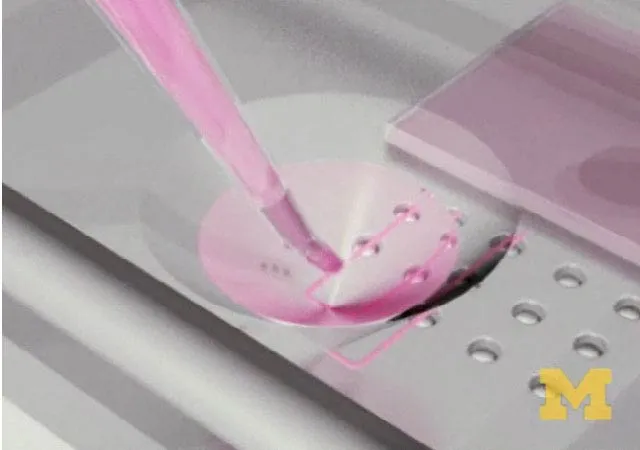
Smith and his colleagues built a device that imitates the motion embryos experience in the body as they make their way down a mammal's oviduct (a woman's Fallopian tube) to the uterus.
"By making the cells feel more at home, we get better cells, which is key to having better infertility treatment," said study researcher Shu Takayama, an associate professor of biomedical engineering at the University of Michigan, Ann Arbor.
The device consists of a thimble-sized funnel, and at the bottom of the funnel are tiny channels that allow nutrient-rich fluids to flow in and waste to move out.
The funnel sits on rows of Braille pins programmed to pulse up and down, pushing fluids in and out of the microchannels. The pulsing simulates motion in the body that ultimately pushes fertilized eggs into the uterus and flushes out an egg's waste products.
"It gets this periodic rocking or fluid flow," Takayama said. "The amazing thing is that the embryos seem to notice."
Rocking embryos
To test out the embryo cradle of sorts, the team incubated early-stage mouse embryos, each about the size of a pencil tip, in either a static dish (similar to current IVF methods) or in the new rocking device. They found the rocked embryos were much healthier and robust after four days compared with the still ones.
(For typical IVF procedures in humans, a woman's egg is fertilized with sperm in a petri dish and three to five days later the embryo is placed into the woman's womb, according to the National Institutes of Health.) Mouse embryos grown in the static dish contained an average of 67 cells compared with about 109 cells for the rocked embryos. A set of embryos that were grown in the bodies of mice for the same amount of time had an average of 144 cells.
Taken alone, the cell-number results might not be too impressive, Takayama said. "The exciting thing is they actually give much better pregnancy rates, at least in mice."
About 77 percent of the rocked mouse embryos led to ongoing pregnancies, compared with 55 percent of the statically-grown embryos and 83 percent of mouse embryos conceived naturally and grown within the oviduct.
The results are detailed in the journal Human Reproduction.
Jeanna Bryner is managing editor of Scientific American. Previously she was editor in chief of Live Science and, prior to that, an editor at Scholastic's Science World magazine. Bryner has an English degree from Salisbury University, a master's degree in biogeochemistry and environmental sciences from the University of Maryland and a graduate science journalism degree from New York University. She has worked as a biologist in Florida, where she monitored wetlands and did field surveys for endangered species, including the gorgeous Florida Scrub Jay. She also received an ocean sciences journalism fellowship from the Woods Hole Oceanographic Institution. She is a firm believer that science is for everyone and that just about everything can be viewed through the lens of science.