















How Sand Dunes Grow Huge
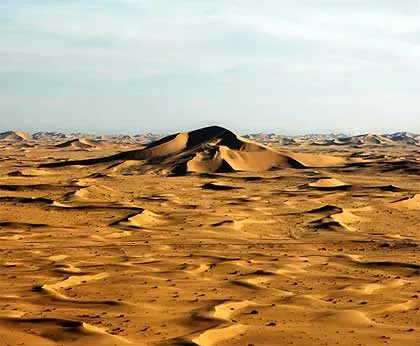
Anyone who has seen giant sand dunes, the tall ones stretching many hundreds, even thousands, of feet across the desert floor, has surely wondered how they get to be so big. Scientists, too, have deliberated the question for years.
The sandy behemoths form in China, the Sahara, Namibia, and Iran, among other desert areas, and they come in ridge, star, or crescent shapes.
Bruno Andreotti and Philippe Claudin of the Laboratory of the Physics and Mechanics of Heterogeneous Media in Paris and colleagues now have some answers. The team studied giant-dune fields on-site, analyzed aerial and satellite photos and meteorological data, and ran aerodynamic models to investigate dune growth.
No matter the shape, giant dunes grow by the amalgamation of smaller dunes, the researchers discovered. Their ultimate size depends upon the average thickness of the lowest layer of the atmosphere, which starts at Earth's surface and within which heat recirculates. The thickness of this convective layer varies from several hundred yards near the ocean to more than a mile above inland deserts, owing to annual variations in ground temperature.
Winds flowing over dune fields are constrained within that layer. As dunes grow wider and taller, they confine the wind flow slightly more, which, in turn, arrests the dune's growth.
So, the thicker the layer, the bigger the dunes. Reaching heights of 1,600 feet or more, star dunes in the Badain Jaran Desert of north central China may be the biggest.
The research was detailed in the journal Nature.
Get the world’s most fascinating discoveries delivered straight to your inbox.
- 101 Amazing Earth Facts
- Expedition Explains Strange Antarctic Megadunes
- Mystery of the Singing Sand Dunes
{{ video="071109-SandUniverse" title="Early Universe Seen in Sand Grains" caption="Sand grains striking an object create a similar shape as that seen in particle smashing experiments that recreate the early moments of the universe. Credit: S. Nagel, H. Jaeger, U. of Chicago" }}