













Newly Discovered Walls Buffered Sphinx from Egypt's Sand

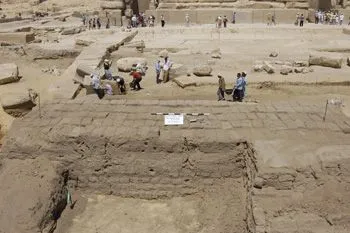
A routine excavation has uncovered ancient walls surrounding the Great Sphinx of Giza, Egypt's Supreme Council of Antiquities (SCA) announced today (Nov. 2).
The walls were likely built to protect the Sphinx from blowing sand, said SCA Secretary-General Zahi Hawass, who is overseeing the excavation.
During routine digging, SCA researchers found two segments of mud wall on the Giza Plateau, where the pyramids of Giza and the Sphinx stand. Both walls stand just under 3 feet (1 meter). One runs north-south and is 282 feet (86 meters) long, while the other runs east-west and is 151 feet (46 m) long.
The walls are part of a larger enclosure previously found north of the Sphinx, according to Hawass. As told in ancient Egyptian texts, King Thutmose IV once went on a hunting trip near the Sphinx. After the trip, he dreamt that the Sphinx wanted him to clear the sand surrounding its body. According to Thutmose, the Sphinx promised that if he restored the statue, he'd become king of Egypt.
So Thutmose had the sand cleared and built a wall to preserve the Sphinx. Until now, researchers thought the wall was only built on the northern side of the Sphinx. The new finding disproves that theory.
The researchers also found a third wall to the east of the temple of King Khafre, the builder of the second-largest pyramid in Giza and the likely builder of the Sphinx. According to Hawass, the wall may be part of the settlement that grew up around King Khafre's pyramid after the monarch's death around 2532 B.C. In this village, priests and officials oversaw the mortuary cult of the dead king.
Khafre's mortuary cult remained strong until the end of Egypt's Old Kingdom around 2143 to 2134 B.C. After that, initial excavations suggest the village was abandoned, said Essam Shehab, the supervisor of the Khafre's valley temple excavation.
Get the world’s most fascinating discoveries delivered straight to your inbox.
Excavations continue on the Thutmose IV enclosure wall, according to the SCA. The archeologists are keeping an eye out for other secrets still hidden in the sand.
