
LiveScience Blogs Home / Archive for December, 2007

NYC Infested with Bedbugs

December 31st, 2007
Author Robert Roy Britt

More than a year ago, we told you bedbugs were making a comeback:

Absent from the U.S. for so long that some thought they were a myth, bedbugs are back. Entomologists and pest control professionals are reporting a dramatic increase in infestations throughout the country, and no one knows exactly why.

So this week’s news is no surprise, but New York City is, well, New York City:
The blood-sucking nocturnal creatures have infested a Park Ave. penthouse, an artist’s colony in Williamsburg, Brooklyn, a $25 million Central Park West duplex and a theater on Broadway, according to victims, exterminators and elected officials.

Said Jeff Eisenberg, owner of Pest Away Exterminating on the upper West Side, in the Daily News article: “In the last six months, I’ve treated maternity wards, five-star hotels, movie theaters, taxi garages, investment banks, private schools, white-shoe law firms, Brooklyn apartments in Greenpoint, DUMBO and Cobble Hill, even the chambers of a federal judge.”

Leave a Reply »
  • Add to delicious
  • Digg It!
  • Save to Newsvine
  • Add to reddit
  • Add to Netscape
  • Email to Friend Email
  • Subscribe Subscribe

Asteroid Impact on Mars: Collision Probability Increased

December 28th, 2007
Author Leonard David

The chance that a rogue mini-world — asteroid 2007 WD5 — will smack into Mars on January 30th has increased from 1.3 percent to 3.9 percent.

That’s the new estimation from officials at the Near Earth Object Program at the Jet Propulsion Laboratory (JPL), stemming from several sky watching teams in Alaska, New Mexico, and in Arizona.

“The impact probability resulting from the recent orbit refinement has increased to a surprising 3.9 percent…about 1 in 25 odds,” explain JPL’s Near Earth Object Program website, updated today regarding the asteroid meets Mars altercation.

Still, there remains an uncertainty, although a Mars impact is still possible. However, the most likely scenario in the weeks to come is that more observations of the asteroid will allow that uncertainty to shrink - so that a Mars impact is definitely ruled out.

The JPL website notes that, in the unlikely event of an impact, the head-on collision would take place on January 30th at 2:55 a.m. Pacific Standard Time, with an uncertainty of a few minutes.

Nothing to set your watch by…but a big event in our time.

Leave a Reply »
  • Add to delicious
  • Digg It!
  • Save to Newsvine
  • Add to reddit
  • Add to Netscape
  • Email to Friend Email
  • Subscribe Subscribe

Odd Event in Earth Orbit: Space Objects Collide?

December 27th, 2007
Author Leonard David

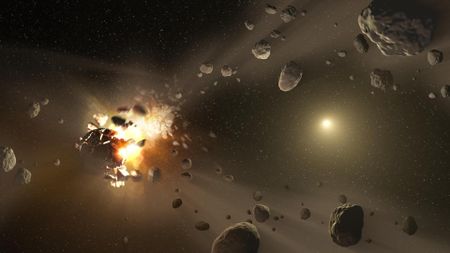
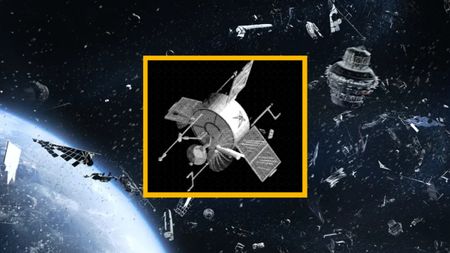
Something odd has happened to NASA’s Upper Atmosphere Research Satellite (UARS).

Back in November, four pieces from the UARS were cataloged by the U.S. Air Force Space Command. What caused the litter from the spacecraft appears to be the result from a single event - perhaps a collision with another space object.

The shuttle-deployed UARS has been circling Earth since 1991. The large spacecraft had served up important Earth climate data prior to its deactivation in late 2005.

But on November 10, UARS experienced some kind of event that produced the debris.

T.S. Kelso runs the CelesTrak web site and is an orbital debris analyst and technical program manager at the Center for Space Standards & Innovation in Colorado Springs, Colorado.

In running back the pieces back to UARS on November 10, he noticed that a piece of debris from Russia’s Cosmos 1275 “was near enough to be considered a suspect for a collision. It intersected the orbit several minutes before the apparent separation point,” Kelso told me.

However, there is a fair amount of error in the positions of these objects - so they do not appear to line up precisely, Kelso added.

By the way, space junk from Cosmos 1275 was produced when that former Soviet Union navigation satellite was blown into fragments back in 1981, perhaps by a chunk of human-made debris - at least that was the speculation in Western circles. However, according to official Russian sources the cause of the breakup of Cosmos 1275 was a battery malfunction.

That cause is consistent with the debris pattern and the fact that the spacecraft broke up after less than two months in space. NASA breakup records have noted this cause for many years.

For Kelso, he thinks collisions in space might be more prevalent than thought.

“Of course, we keep hearing that there have only been three recorded collisions, but the process of detecting them and then doing the analysis can take months or years…as seen already in this case,” Kelso said.

“Sooner or later, we’re going to stop assuming that because we don’t notice collisions doesn’t mean they aren’t happening. At least this satellite was decommissioned before this happened,” Kelso concluded.

Leave a Reply »
  • Add to delicious
  • Digg It!
  • Save to Newsvine
  • Add to reddit
  • Add to Netscape
  • Email to Friend Email
  • Subscribe Subscribe

NASA Outer Planet Mission Studies: International Collaboration

December 25th, 2007
Author Leonard David

Inner circles at NASA continue to probe a set of outer planet flagship missions.

New word from James Green, Director of the Planetary Sciences Division at NASA Headquarters, is that phase-2 studies will focus on a Europa Explorer, a Jupiter System Orbiter, and a Titan Explorer.

Moreover, these studies will be carried out in cooperation with the European Space Agency (ESA) and the Japan Aerospace Exploration Agency (JAXA).

There’s no question that coming to grips — or is it gripes? — regarding where to send an expensive outer planet flagship mission is a challenge. It looks like NASA can cough up roughly $2 billion for such a mission, a figure that likely puts a squeeze on how ambitious a new outer planet mission might be.

Collaborating with other nations on an outer planet flagship mission also brings up timetable issues, multi-nation processes and sticky International Traffic in Arms Regulations (ITAR) complications on the U.S. side.

Fran Bagenal, chair of NASA’s Outer Planets Assessment Group (OPAG) steering committee, tells me that international collaboration has always been understood to be part of the process. But how it is to work remains unclear…an issue that’s been noted within the OPAG membership.

NASA’s Green has informed the space science community that the space agency is in the process of developing new ground rules, plus the necessary programmatic changes that will be needed to include international collaborators in moving forward on a new outer planet mission.

The plan is to start working with ESA and JAXA, Green said, as soon as possible in 2008.

Leave a Reply »
  • Add to delicious
  • Digg It!
  • Save to Newsvine
  • Add to reddit
  • Add to Netscape
  • Email to Friend Email
  • Subscribe Subscribe

Send Yuletide Greetings to the Space Station

December 22nd, 2007
Author Tariq Malik

The three astronauts living aboard the International Space Station (ISS) are a long way from home this holiday season, but are apparently awash in digital cheer thanks to some electronic Christmas cards from the people of Earth.

Expedition 16 commander Peggy Whitson and flight engineers Dan Tani and Yuri Malenchenko have received more than 6,000 electronic cards bearing good wishes from around the globe via a free NASA portal. You can too by clicking here.

“If those greetings had been sent by Christmas cards, the postal sacks would have weighed about 200 pounds,” the agency said Friday. “Just the postage would have cost more than $1,500.”

The Expedition 16 crew's Merry X-mas
The Expedition 16 astronauts are only the latest space crew to spend the holiday season in orbit.

According to NASA’s records, the first astronauts to spend Christmas in space were the crew of Apollo 8 in 1968, who beamed a special message back to Earth during their historic first flight around the moon.

NASA’s next batch of Christmas spaceflyers flew in 1973 during the fourth Skylab mission. The astronauts assembled an ad-hoc Christmas tree out of food cans to mark the holiday.

NASA’s first holiday astronaut of the space shuttle era was John Blaha, who spread yuletide cheer aboard Russia’s Space Station Mir in 1996. Shuttle astronauts marked the holiday in 1999 during the STS-103 mission to the Hubble Space Telescope, to date the only orbiter mission to spend Christmas in space.

The first ISS astronauts began spending the holidays in orbit in 2000 during Expedition 1. Three years later, the Expedition 6 crew would slather red and white frosting over Twinkies as an impromptu Christmas cake.

Click here to learn more about the history of Christmas in space.

Click here to send your own message to the Expedition 16 crew aboard the space station and view the astronaut’s holiday video.

For a sample of some of the thousands of messages already received by the station crew, click here.

Leave a Reply »
  • Add to delicious
  • Digg It!
  • Save to Newsvine
  • Add to reddit
  • Add to Netscape
  • Email to Friend Email
  • Subscribe Subscribe

Mars Impactor: Rovers at the Ready

December 21st, 2007
Author Leonard David

That possible impact of an asteroid on Mars at the end of January would be quite a show for the orbiters and rovers now on duty at the red planet.

I asked Steve Squyres - lead scientist of the Spirit and Opportunity Mars rovers at Cornell — what he thought might be observable by the robots - at that time, in their fourth year of operations.

“If an impact takes place, the most likely thing for us to observe would be dust that has been lofted into the atmosphere by the impact event and then carried over the rover sites by wind,” Squyres said. “So if there is an impact, we’ll increase our monitoring of dust in the atmosphere to see if we can observe any effects.”

Squyres added that the rover team, of course, would try to image the sky at the predicted time of impact to see if anything can be seen, “but that’s got to be considered a very improbable long shot.”

Scientists say that the asteroid that might hit Mars — 2007 WD5 that was spotted late November — is similar in size to the Tunguska impactor that struck Siberia a century ago.

Recently, experts at Sandia National Laboratories ran some supercomputer simulations suggesting that the Tunguska asteroid hit here on Earth a century ago may have been much smaller than previously thought. One message from their study suggests that smaller objects can create quite a mess given the stunning amount of devastation at Tunguska.

So…should be quite a dust-up on Mars if 2007 WD5 pings the red planet next month.

Leave a Reply »
  • Add to delicious
  • Digg It!
  • Save to Newsvine
  • Add to reddit
  • Add to Netscape
  • Email to Friend Email
  • Subscribe Subscribe

Driving Under the Influence of Technology

December 20th, 2007
Author Robert Roy Britt

Every excursion across my small swath of suburbia now involves dealing with multiple erratic drivers, swerving dangerously to pass, tailgating, and generally looking as though they don’t realize there are other cars on the road. Truth is, they don’t: They’re talking on a cell phone or, worse, texting, and studies show they really aren’t aware of their surroundings. The problem has grown markedly worse in the past couple years as the devices (count iPods and GPS mappers now, too) have become ubiquitous.

In the UK, it’s illegal.

“Drivers who adjust sat-navs, tinker with MP3 music players such as iPods or send text messages at the wheel could also face prison sentences,” according to new guidelines from prosecuters, detailed in The Telegraph.

Studies clearly show that texting or phoning while driving is dangerous, about like driving drunk.

Of course, motor vehicle laws do not always prevent dangerous behavior. From The Telegraph article: “Using a hand-held mobile while driving was outlawed in 2003, but it is estimated that half a million motorists flout the ban each day.”

Still, the ban should span the pond. Many motorists flout our seat belt law, too, but that doesn’t mean the law should never have been instituted.

Leave a Reply »
  • Add to delicious
  • Digg It!
  • Save to Newsvine
  • Add to reddit
  • Add to Netscape
  • Email to Friend Email
  • Subscribe Subscribe

Cheers, Beer Drinkers!

December 19th, 2007
Author Andrea Thompson

I’m not a huge fan of Guinness myself, but there’s some good news if you are. A pint of the famous beer a day prevents heart clots (which can trigger heart attacks) as well as an aspirin, according to a study featured in this BBC News article.

 Our own Robin Lloyd details the steps that lead to a heart attack, which may seem sudden, but actually develop over time.

The antioxidants found in the Guinness’s dark brew are responsible for its protective effect, the research in the BBC article found. Other foods and drinks that are sources of these beneficial molecules are red wine, coffee, fruits and vegetables.

Leave a Reply »
  • Add to delicious
  • Digg It!
  • Save to Newsvine
  • Add to reddit
  • Add to Netscape
  • Email to Friend Email
  • Subscribe Subscribe

Fat Chance: Green Ship Powered by Liposuction

December 19th, 2007
Author Robert Roy Britt

New Zealand skipper Pete Bethune and his wife have mortgaged their house to finance a trip around the world. They’ll try to set a record by doing the trip really fast. The normalcy of this story stops there.

Their ship, which runs on biodiesel, will also be powered in part by human fat. It’s all a stunt to showcase alternative energy.

From the Daily Mail: “Demonstrating further commitment to the cause, Bethune underwent liposuction and donated enough to produce 100ml of biofuel, while two other, larger volunteers also had the procedure, making a total of 10 litres of human fat.”

Meanwhile, the U.S. Air Force pulled a green stunt of its own this week, marking the 104th anniversary of powered flight by completing the first transcontinental flight of an aircraft using a blend of regular aviation and synthetic fuel. Those wild and crazy military types!

Leave a Reply »
  • Add to delicious
  • Digg It!
  • Save to Newsvine
  • Add to reddit
  • Add to Netscape
  • Email to Friend Email
  • Subscribe Subscribe

SETI Debate on Transmitting Targeted Signals

December 19th, 2007
Author Leonard David

Looks like top-thinkers in making contact with extraterrestrials have become a bit star-crossed.

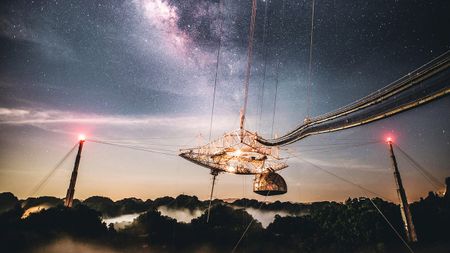
The scene is the International Academy of Astronautics (IAA) that has a permanent study group and task groups set up to look at issues regarding the Search for Extraterrestrial Intelligence (SETI) and policy issues of contacting alien starfolk.

What has surfaced is heated debate over “Active SETI” - that is, beaming out deliberate and powerful Spinal Tap-like signals that are cranked up to #11 on the volume control knob.

Several active participants in the IAA SETI deliberations have raised a warning flag, along with their collective eyebrows on the matter.

I contacted one of those people engaged in the whirlpool of debate, Michael Michaud, a former director of the U.S. State Department’s Office of Advanced Technology. He is also recent author of the seminal and scholarly book: “Contact with Alien Civilizations - Our Hopes and Fears about Encountering Extraterrestrials”.

“While I am glad to see media interest in the Active SETI issue, some journalists have misrepresented the debate. None of us are calling for a ban on all transmissions. We recognize that it is unrealistic and probably unnecessary to stop the routine radio, television, and radar signals that the Earth emits every day.”

But what Michaud and others within the IAA are calling for “is more open, democratic consideration of whether it is or is not advisable to transmit powerful targeted signals when we know nothing about the capabilities or intentions of the civilizations that might detect them,” he told me via email. “My personal goal is to get people to think in terms of species interests, not just personal, organizational, or national interests. We are learning to do this as we face global problems such as climate change or the possibility of an asteroid impact. The bottom line is responsible behavior that keeps the interests of the larger society in mind.”

Michaud contends that the exact mechanism for addressing this question is open to debate.

“As a starting point, I suggest that people who want to send unusually powerful, targeted signals from radio telescopes be asked to submit such plans to the International Astronomical Union for approval. If an organization composed of astronomers has reservations about such Active SETI, the issue would have to be seen as one of more general public concern,” Michaud said.

Furthermore, some critics who claim that interstellar flight is impossible or totally unrealistic make the false assumption that such missions must carry biological beings with the life spans of humans, Michaud said, adding that some also assume that all journeys must be round-trips.

“These assumptions do not stand up under objective scrutiny, particularly when we consider that an alien civilization may be far more technologically advanced than we are,” Michaud told me.

Michaud and the other IAA members engaged in the Active SETI discussion all strongly favor searching for signals. “If we detect another civilization, we could again make a conscious decision — with the interests of Humankind as our measure — as to whether we should or should not initiate communication,” he added.

“It would help if certain journalists would stop using outdated cliches about contact. The term ‘little green men’ is just silly,” Michaud continued. “If direct contact ever takes place, it is far more likely to be with intelligent machines than with biological beings. It is even more stupid — and irrelevant — to describe the potential threat as one of being eaten.”

Michaud underscored the point that it took 50 years (the 1930s to the 1980s) for the public to take seriously the potential threat from collisions with Earth-crossing asteroids, and to begin thinking about how to deal with them.

“If we date the beginning of SETI to 1960, a more realistic approach to direct contact is due about now,” Michaud concluded.

Leave a Reply »
  • Add to delicious
  • Digg It!
  • Save to Newsvine
  • Add to reddit
  • Add to Netscape
  • Email to Friend Email
  • Subscribe Subscribe