













Cricket Sets Testicle Size Record

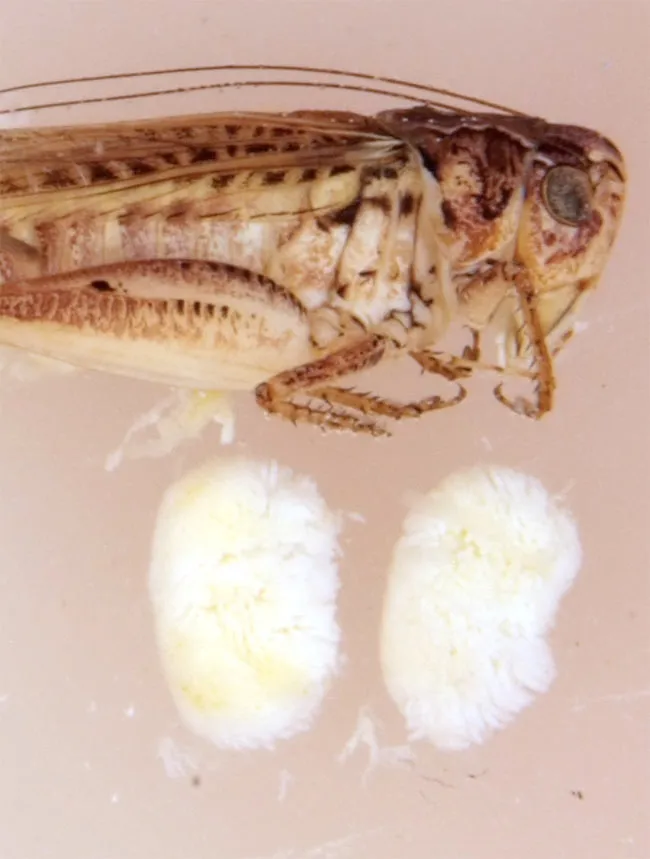
A species of cricket has broken an unlikely world record: largest testicles in relation to body weight.
The Tuberous bushcricket's testicles account for 14 percent of its body weight. To put that in perspective, the testicles of a man weighing 200 pounds (91 kilograms) with that ball-to-body ratio would weigh 28 pounds (12.7 kg).
The bushcricket, whose anatomical extremes are reported today (Nov. 9) in the journal Biology Letters, edges out the record of a species of fruit fly, Drosophila bifurca, whose testes to body weight ratio has been recorded as 10.6 percent.
More semen or more mating?
Bushcrickets, known in Australia and America as katydids, are found worldwide, said study researcher Karim Vahed, a reader in behavioral ecology at the Universtiy of Derby in the United Kingdom. Tuberous bushcrickets are found in grassy areas of southern Europe, where Vahed and his colleagues often collect specimens to study the evolutionary biology of insect mating.
In most species studied, especially vertebrates, males boast larger testes when females of the species are more promiscuous, Vahed told LiveScience. One explanation for these large cajones is that it enables males to produce more sperm per ejaculate, effectively drowning out the competition.
However, the researchers report, the cricket's large testicles don't produce greater volumes of semen per ejaculate. In fact, they produced less voluminous sperm than smaller testicles. The Tuberous bushcricket may benefit not from increased sperm per ejaculation, but from increased stamina over time.
Get the world’s most fascinating discoveries delivered straight to your inbox.
Large testes "allow males to capitalize on the readily available supply of willing females," Vahed said. "They allow males to have a greater rate of ejaculate production rather than producing extra-large ejaculates."
Titillating crickets
One of the advantages of studying insect mating is that females store sperm from every mating event in their bodies, Vahed said, allowing researchers to determine how many times the crickets mate in their few months of life. Tuberous cricket females mate an average of 23 times, putting them on the upper end of the cricket promiscuity spectrum, Vahed said.
Vahed is now researching the vast variety of male cricket titillators, the organs male crickets insert into female crickets during mating. Titillators come in all shapes and sizes, from smooth to spiny, and no one knows why, Vahed said.
Though the size of the Tuberous bushcricket's genitalia was a suprise, Vahed said, the vast variation in gonads among insects makes them good study subjects.
"You're always going to find something new just because of their diversity and how little-studied they are," he said. "Somewhere out there I'm sure there's an insect that will top even the Tuberous bushcricket's testes record."
The Tuberous bushcricket joins a veritable Who's-Who list of animals with strange genitalia, including:
- Single-testicled carabid beetles
- Rodents that enjoy a mating advantage thanks to their long penises
- Polar bears whose penises are shrinking because of pollutants
- Ducks with penises like corkscrews (and vaginas to match)
- Smart bats with small testicles
And to round out the list, some male fruit bats (Rousettus aegyptiacus) have testes that are 2.15 percent of their body mass, whereas their brains are only 1.70 percent.

Stephanie Pappas is a contributing writer for Live Science, covering topics ranging from geoscience to archaeology to the human brain and behavior. She was previously a senior writer for Live Science but is now a freelancer based in Denver, Colorado, and regularly contributes to Scientific American and The Monitor, the monthly magazine of the American Psychological Association. Stephanie received a bachelor's degree in psychology from the University of South Carolina and a graduate certificate in science communication from the University of California, Santa Cruz.