













Lazy Lizards Run, Don't Walk
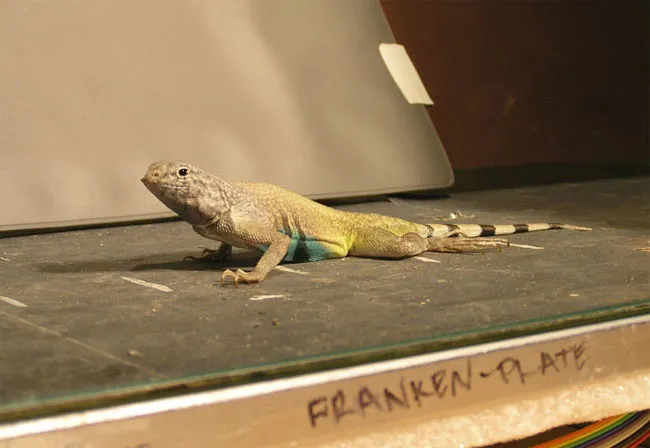
Like humans, some lizards are always on the go, grabbing food en route, while others wait like couch potatoes expecting pizza delivery.
New video research finds the lazy lizards that wait for food to pass by on a seeming silver platter actually have evolved into skilled sprinters, while the constantly active foragers are built for long walks.
Monitor lizards and some skinks are considered wide foragers. They spend 80 percent of their lives on the move, slowly slinking about using their specialized tongues to chemically sniff out prey. The sit-and-wait lizards, well, sit and wait. Then when a meal passes by, the iguana, for instance, lunges like a hungry delivery customer hearing the doorbell, to sprint after the unsuspecting morsel and snatch it up with a tongue flick.
To figure this out, using high-speed video and force measurements, researchers tracked 18 lizard species as they trekked along a racetrack at a range of speeds. The wide foragers used a walking gait, which the scientists say allows them to sniff every little nook in search of food. The "pizza predators" always ran, even when moving at relatively slow speeds.
How to tell the difference? "When you walk, your foot hits the ground and your center of mass sort of goes up in the air and then falls over like an upside-down pendulum," said co-researcher Stephen Reilly, a biologist at Ohio University. When you run, your center of mass first dips down before springing upward as you push off the ground with your leg muscles. Running involves a bouncing movement.
The study, funded by the National Science Foundation and detailed in the April 1 issue of the Journal of Experimental Biology, sheds light on adaptations that have evolved in lizards as they change their food-snagging techniques.
All lizards have the ability to run, particularly to evade predators. And at some time in the past, all lizards were sit-and-wait hunters, the researchers say.
Get the world’s most fascinating discoveries delivered straight to your inbox.
"Lizards are adapted to sit and wait for food," Reilly told LiveScience. "But in places where there isn't a lot of food walking around, like in deserts — that's where a lot of wide foragers are — they have to go look for their food or they're going to die."
- Video: Lizard Race
- Top 10 Amazing Animal Abilities
- Images: Snakes, Frogs and Lizards
Jeanna Bryner is managing editor of Scientific American. Previously she was editor in chief of Live Science and, prior to that, an editor at Scholastic's Science World magazine. Bryner has an English degree from Salisbury University, a master's degree in biogeochemistry and environmental sciences from the University of Maryland and a graduate science journalism degree from New York University. She has worked as a biologist in Florida, where she monitored wetlands and did field surveys for endangered species, including the gorgeous Florida Scrub Jay. She also received an ocean sciences journalism fellowship from the Woods Hole Oceanographic Institution. She is a firm believer that science is for everyone and that just about everything can be viewed through the lens of science.