













Why Deep-Diving Mammals Don't Black Out
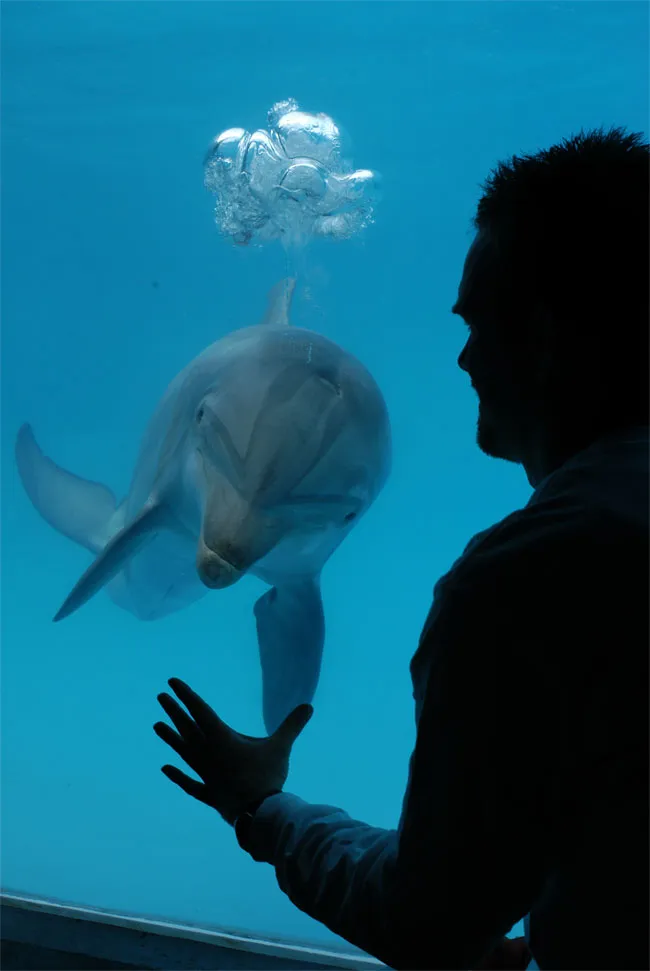
Some seals and dolphins can hold their breath underwater for a cheek-popping hour or more without passing out from lack of oxygen.
Definitely don't try this at home. Humans can't make it more than a few minutes without breathing (at least without some sci-fi device).
The secret to the superhero animal feat is elevated levels of special oxygen-carrying proteins found in their brains, a new study reveals. But the research leaves puzzles.
Scientists have long wondered why marine mammals, such as dolphins, whales , Weddell seals and sea otters, are so tolerant of such low oxygen conditions. The simplest explanation had been that they evolved adaptations to boost oxygen delivery to the brain. But studies have shown that the oxygen levels in their blood vessels plummeted within minutes of dipping beneath the water's surface.
"The kinds of levels we were seeing in arterial blood would have caused us to black out under water," said lead study author Terrie Williams, professor of ecology and evolutionary biology at the University of California, Santa Cruz.
The research will be published in the Dec. 18 issue of the journal Proceedings of the Royal Society B.
Diving secret
Get the world’s most fascinating discoveries delivered straight to your inbox.
Williams and her colleagues focused on two newly discovered proteins called neuroglobin and cytoglobin. They are similar to hemoglobin, an iron-containing molecule that carries oxygen in blood and circulates throughout the body and brain, but neuroglobins and cytoglobins (grouped together as brain globins) reside in brain tissues.
The scientists compared the amounts of hemoglobin and the brain globins in 16 mammal species, including land animals such as a bobcat and a mountain lion, shallow swimmers such as the bottlenose dolphin and California sea lion, and deep divers such as the pilot whale and Risso's dolphin.
The results were not clear-cut.
On average, the brains of marine mammals had more hemoglobin and brain globins than those of land animals, suggesting it's these proteins that keep the divers alive and alert during deep dives. The shallow-swimming and highly active dolphins, sea lions and sea otters had higher amounts of the brain globins than did the deep-diving whales. Williams suggests that the agile swimmers need to shuttle oxygen quickly to the brain and so they rely on the brain globins rather than the hemoglobin. The more hemoglobin in the blood, the more viscous the blood becomes, making transport to the brain slower.
And then there was the bobcat. Unlike the dog-related species, including foxes and coyotes, bobcat tissues showed high amounts of the brain globins. "Maybe it's not just breath-holding that stimulates these globins, but high levels of activity, such as sprinting," Williams said.
Human aging
The finding could shed light on strokes and aging in humans. For instance, boosting globin production in humans could potentially lessen brain damage due to disease and aging.
"If you're a wild animal you don't get the option of having a stroke. If you have a stroke, you're dead," Williams told LiveScience. "[The diving mammals] might be the group to look toward, because evolution and selective pressures would push them toward better protection."
Bowhead whales live 200-plus years, more than double the typical human lifetime. Williams asks, "What if you could do something that would keep your brain active for twice as long?"
Jeanna Bryner is managing editor of Scientific American. Previously she was editor in chief of Live Science and, prior to that, an editor at Scholastic's Science World magazine. Bryner has an English degree from Salisbury University, a master's degree in biogeochemistry and environmental sciences from the University of Maryland and a graduate science journalism degree from New York University. She has worked as a biologist in Florida, where she monitored wetlands and did field surveys for endangered species, including the gorgeous Florida Scrub Jay. She also received an ocean sciences journalism fellowship from the Woods Hole Oceanographic Institution. She is a firm believer that science is for everyone and that just about everything can be viewed through the lens of science.