
 Live Science Plus


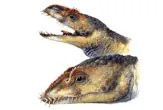
Scientists have identified a new species of ancient aquatic reptile that swam the seas when dinosaurs still ruled the Earth.
Dubbed Umoonasaurus, the creature lived in waters off the coast of what is now Australia 115 million years ago, when the continent was located much closer to Antarctica than it is now.
Plesiosaurs were large marine reptiles that had stocky, barrel-shaped bodies, short tails and paddle-like limbs. Some had long, slender necks, while others had short, squat ones.

What made Umoonasaurus stand out from other plesiosaurs were a series of high, thin crests on its head and numerous fused vertebrae at the end of its tail that might have supported a small tail fin [Illustration].
The new species will be detailed in an upcoming issue of Biology Letters, a journal of the Royal Society in England.
'Killer whales of the Jurassic'
Umoonasaurus belonged to a group of top aquatic predators known as rhomaleosaurids.
Get the world’s most fascinating discoveries delivered straight to your inbox.
"They were the killer whale equivalent of the Jurassic," said study leader Benjamin Kear of the University of Adelaide and the South Australian Museum.
Unlike other rhomaleosaurids, however, which generally had large heads, squat necks and were relatively large, Umoonasaurus grew to only about 8 feet and had a small skull perched atop a slender, stalk-like neck.
Umoonasaurus outlasted many plesiosaur species and was among of the last of its kind. It lived during the twilight of the dinosaurs' reign, before the planet experienced one of the most famous, though not the worst, known mass extinctions.
Fossils of Umoonasaurus have been found in Australian opal mines for years, ever since the late 1960s, but it was only last year with fresh analyses that the creature was recognized as being a unique species. Now, finally, a scientific paper on the discovery will be published.
A cool reptile
Although far from frigid today, for much of its geologic history, Australia was a southern polar continent. It's only been in the past 50 million years or so that Australia drifted north. During the Cretaceous period when Umoonasaurus lived, the continent was located at about 70 degrees south latitude.
"This is equivalent to the middle of the southern Antarctic Ocean today," Kear told LiveScience.
Its ability to survive in cold waters makes Umoonasaurus one of only a handful of plesiosaur species known to live in high latitudes. Presumably, the sea creature had developed a way to cope with the low water temperatures.
Kear and his team speculate that the beasts might have been warm-blooded like mammals and able to regulate their core body temperatures, or that they might have taken part in seasonal migrations like modern whales.
Related Stories
- How the Real 'Loch Ness Monster' Swam
- Rumor or Reality: The Creatures of Cryptozoology
- Ancient Swimming Reptiles Uncovered
Explore Dinosaurs
- Gallery: Dinosaur Fossils
- Dinosaurs that Learned to Fly
- Scientists Debate Dinosaur Demise
- The Biggest Carnivore: Dinosaur History Rewritten
- How Dinosaurs Might Have Walked
- A Brief History of Dinosaurs
- All About Dinosaurs
Pangea
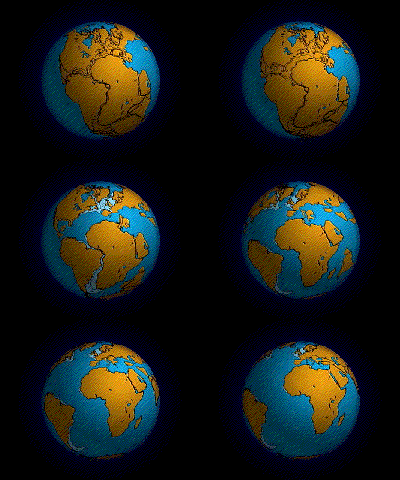
The supercontinent Pangea began to break up about 225-200 million years ago. This animation shows how it unfolded.
SOURCE: USGS