















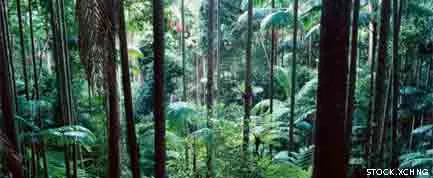
Plants and animals living in warm, tropical climates evolve faster than those living in more temperate zones, a new study suggests.
The finding, detailed in the May 2 issue of the journal for the Proceedings of the National Academy of Sciences, could help explain why rainforests have such rich biodiversity compared to other parts of the planet.
A census of all the plants and animals around the world would reveal that species richness is uneven: it is highest in the tropics, the regions of Earth near the equator, and lower the closer one goes toward the planet's poles.
What's going on
To investigate the reasons for this trend, Shane Wright of the University of Auckland, New Zealand, and colleagues looked at the rate of molecular evolution for 45 tropical plants and compared it to that of related species living at more temperate latitudes.
The researchers examined the rate at which DNA bases in the plants' genetic code are substituted. Like characters in a four-letter alphabet, bases are DNA molecules arranged to spell out instructions for building proteins. If one of the letters—A, T, G or C—become substituted with another, the instructions can change and a dysfunctional or entirely new and useful protein can be produced.
The researchers found that tropical plants had more than twice the rate of base substitution compared to their temperate cousins.
Get the world’s most fascinating discoveries delivered straight to your inbox.
How it works
The finding supports a theory put forth by biologist Klaus Rohde in 1992 that climate can have a powerful effect on how fast organisms evolve and branch off into new species. Scientists think it works like this:
Warmer temperatures speed up metabolism by allowing chemical reactions to occur at a faster rate, but this increased efficiency comes at a price: it produces higher quantities of charged atoms or molecules called "free radicals," which can damage biological molecules like proteins and so-called "nucleic acids" such as DNA. Higher metabolism also speeds up DNA replication, which is just another chemical reaction, and this can increase the number of copying mistakes that can occur.
Together, damage to DNA by free radicals and replication mistakes could result in mutations that, over time and through natural selection pressures, can form new species.
- First Flowers Triggered Boom in Ant Diversity
- SPECIAL REPORT: Evolution & Intelligent Design
- Biodiversity Declining at 'Unprecedented Rate'
- How Evolution Works