













How Hummingbirds Hover

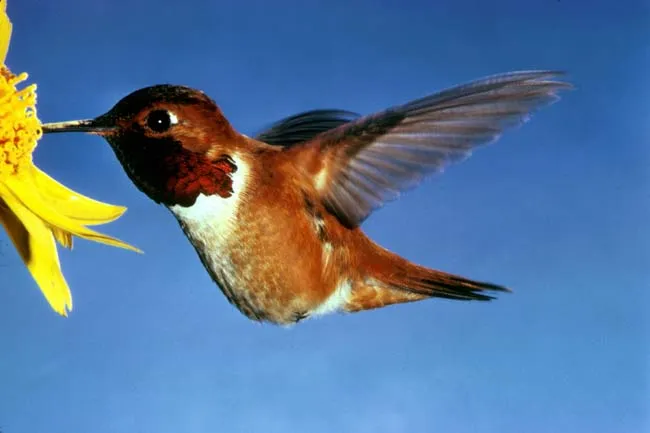
As it hovers in front of a flower or feeder, a hummingbird gets lift not only from the down stroke of its wings but also the up stroke. This is similar to the lift generated by insect wings, but new research shows that hummers are not simply bugs with feathers.
The prolonged hovering ability of hummingbirds had previously been attributed to an insect-like flapping – despite the fact that birds have an entirely separate wing structure. Insect wings are stiff but flexible membranes, whereas bird wings are bony appendages with light feathers.
A group of researchers have studied the airflow around a rufous hummingbird and found that 75 percent of the bird's weight is supported by the down stroke, while the other 25 percent is lifted by the up stroke.
In comparison, most nectar-feeding insects get equal (50-50) support from the up and down motion of their wings. Other birds rely entirely (100 percent) on the down stroke.
"We were surprised to find that the up stroke in the hovering hummingbird was much less active than the down stroke," said Bret Tobalske from the University of Portland. "This finding provides new insight into evolutionary trends that led to sustained hovering in birds."
The implications are that hovering birds made the best of feather and bone by employing unique flexes, twists and arches that insect wings would be incapable of performing.
"Although hummingbirds do not exhibit the elegant aerodynamic symmetry of insects, natural selection rewards 'good enough' as richly as it does our aesthetic ideals," write the authors in an article for the June 23 issue of Nature.
Get the world’s most fascinating discoveries delivered straight to your inbox.
To capture the swirling vortexes around wings beating as much as 100 times per second, Tobalske and his collaborators used digital particle imaging velocimetry (DPIV), in which tiny droplets of olive oil are sprayed throughout a wind tunnel with a hummingbird feeder.
While a bird hovers in front of the feeder, a laser illuminates the oil droplets for recording by a high-speed camera. The images show just how much lifting force the birds generate with each flap of the wing.
Seeing how Igor Sikorsky – the man credited with building the first successful helicopter – was likely inspired by hummingbirds, these new findings on hovering aerodynamics may influence future flying vehicles, like miniature and full-sized ornithopters.
Related Stories
