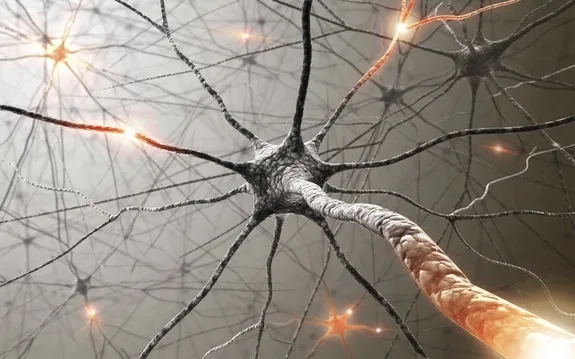
Like people calling upon trusted neighbors after a house fire, brain cells damaged by stroke may put out distress signals. This elicits nearby cells to send supplies to help the damaged neurons recover.
Previous research has revealed that neurons can expel damaged mitochondria, the important cellular organelles that provide energy to the cell. Now, scientists in the United States and China have found that other cells in the brain, called astrocytes, which surround neurons, see this action as a distress signal. These cells then donate some of their own mitochondria, pushing the organelles out of their own membranes, into the space amongst cells, where the damaged neurons can retrieve the cellular equipment.
"The hope is that if we can rigorously understand this mechanism, we may eventually find ways of amplifying this process to protect [the human] brain and help stroke patients recover," said Eng Lo, a professor of neurology and radiology at Harvard Medical School in Massachusetts and senior author on a paper describing the discovery today (July 27) in the journal Nature. [10 Things You Didn't Know About the Brain]
Latest Videos From
The process of removing worn-out parts — "taking out the trash," in essence — is crucial for cell health. Scientists had long thought that cells dismantled their damaged organelles only internally, within their own cell boundaries, through a process called autophagy. In this process, various cellular components surround the damaged organelles and break them down for reuse or disposal.
However, in 2014, scientists at John Hopkins University in Baltimore discovered that the cells of the eye's retina can "contract out" this dirty work, excreting old or damaged mitochondria in their entirety and leaving nearby astrocytes to dismantle and dispose of the organelles. Additionally, scientists only recently learned that cells can exchange whole, working organelles. In 2012, scientists at Columbia University in New York discovered that healthy lung cells can secrete functional mitochondria for damaged cells to use, but the how they did this was a mystery.
The latest work by Lo's group bridges these two recent discoveries by revealing a pathway in which damaged cells can signal healthy cells via the white flag of mitochondria-dumping. These researchers created a stroke-like scenario in mice by cutting off the blood flow that nourishes the neurons, resulting in a mix of cell damage and cell death in the animals' brains. Many of the damaged neurons began to shed their mitochondria, and the astrocytes responded promptly with replacements, the researchers found.
"The damaged-but-not-yet-dead neurons [appear to] release 'help-me' signals that induce astrocytes to 'donate' mitochondria and help with neuronal recovery," Lo told Live Science.
He emphasized that the study provides only a proof of concept of this healing mechanism in a laboratory animal. "Whether they are clinically relevant in actual human stroke patients is unknown," Lo said.
The research team noted that much more research is needed in order to understand the signaling between neurons and astrocytes, a process called "neuro-glial cross talk" that scientists are only beginning to tap into. Glial cells, which include astrocytes, surround and support neurons in various ways.
The research team includes scientists at Capital Medical University in Beijing, along with first author Kazuhide Hayakawa, Lo's colleague at Massachusetts General Hospital and Harvard Medical School.
Follow Christopher Wanjek @wanjek for daily tweets on health and science with a humorous edge. Wanjek is the author of "Food at Work" and "Bad Medicine." His column, Bad Medicine, appears regularly on Live Science.