













Female Sculptures Guard Mysterious Tomb in Greece
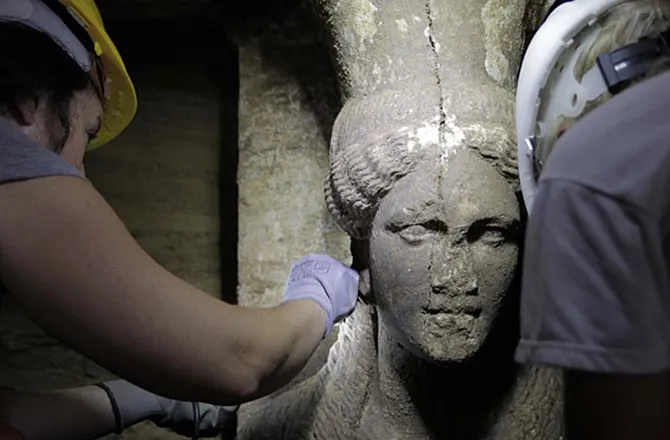
Greek archaeologists made another amazing find Saturday as they unearthed two finely sculpted Caryatids -- female sculptures -- inside a mysterious tomb from the time of Alexander the Great, in Amphipolis, about 65 miles from Thessaloniki.
Carved from marble with traces of blue and red paint, the Caryatids were found when a team of archaeologists led by Katerina Peristeri removed sandy soil in front of a sealing wall.
Photos: Female Sculptures Revealed in Greek Tomb
The sculptures stood between two marble pillars supporting a beam. Wearing a sleeved tunic and earrings, they feature long, thick hair covering their shoulders. While the face of one Caryatid survives almost intact, the other is missing.
“The right arm of the western Caryatid and the left arm of the eastern one are both outstretched, as if to symbolically prevent anyone attempting to enter the grave,” the Culture Ministry said in a statement.
Earlier the team discovered two headless, wingless sphinxes guarding the tomb’s entrance.
“The presence of a second sealing wall with Caryatids supports the idea this is an outstanding monument of particular importance,” the Ministry statement said.
Get the world’s most fascinating discoveries delivered straight to your inbox.
Mosaics Revealed at Alexander the Great-Era Tomb
Pieces of the sculptures, such as parts of hand palm and finger fragments, were recovered from the soil.
Also, a perfectly preserved rectangular marble block, measuring 14 feet long and 3 feet wide, was unearthed at the bottom of the vault.
On the underside of the large block, the archaeologists found blue, red and yellow painted decoration, representing panels with rosettes in the center.
Other rosettes were found earlier, embossed on a marble beam.
PHOTOS: Greek Tomb Shows Signs of Looting
According to Andrew Chugg, author of “The Quest for the Tomb of Alexander the Great,” the rosettes at Amphipolis strongly resemble those decorating the edge bands of the gold coffin from the tomb of Philip II, Alexander the Great’s father.
“It’s looking as though a rosette is a badge of the occupant,” Chugg told Discovery News.
At the moment, Chugg considers Olympia, Alexander’s mother, as the person most likely buried in the magnificent tomb.
“The Caryatids are a truly spectacular find. The fact that we now have a second pair of sculpted female guardians is of course boosting the case for this being the tomb of an important queen,” Chugg said.
He noted the sphinxes guarding the tomb entrance were a symbol of Macedonian queens from the late fourth century B.C.
Toxic Wine Might Have Killed Alexander the Great
“Sphinxes are not particularly common in high status Macedonian tombs of this era, but, significantly, sphinxes were prominent parts of the decoration of two thrones found in the late 4th century BC tombs of two Macedonian queens in the royal cemetery at Aegae, modern Vergina,” Chugg wrote in the Greek Reporter.
One of the thrones decorated with sphinxes was attributed to Eurydice I, Alexander the Great’s grandmother.
Historical records point to two Macedonian queens who died at Amphipolis in the last quarter of the fourth century B.C.: Olympias and Roxane, Alexander’s wife.
“Olympias is looking like a very strong candidate now with Roxane in second place and a combination of the two is not unlikely,” Chugg concluded.
Originally published on Discovery News.