













Bears Use Wildlife Crossings to Find New Mates

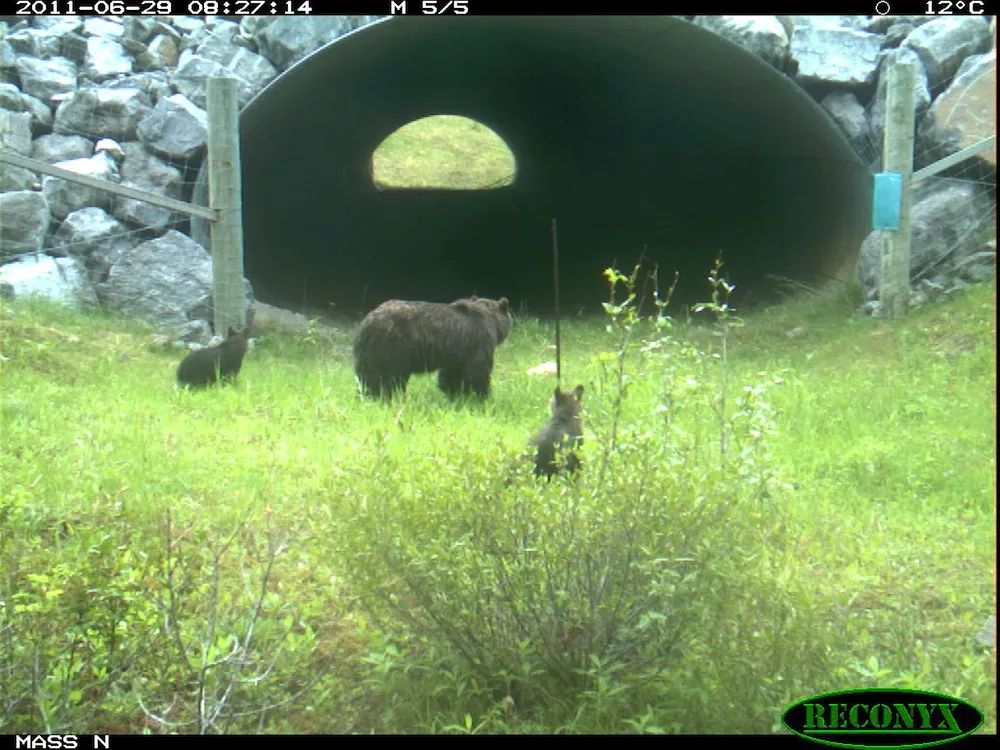
As more and more roads cut across the territories of wild animals, wildlife crossings are being built to bridge these barriers. But there has been little evidence that animals actually use the crossings.
Now, a team of researchers at Montana State University has compared the genetics of grizzly bears and black bears at road crossings in the Canadian Rockies, finding the bears do indeed move across the Trans-Canada Highway, and breed with mates on the other side.
The study provides the first proof that wildlife crossings maintain genetic diversity, the researchers say. [Photos of Grizzlies & Black Bears Crossing the Highway and Bear-Crossing Video]
"Roads connect human populations, but fragment wildlife populations," wrote the authors of the study, detailed today (Feb. 18) in the journal Proceedings of the Royal Society B.
Busy roads can lead to deaths or deter animals trying to cross the pathways. This prevents gene flow — the transfer of genes from one population to another — reducing genetic diversity and making it harder for the animals to adapt to a changing environment.
The effects will only worsen with climate change, the researchers added.
Wildlife biologist Michael Sawaya of Montana State University and his colleagues conducted a three-year study of grizzly (Ursus arctos) and black bears (Ursus americanus) at Banff National Park, Canada, to test how effectively wildlife crossing structures actually bridged bear populations.
Get the world’s most fascinating discoveries delivered straight to your inbox.
The researchers set up barbed-wire hair traps on highway underpasses and overpasses, and sequenced the DNA from fur left behind by passing bears. The scientists compared genetic data from the wildlife crossings with data from bear populations in surrounding areas.
Results showed a genetic discontinuity — a division between two distinct populations — at the Trans-Canada Highway for grizzly bears, but not for black bears. Genetic tests revealed that 47 percent of black bears and 27 percent of grizzly bears that used the crossings (including males and females) bred successfully.
The findings are good news for bears and other animals whose territories are increasingly divided by highways. "It is clear that male and female individuals using crossing structures are successfully migrating, breeding and moving genes across the roadway," the researchers wrote.
The team noted that grizzlies have used crossings at a growing rate between 1996 and 2008, probably in part because bear cubs learned the behavior from their mothers.
The study also found that male bears that used the crossings most often had the highest reproductive success of males that crossed, suggesting crossings increased the number of opportunities for the bears to mate, though the researchers say more studies are needed.
Follow Tanya Lewis on Twitter and Google+. Follow us @livescience, Facebook & Google+. Original article on Live Science.
