













Gun-Toting Robots May Fight Alongside Soldiers in Future Battles

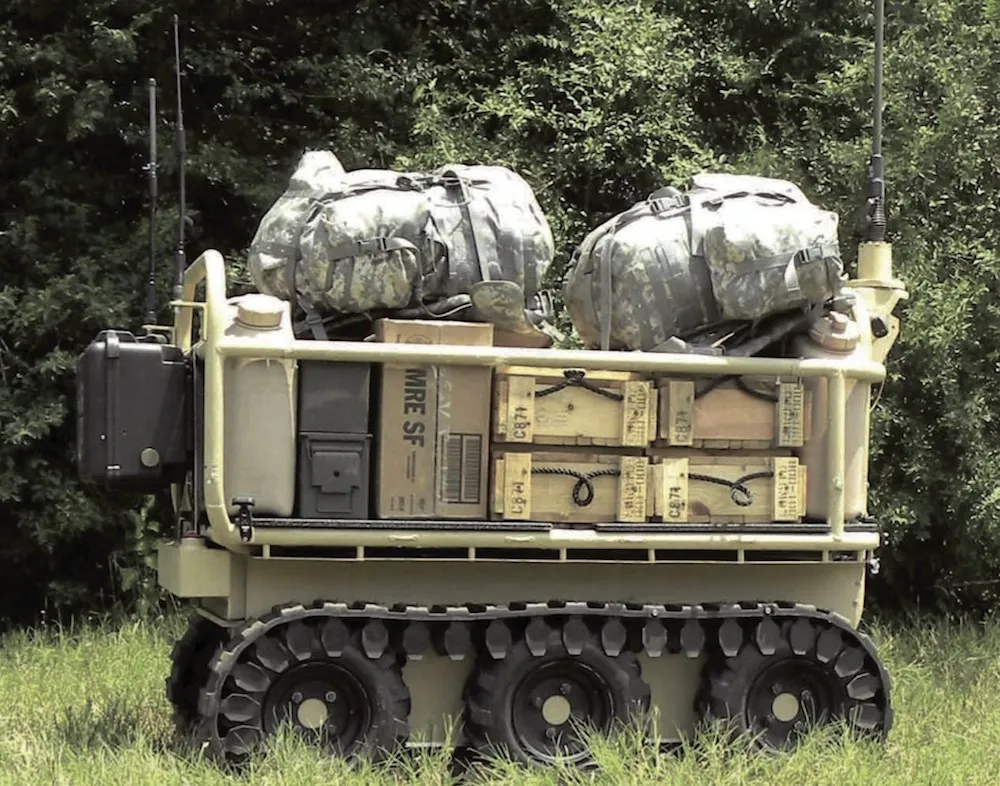
American soldiers may soon be joined on the battlefield by machine gun-toting robots on wheels, according to U.S. Army officials.
Earlier this month, military leaders attended a technology demonstration at Fort Benning, Ga., where robotics companies exhibited their most advanced weaponized creations, reported ComputerWorld.com. The display was designed to show the potential ways robots could support troops in combat.
Army leaders watched a human controller command a wheeled robot, positioned more than 490 feet (150 meters) away, open fire with an M240 machine gun. The robot, which also uses thermal-imaging technology to spot concealed enemies, could protect soldiers from potentially dangerous assaults.
Humanoid robots fighting alongside troops on the battlefield may be some time off, the current wheel-bound creations already show strong promise, according to the Army. [Humanoid Robots to Flying Cars: 10 Coolest DARPA Projects]
"We were hoping to see how they remotely control lethal weapons," Lt. Col. Willie Smith, chief of unmanned ground vehicles at Fort Benning, told ComputerWorld of the technology demonstration. "We were pleased with what we saw here. The technology is getting to be where it needs to be. It's a start."
While gun-toting robots are not yet officially used by the military in combat, the U.S. Army and the U.S. Marines have experimented with prototype machines.
Smith said he is unsure how soon armed robots may join the Army's ranks, but he hopes the military will begin introducing these types of robots into battlefield settings within five years. "They're not just tools, but members of the squad. That's the goal," Smith told ComputerWorld.
Get the world’s most fascinating discoveries delivered straight to your inbox.
Northrop Grumman, iRobot Corp, HDT Robotics and QinetiQ were among the commercial companies demonstrating their hardware for the military, reported ComputerWorld. The robots can be equipped with a variety of weapons, and are capable of performing a range of tasks.
Northrop Grumman's robot, the Carry-all Mechanized Equipment Landrover or CaMEL, uses a telescope and thermal-imaging technology to identify enemies up to 2 miles (3.5 kilometers) away. The robot can operate for more than 20 hours on 3.5 gallons of fuel, according to Northrop Grumman. The CaMEL is also capable of wielding a number of lethal weapons, including a grenade launcher, an automatic weapon and anti-tank missiles.
The robots, which can be operated through satellite communications, ensure that human soldiers can remain safely out of harms way, in some cases hundreds of miles away from the battlefield.
Executives from the robotics companies say the robots can be air-dropped into a war zone from a helicopter or plane, or may rove alongside the troops on patrol, reported ComputerWorld.
Still, don't expect these mechanized warriors to take over completely for human soldiers. At least not yet, said Tollie Strode Jr., a senior project officer with the Maneuver Battle Lab at Fort Benning.
"The robot may acquire an enemy target, but it will still always ask a human for permission to fire," Strode told ComputerWorld. "I think the ability for a robot to acquire and assess a target and ID it as a threat and fire is probably five or 10 years out. However, even if that capability exists … we'll have a human in the process of deciding what to do."
Follow Denise Chow on Twitter @denisechow. Follow LiveScience @livescience, Facebook & Google+. Original article on LiveScience.

Denise Chow was the assistant managing editor at Live Science before moving to NBC News as a science reporter, where she focuses on general science and climate change. Before joining the Live Science team in 2013, she spent two years as a staff writer for Space.com, writing about rocket launches and covering NASA's final three space shuttle missions. A Canadian transplant, Denise has a bachelor's degree from the University of Toronto, and a master's degree in journalism from New York University.