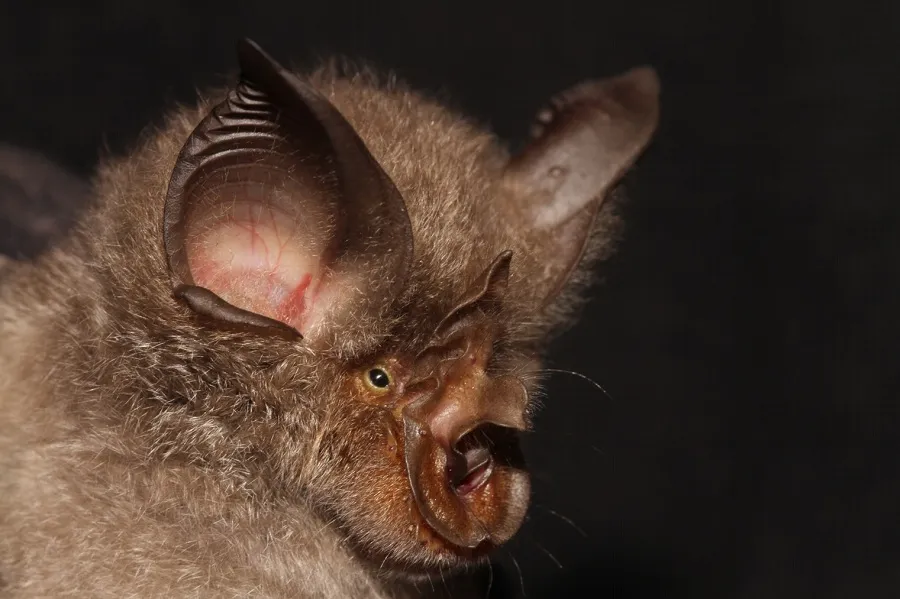
Researchers have identified four new species of horseshoe bats with large, strangely shaped noses in eastern Africa.
Scientists had thought all four belonged to a single species, Hildebrandt's horseshoe bat (Rhinolophus hildebrandtii), first described in 1878. But reports of different echolocation frequencies recorded among the bats suggested there might be rifts in the species. (Sonar calls are often used to identify different types of bats.)
Researchers led by Peter J. Taylor, of South Africa's University of Venda, found R.hildebrandtii indeed included four cryptic species with subtle differences in their sonar calls, skull shape and DNA. Cryptic species often cannot be distinguished by their physical features, putting the burden on genetics research to identify new creatures.
The horseshoe bat family is characterized by their intricately shaped flaps dubbed "noseleaves" around their nostrils. While most bats emit sonar from their mouths, these bats send out their echolocation signals from their noses. Previous research showed that grooves created by the horseshoe bats' noseleaves help focus their sonar calls.
The newly identified species include Cohen's horseshoe bat (Rhinolophus cohenae), found in South Africa's Mpumalanga Province; the Mount Mabu horseshoe bat (Rhinolophus mabuensis), of the mountainous region of northern Mozambique; Smithers' horseshoe bat (Rhinolophus smithersi), found across savanna woodlands of the Limpopo and Zambezi valleys; and the Mozambican horseshoe bat (Rhinolophus mossambicus), which likely lives across the savanna region of Zimbabwe and Mozambique, the researchers said.
The new bats were described Wednesday (Sept. 12) in the journal PLoS ONE.
Megan has been writing for Live Science and Space.com since 2012. Her interests range from archaeology to space exploration, and she has a bachelor's degree in English and art history from New York University. Megan spent two years as a reporter on the national desk at NewsCore. She has watched dinosaur auctions, witnessed rocket launches, licked ancient pottery sherds in Cyprus and flown in zero gravity. Follow her on Twitter and Google+.