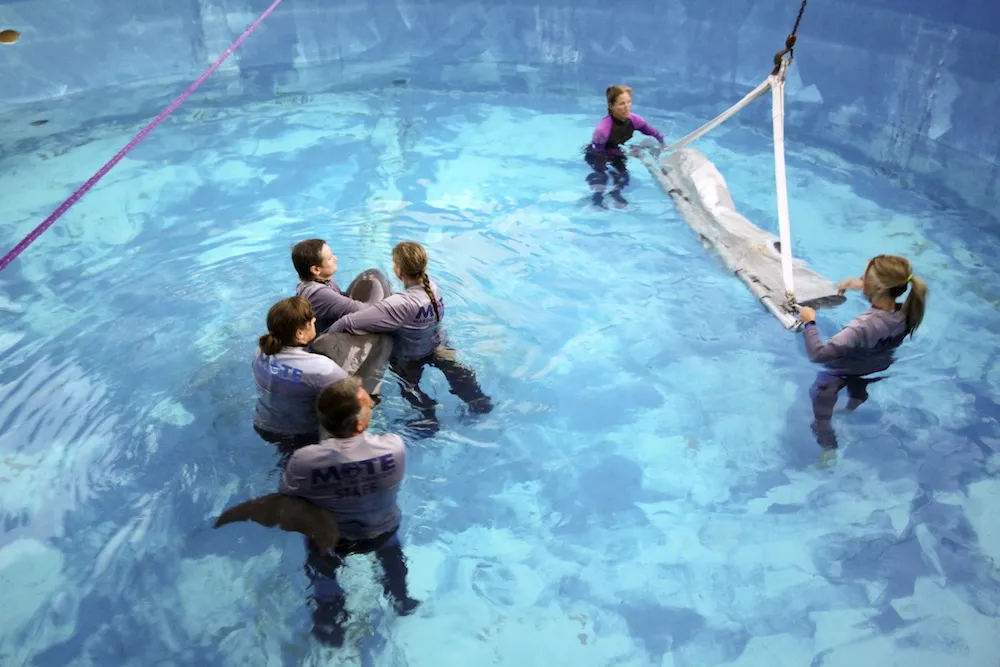
Rescued Dolphin 'Edna' Released into Wild
Get the world’s most fascinating discoveries delivered straight to your inbox.
You are now subscribed
Your newsletter sign-up was successful
Want to add more newsletters?
Delivered Daily
Daily Newsletter
Sign up for the latest discoveries, groundbreaking research and fascinating breakthroughs that impact you and the wider world direct to your inbox.
Once a week
Life's Little Mysteries
Feed your curiosity with an exclusive mystery every week, solved with science and delivered direct to your inbox before it's seen anywhere else.
Once a week
How It Works
Sign up to our free science & technology newsletter for your weekly fix of fascinating articles, quick quizzes, amazing images, and more
Delivered daily
Space.com Newsletter
Breaking space news, the latest updates on rocket launches, skywatching events and more!
Once a month
Watch This Space
Sign up to our monthly entertainment newsletter to keep up with all our coverage of the latest sci-fi and space movies, tv shows, games and books.
Once a week
Night Sky This Week
Discover this week's must-see night sky events, moon phases, and stunning astrophotos. Sign up for our skywatching newsletter and explore the universe with us!
Join the club
Get full access to premium articles, exclusive features and a growing list of member rewards.
A once-stranded dolphin has been successfully rehabilitated and released into the wild after two months of care.
Edna, a bottlenose dolphin, became stranded on Longboat Key in Sarasota, Fla., on June 6. Volunteers from the Mote Marine Laboratory Sea Turtle Patrol found the distressed dolphin and called in the Sarasota Dolphin Research Program to save her.
Edna is likely between 2 and 6 years old and weighed only 165 pounds (75 kilograms) when she arrived at Mote's Dolphin and Whale hospital for rehab — severely underweight for a bottlenose. She was suffering from pneumonia, gastritis and other health problems.
Wildlife rehabbers cared for Edna around the clock, treating her ailments and bringing her weight up to a healthy 240 pounds (109 kg). By early August, the dolphin was swimming and feeding on her own.
On Tuesday (Aug. 14) morning, Mote staff returned Edna to the sea about 2 miles (3.2 kilometers) offshore, where the dolphin spent a few moments readjusting. [Gallery: Releasing Edna the Dolphin]
"It was excellent to see her return home," Lynne Byrd, a medical care and rehabilitation coordinator at Mote, said in a statement. "We watched her get her bearings and then she seemed to be showing some fishing behaviors — that's a good sign."
The scientists fitted Edna with a satellite tag on her fin that will record her dives and other movements, adding to their knowledge of wild dolphin behavior.
Get the world’s most fascinating discoveries delivered straight to your inbox.
"This satellite tagging technology really enables us to determine the success of our rehabilitation and release," said Dr. Randy Wells, director of the Sarasota Dolphin Research Program. "And it will also allow us the opportunity to learn more about the behavior of a dolphin that spends most of its time further offshore than our Sarasota Bay dolphins."
Follow LiveScience on Twitter @livescience. We're also on Facebook & Google+.


Stephanie Pappas is a contributing writer for Live Science, covering topics ranging from geoscience to archaeology to the human brain and behavior. She was previously a senior writer for Live Science but is now a freelancer based in Denver, Colorado, and regularly contributes to Scientific American and The Monitor, the monthly magazine of the American Psychological Association. Stephanie received a bachelor's degree in psychology from the University of South Carolina and a graduate certificate in science communication from the University of California, Santa Cruz.