













Hidden Sparkle Revealed in Renaissance Frescoes

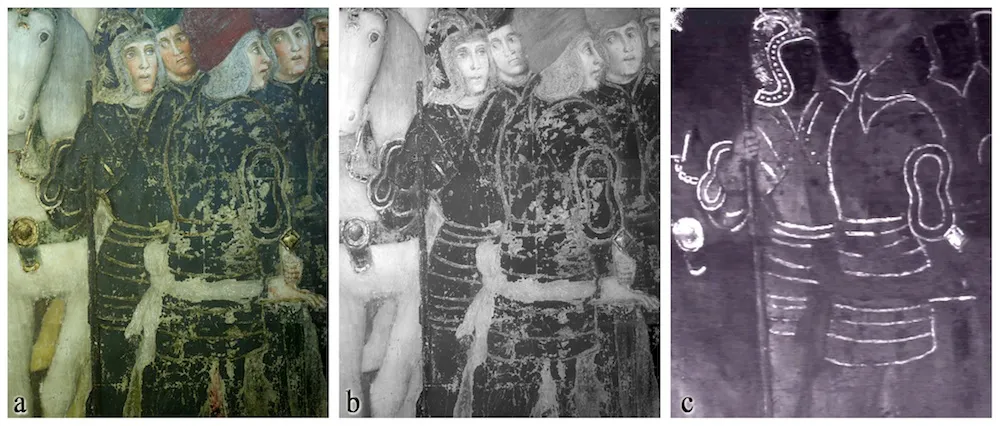
A new look at old paintings reveals never-before-seen details of two Renaissance works of art, including hidden decorations in brilliant silver and gold.
The hidden accents appear on frescoes painted in the Chapel of Theodelinda in the Monza Cathedral in Italy. To the naked eye, they appear dull and are sometimes even painted over. Using a new technique, however, Italian scientists can make the colors pop. These new visualizations could help art historians restore and conserve the paintings.
The technique is called thermal quasi-reflectography, or TQR. It uses reflected light to differentiate between different pigments on a piece of art.
"This is, to the best of our knowledge, the first time that this technique has been applied on artworks," study researcher Dario Ambrosini of the University of L'Aquila in Italy said in a statement. "This novel method represents a powerful yet safe tool for artwork diagnostics." [See Photos of the Renaissance Art]
A new light on old art
Art conservators have long used parts of the light spectrum not visible to the naked eye to bring out tiny details in old paintings. Infrared light, for example, has wavelengths longer than visible light. By taking images of artwork in these long wavelengths, scientists can see places where layers have been painted upon layers, revealing preparatory sketches and changes by the artist.
Other techniques use thermal, or heat, energy to investigate the materials a painting is made of as well as structural flaws. A dot of paint with an air bubble behind it, for example, will emit less heat than spots where the paint is flush because of the insulating properties of air.
Get the world’s most fascinating discoveries delivered straight to your inbox.
Ambrosini and his colleagues turned this last technique on its head. Instead of measuring heat emitted from a painting, the researchers shone a halogen lamp in the mid-infrared spectrum onto the frescoes and measured the amount of light reflected back. A camera capable of capturing mid-wavelength infrared light recorded the image created as the light bounced off the art.
The set-up was simple, but the researchers had to control the environment carefully, ensuring that the lamp did not heat the painting surface and that there were no other sources of heat nearby.
Unseen detail
The researchers tested the TQR technique on two frescoes, or murals created on wet plaster on walls. The first were the 15th-century paintings in the Chapel of Theodelinda, which depict the life of the patron queen of the church. With the TQR system, the scientists were able to make out extra detail on the old frescoes. Suits of armor, dulled and uniform to the naked eye, reveal sharp lines and careful detail under the infrared technique. In one case, the individual fingers of a soldier grasping a staff come out of hiding.
Because silver and gold pigments are highly reflective, they stand out strongly in the new views of the Theodelinda frescoes. Decorations on the soldier's armor appear almost luminous in the new images.
Next, the researchers tried the technique on Piero della Francesca's "The Resurrection," which dates back to the 1460s and depicts the resurrection of Jesus Christ. This painting is held in the Museo Civico of Sansepolcro in Italy.
In this fresco, the new images showed differences in pigments that look nearly identical to the naked eye. They also showed telltale signs of retouching, as well as a segment of a soldier's sword painted with two different fresco techniques. These tiny details can be very important to art historians trying to restore a work to its original condition.
The researchers are now testing the technique on other, non-fresco types of paintings, hoping it can be used to tell what kinds of pigments were used to make the painting.
"Determining the chemical makeup of the pigments is important in determining how best to protect and restore the artwork," Ambrosini said. He and his colleagues reported their work Monday (June 18) in the open-access journal Optics Express.
Follow Stephanie Pappas on Twitter @sipappas or LiveScience @livescience. We're also on Facebook & Google+.

Stephanie Pappas is a contributing writer for Live Science, covering topics ranging from geoscience to archaeology to the human brain and behavior. She was previously a senior writer for Live Science but is now a freelancer based in Denver, Colorado, and regularly contributes to Scientific American and The Monitor, the monthly magazine of the American Psychological Association. Stephanie received a bachelor's degree in psychology from the University of South Carolina and a graduate certificate in science communication from the University of California, Santa Cruz.