













17,000-year-old stripes of red in a Welsh cave are the oldest rock art in the UK, study finds
Over a century after a red-lined cave wall was discovered, scientists have determined that it represents the U.K.'s oldest rock art.

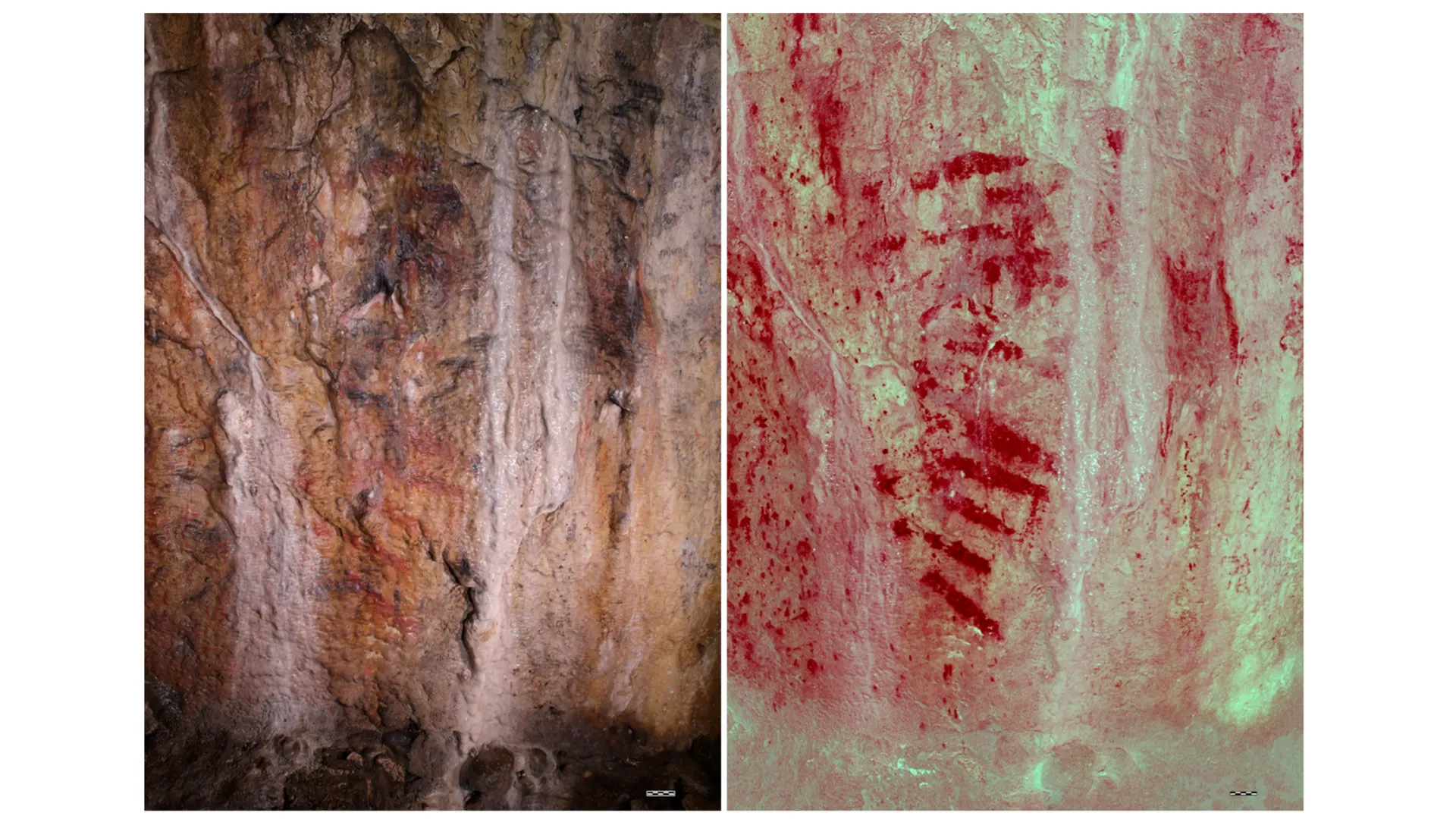
For a century, experts dismissed a series of parallel red lines discovered in a Welsh cave as a phenomenon of nature rather than human-made rock art. But a new study shows the lines are a rare example of Paleolithic art — and at 17,000 years old, they're the earliest example of rock art in the British Isles.
Bacon Hole is a cave in the limestone cliffs of Gower, a peninsula in southwest Wales. In 1912, a team of geologists and archaeologists found a panel deep within the cave covered in a series of 11 horizontal lines.
The discovery made waves on both sides of the Atlantic as the experts claimed the lines were the first known Upper Paleolithic (50,000 to 12,000 years ago) rock art in Britain. But by 1928, skeptics had cast doubt on the explanation of the lines as human-made and suggested they were a natural phenomenon.
The debate died down, in part, because the lined panel's location within the cave was never specified and the knowledge was lost. In 2022, an international team of researchers rediscovered the panel and were able to scientifically analyze the composition of the paint and estimate its year of creation.
In a study published May 26 in the journal Quaternary, the researchers used uranium-thorium dating of the calcite crust overlaying the panel to show that the horizontal lines were created, at a minimum, 18,300 to 15,700 years ago. Uranium-thorium dating can be prone to overestimating the age of rock art because groundwater can leech uranium from calcite, making it appear older than it is. But scientists are working to address this issue, by including other lines of evidence when creating an age estimate.
The team also discovered that the lines were red-hued because of hematite, an iron-oxide compound naturally secreted by rocks in other parts of the cave. The fact that the lines were equidistant from one another suggests they were made by humans in a deliberate and structured pattern, the researchers wrote in the study, as do the patterns of finger dots and splashes of hematite they found elsewhere in the cave.
But the team cautioned in the study that their date is based on a single analysis, and the cave walls require further analysis.
Get the world’s most fascinating discoveries delivered straight to your inbox.
What did the cave and its art mean to prehistoric people?
"It is difficult to determine exactly how Bacon Hole was used during the Upper Palaeolithic, and the evidence suggests it may have served multiple purposes over time," study first author George Nash, an archaeologist at the University of Liverpool in the U.K., told Live Science in an email. "The presence of rock art in the deeper, darker parts of Bacon Hole suggests that at least some areas of the cave may have held symbolic or ritual significance."
But it's challenging to speculate as to what ancient hunter-gatherers may have meant when they inked nearly a dozen red lines on a cave wall thousands of years ago.
One of the archaeologists who originally found the lines, rock art expert Henri Breuil, often interpreted Upper Paleolithic cave art as "sympathetic magic," an anthropological term referring to the idea that art could influence the real world. For instance, if Paleolithic hunters drew a bison on a cave wall, Breuil might assume it was intended to bring about a successful bison hunt.
At Bacon Hole, the red-lined panel is located deep within the cave with an absence of natural light, according to Nash, which may have created a sense of foreboding and mystery.
"The darkness itself may have been an essential part of the ritual experience," Nash said. "Deep cave chambers are acoustically unusual, visually disorienting, and separated from the everyday world. Entering such spaces could have created a sense of transition to a different realm."
RELATED STORIES
- World's oldest known rock art predates modern humans' entrance into Europe — and it was found in an Indonesian cave
- Ancient rock art depicting hunters and geometric shapes discovered in Egypt's Sinai Desert — and it spans a period of 10,000 years
- 5,000-year-old rock art from ancient Egypt depicts 'terrifying' conquest of the Sinai Peninsula
Bacon Hole is also notable for having been visited again and again over the millennia. Archaeologists in the 19th century found pre-Roman potsherds in the cave, as well as a Roman-era bone pin, a seventh-century Irish brooch, Saxon-era beads, and a medieval cooking pot. And in 1894, a local fisherman covered many of the walls of Bacon Hole with modern graffiti.
While the mouth of the cave overlooks a fertile plain and a coastline that were likely full of animal resources, such as wild game and fish, for thousands of years, "practical considerations alone may not explain why people continued to visit the cave across such long periods of time," Nash said.
"Once a place becomes embedded in cultural memory, it can acquire meanings that endure long after its original purpose has been forgotten," he said. "Bacon Hole's prominent location, natural resources, and enduring presence within the landscape likely combined to make it a place repeatedly returned to by successive generations."
Nash, G.H., Collado, H., Gomes, H., Garcês, S., Lattao, V., Rosina, P., Marrocchino, E., Eftekhari, N., Oosterwijk, B., Pike, A.W.G., Hoffmann, D.L., Standish, C.D., Hiemstra, J.F., Shao, Q. (2026). Rediscovered Late Upper Palaeolithic painted imagery at Bacon Hole, Gower Peninsula, South Wales. Quaternary. https://doi.org/10.3390/quat9030043
What do you know about the Paleolithic, Mesolithic and Neolithic eras? Find out with our Stone Age quiz!

Kristina Killgrove is a staff writer at Live Science with a focus on archaeology and paleoanthropology news. Her articles have also appeared in venues such as Forbes, Smithsonian, and Mental Floss. Kristina holds a Ph.D. in biological anthropology and an M.A. in classical archaeology from the University of North Carolina, as well as a B.A. in Latin from the University of Virginia, and she was formerly a university professor and researcher. She has received awards from the Society for American Archaeology and the American Anthropological Association for her science writing.
You must confirm your public display name before commenting
Please logout and then login again, you will then be prompted to enter your display name.