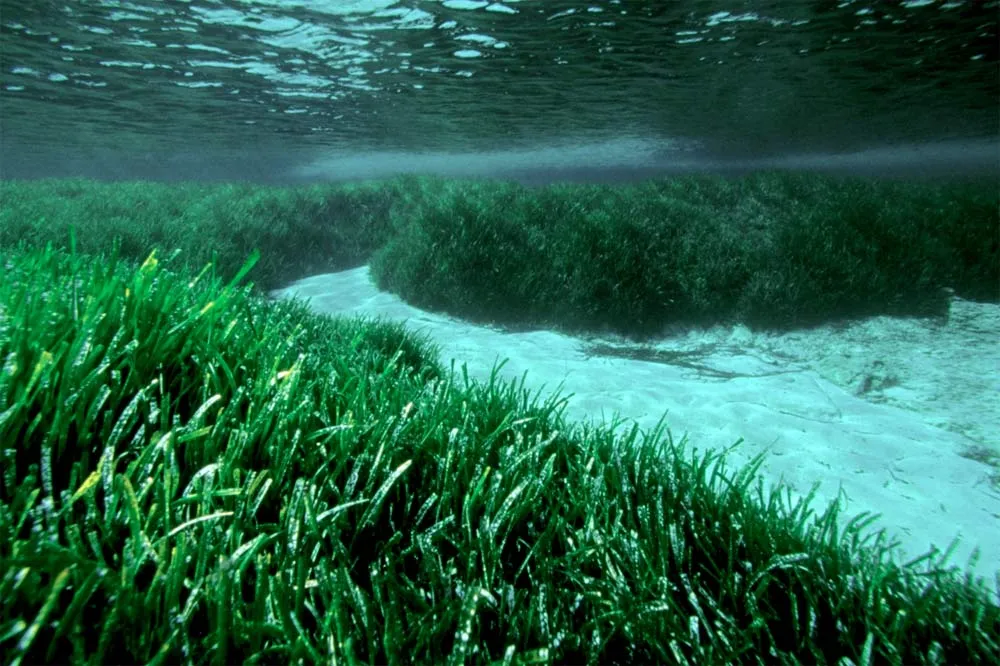
Seagrass meadows can be composed of ancient giant clones, organisms stretching up to nearly 10 miles wide that may be up to tens of thousands of years old, scientists find.
The seagrass in question, Posidonia oceanica, reproduces either sexually through flowering or asexually by generating clones of itself. This can result in single organisms that are very large and very old. Such clonal organisms may be the oldest and largest life forms in the world — for instance, the honey mushroom Armillaria solidipes may span up to 3.4 square miles (8.8 sq kilometers) in area and the quaking aspen (Populus tremuloides) may reach up to 6,000 metric tons in mass.
"Clonal organisms have this extraordinary capacity that when a 'perfect' genome emerges, it can be transmitted through generations without being altered, and has potentially no end," said researcher Sophie Arnaud-Haond, a marine biologist at the French Research Institute for Exploration of the Sea.
Latest Videos From
However, theory predicts the genome of a clone organism will, "through the process of copying, be altered slightly by what are called 'somatic mutations' — copy errors," Arnaud-Haond said. "Accumulate those mutations, most of which are expected to have a negative impact, and over generations, it will degenerate and eventually disappear. The age of clonal organisms should therefore be limited as well." [Extreme Life on Earth: 8 Bizarre Creatures]
To learn more about how long the seagrass P. oceanica can actually live, researchers analyzed 40 meadows of it across 2,175 miles (3,500 km) of the Mediterranean.
Not all of the seagrass the scientists discovered was genetically identical. However, the seagrass clones they did find suggest both extreme size and age. Some reached up to 9.3 miles (15 km) wide and may well be more than 100,000 years old.
"Posidonia oceanica ranks amongst the oldest organisms revealed thus far," Arnaud-Haond told LiveScience.
Computer models helped demonstrate that Posidonia oceanica has a mode of spread common to other seagrasses that allows the plant to avoid the accumulation of deleterious mutations and explains how it escapes the degeneration expected of clonal organisms.
"The understanding of the particularities that rendered those genomes so adaptable to a broad range of environmental conditions may be the focus of extremely interesting research in the future," Arnaud-Haond said.
Seagrasses are the foundation of key coastal ecosystems but have waned globally for the past 20 years, with P. oceanica meadows declining at an estimated rate of about 5 percent annually.
"Posidonia oceanica's clones have been able to survive greatly fluctuating environmental conditions, and meadows we observe nowadays are the outcome of millennia of evolution. On the one hand, this suggests an ability to cope with environmental change that could be a positive clue on their ability to cope with medium- and long-term prospects of global change. On the other hand, changes are occurring nowadays at an unprecedented rate, and the sharp decline of seagrass meadows in general and Posidonia oceanica in particular is raising concerns as to the ability of this slow-growing species and its old, patiently selected clones to face these new and rapidly occurring environmental challenges."
The scientists detailed their findings online in the Feb. 1 issue of the journal PLoS ONE.