
-
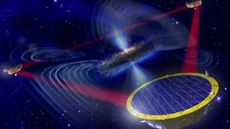 Europe approves LISA, a next-generation space mission that will discover the faintest ripples in space-time
The new LISA gravitational wave detector, which will be launched into orbit in 2035, promises to detect cosmic collisions from the earliest moments after the Big Bang.
space -
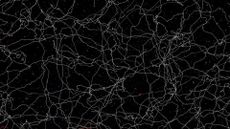 Cosmic strings can break — and when they do, they shake the universe
Many models of the universe predict the existence of countless invisible strings stretching across space. New research finds a way these strings might snap — and how we could feel the fallout.
black-holes -
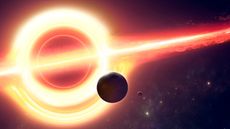 James Webb telescope discovers the oldest, most distant black hole in the universe
The James Webb Space Telescope's discovery of the universe's oldest black holes is giving astronomers some vital clues for how they came to be.
black-holes -
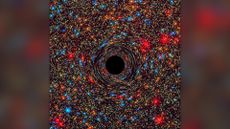 Tiny black holes from the dawn of time may be altering our planet's orbit, new study suggests
A study suggests primordial black holes may make planets and moons near us wobble. If measured experimentally, this will provide the first concrete proof such objects exist.
black-holes -
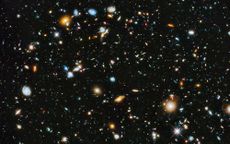 Unexpected cosmic clumping could disprove our best understanding of the universe
The tension, centered around a value for cosmic lumpiness known as S8, could join the Hubble tension in dethroning our best picture of how the universe evolved.
space -
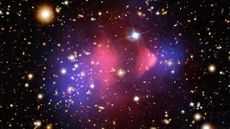 The 1st life in the universe could have formed seconds after the Big Bang
The first life-forms capable of evolution could have appeared just moments after the Big Bang, a physicist explains.
space -
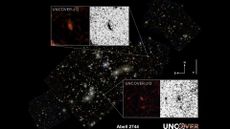 James Webb telescope discovers 2 of the oldest galaxies in the universe
The James Webb Space Telescope has discovered a cosmic 'peanut' and 'fluff ball' that happen to be two of the four oldest galaxies in the known universe.
astronomy -
 Many physicists think we live in a multiverse. But they're getting a simple math rule wrong.
Our universe seems to be perfectly suited for life. But anyone who claims that's evidence of a multiverse is falling prey to a logical fallacy.
physics-mathematics -
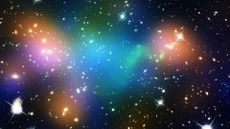 Dark matter may have its own 'invisible' periodic table of elements
Dark matter may come in multiple particles and weights, similar to the ordinary elements on the periodic table, a new theory suggests.
cosmology


