
-
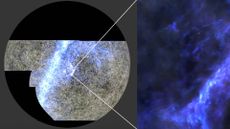 Atacama Telescope reveals earliest-ever 'baby pictures' of the universe: 'We can see right back through cosmic history'
New observations with the Atacama Cosmology Telescope in Chile reveal the earliest-ever "baby pictures" of our universe, showing some of the oldest light we can possibly see.
cosmology -
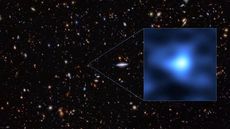 'I was astonished': Ancient galaxy discovered by James Webb telescope contains the oldest oxygen scientists have ever seen
Scientists have made the record-breaking detection of oxygen in an ancient galaxy that existed just 300 million years after the Big Bang. The detection is prompting astronomers to rethink how quickly stars and galaxies formed in the young universe.
2 Commentscosmology -
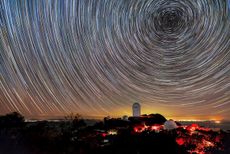 'The universe has thrown us a curveball': Largest-ever map of space reveals we might have gotten dark energy totally wrong
Findings from the Dark Energy Spectroscopic Instrument (DESI) suggest that dark energy could be evolving over time. If they're right, cosmology will need a new model.
21 Commentscosmology -
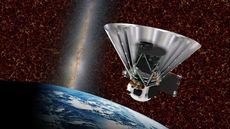 Liftoff! NASA launches SPHEREx telescope — an infrared observatory that will help JWST solve the mysteries of the universe
NASA's newly-launched SPHEREx space telescope will offer a complementary 'panoramic' view to the JWST's high resolution infrared snapshots, enabling astronomers to study some of the universe's biggest mysteries.
space-exploration -
 The universe's water is billions of years older than scientists thought — and may be nearly as old as the Big Bang itself
A new study suggests that water first appeared in the universe just a couple hundred million years after the Big Bang — meaning life could have evolved billions of years earlier than previously thought.
12 Commentscosmology -
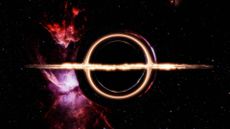 'Einstein's equations need to be refined': Tweaks to general relativity could finally explain what lies at the heart of a black hole
Black hole singularities should not exist, according to theories of quantum mechanics. New tweaks to Einstein's equations of general relativity could finally do away with them, and explain what truly lies at the heart of a black hole.
16 Commentsquantum-physics -
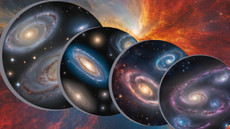 A cosmic 'CT scan' shows the universe is far more complex than expected
"This process is like a cosmic CT scan, where we can look through different slices of cosmic history and track how matter clumped together at different epochs."
cosmology -
 'The Majoron' — a bizarre particle that's its own opposite — could explain the biggest mysteries of the universe, scientists claim
There's a significant imbalance between matter and antimatter in our universe, but a strange particle called "the Majoron" could finally explain it, an audacious new study suggests.
particle-physics -
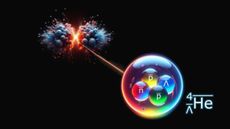 Large Hadron Collider finds 1st evidence of the heaviest antimatter particle yet
Scientists at CERN's ALICE detector are replicating conditions found during the Big Bang, attempting to get to the bottom of how matter came to dominate over antimatter.
particle-physics


