
-
 'Physics itself disappears': How theoretical physicist Thomas Hertog helped Stephen Hawking produce his final, most radical theory of everything
Thomas Hertog tells us how he collaborated with Stephen Hawking on his final theorem — a Darwinian revolution in physics that explains the origin of time.
cosmology -
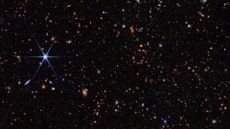 James Webb telescope finds carbon at the dawn of the universe, challenging our understanding of when life could have emerged
The James Webb Space Telescope has found carbon in a galaxy just 350 million years after the Big Bang. That could mean life began much earlier too, a new study argues.
cosmology -
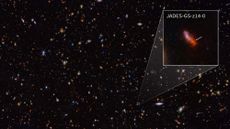 James Webb telescope discovers earliest galaxy in the known universe — and its shockingly big
The James Webb Space Telescope has detected the two earliest, most distant galaxies in the known universe, dating to just 300 million years after the Big Bang. The detection of even earlier galaxies is likely to follow.
cosmology -
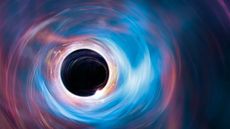 Scientists may have finally solved the problem of the universe’s 'missing' black holes
Primordial black holes are one of the strongest candidates for the universe's missing dark matter. But a new theory suggests that not enough of the miniature black holes formed for this to be the case.
black-holes -
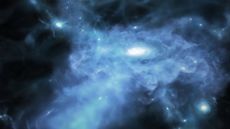 James Webb telescope sees 'birth' of 3 of the universe's earliest galaxies in world-1st observations
The James Webb Space Telescope may have spotted the birth of some of the earliest galaxies in the universe for the first time ever, new research hints.
cosmology -
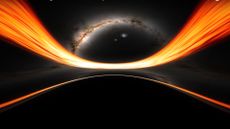 Newfound 'glitch' in Einstein's relativity could rewrite the rules of the universe, study suggests
Einstein's theory of general relativity is our best description of the universe at large scales, but a new observation that reports a "glitch" in gravity around ancient structures could force it to be modified.
physics-mathematics -
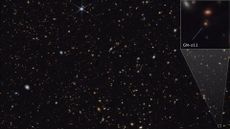 The James Webb telescope may have found some of the very 1st stars in the universe
The James Webb Space Telescope zoomed in on galaxy GN-z11, which existed just 430 million years after the Big Bang, to reveal what may be some of the oldest stars in the universe.
cosmology -
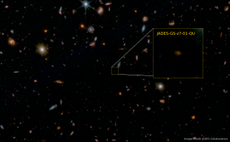 James Webb telescope detects oldest 'dead' galaxy in the known universe — and its death could challenge cosmology
Astronomers using the James Webb Space Telescope have detected the oldest "dead" galaxy ever observed, at just 700 million years after the Big Bang. The stalled-out relic defies explanation by our current knowledge of the early cosmos.
cosmology -
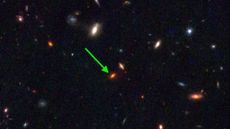 James Webb telescope finds ancient galaxy larger than our Milky Way, and it's threatening to upend cosmology
Astronomers believe the first galaxies formed around giant halos of dark matter. But a newly discovered galaxy dating to roughly 13 billion years ago mysteriously appeared long before that process should have occurred.
cosmology


