













Heaviest antimatter particle ever discovered could hold secrets to our universe's origins
The newly found antiparticle, called antihyperhydrogen-4, could have a potential imbalance with its matter counterpart that may help scientists understand how our universe came to be.

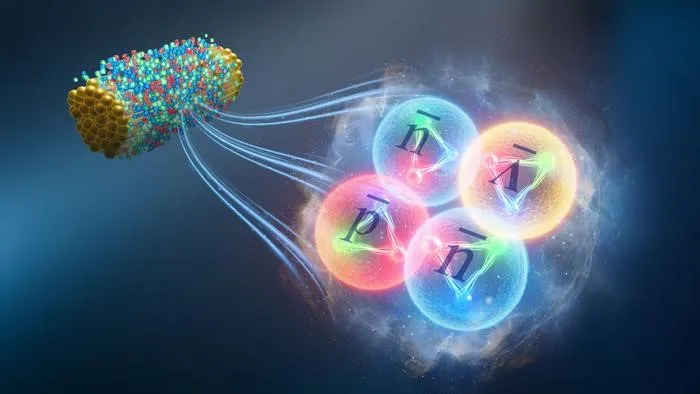
Scientists have spotted the heaviest antimatter nucleus ever detected lurking in a particle accelerator.
The antimatter heavyweight, called antihyperhydrogen-4, is made up of an antiproton, two antineutrons and one antihyperon (a baryon that contains a strange quark). Physicists found traces of this antimatter among particle tracks from 6 billion collisions at the Relativistic Heavy Ion Collider (RHIC) at Brookhaven National Laboratory in New York.
By studying the strange particle, physicists hope to discover some key differences between matter and antimatter, which may help explain why our universe is now filled with matter given that antimatter was created in equal amounts at the beginning of time. The researchers published their findings Aug. 21 in the journal Nature.
"Our physics knowledge about matter and antimatter is that, except for having opposite electric charges, antimatter has the same properties as matter — same mass, same lifetime before decaying, and same interactions," study co-author Junlin Wu, a graduate student at the Joint Department for Nuclear Physics, Lanzhou University and Institute of Modern Physics, China said in a statement. "Why our universe is dominated by matter is still a question, and we don't know the full answer."
According to the standard model of cosmology, after the Big Bang the young cosmos was a roiling plasma broth of matter and antimatter particles that popped into existence and annihilated each other upon contact.
Related: 'Ghostly' neutrinos spotted inside the world's largest particle accelerator for the first time
Theory predicts that the matter and antimatter inside this plasma soup should have annihilated each other entirely. But scientists believe that some unknown imbalance enabled more matter than antimatter to be produced, saving the universe from self-destruction.
Get the world’s most fascinating discoveries delivered straight to your inbox.
To investigate what could have caused this imbalance, the researchers behind the new study produced antimatter particles from a mini-Big Bang simulator. The RHIC collider hurls billions of heavy ions (atomic nuclei stripped of their electrons) at each other, creating a plasma soup from which the primordial elements of our cosmos briefly emerge, combine and then decay.
RELATED STORIES
To fish out new particles from the plasma sea, the physicists searched for the telltale tracks made as the ions decay, or transform into other particles. By retracing the trajectories of these particles from billions of collision events, the researchers found roughly 16 antihyperhydrogen-4 nuclei.
Both hyperhydrogen-4 and its antimatter counterpart antihyperhydrogen-4 seem to wink out of existence very quickly, the researchers found. But the physicists didn't find a significant difference between their lifetimes — indicating that our best models describing the two types of particles are correct.
"If we were to see a violation of [this particular] symmetry, basically we'd have to throw a lot of what we know about physics out the window," study co-author Emilie Duckworth, a doctoral student at Kent State University, said in the statement.
The scientists' next step will be to compare the masses of the antiparticles and their particle opposites, which they hope could reveal some clues as to how our matter-heavy universe came to be.

Ben Turner is a U.K. based writer and editor at Live Science. He covers physics and astronomy, tech and climate change. He graduated from University College London with a degree in particle physics before training as a journalist. When he's not writing, Ben enjoys reading literature, playing the guitar and embarrassing himself with chess.