















The universe had a secret life before the Big Bang, new study hints
The secrets of black holes and dark matter could lie before the Big Bang, a new study of "bouncing" cosmology hints.

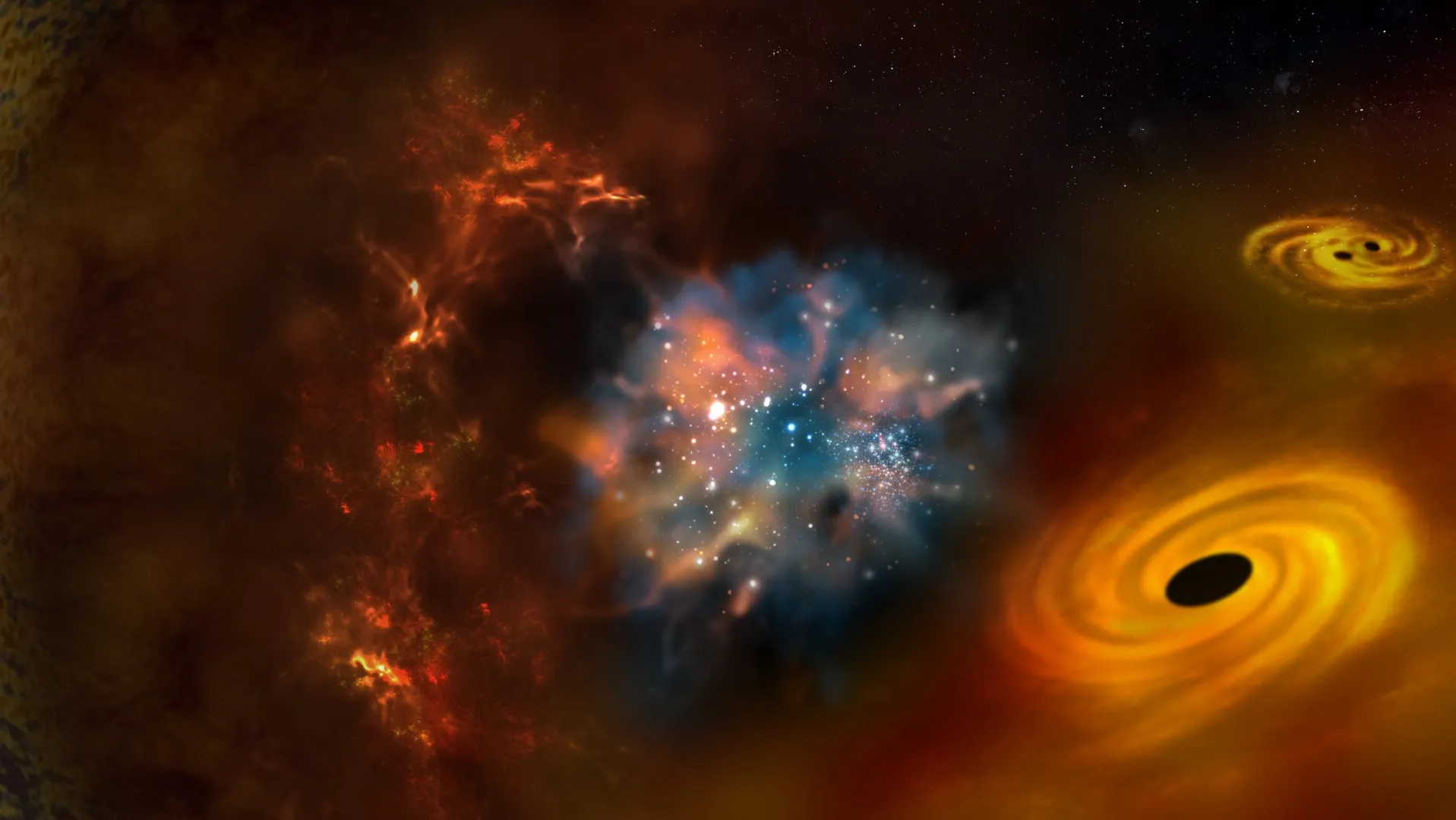
The Big Bang may not have been the beginning of the universe, according to a theory of cosmology that suggests the universe can “bounce” between phases of contraction and expansion. If that theory is true, then it could have profound implications about the nature of the cosmos, including two of its most mysterious components: black holes and dark matter.
With this in mind, a recent study suggests that dark matter could be composed of black holes formed during a transition from the universe's last contraction to the current expansion phase, which occurred before the Big Bang. If this hypothesis holds, the gravitational waves generated during the black hole formation process might be detectable by future gravitational wave observatories, providing a way to confirm this dark matter generation scenario.
Observations of stellar movements in galaxies and the cosmic microwave background — an afterglow of the Big Bang — indicate that about 80% of all matter in the universe is dark matter, a substance that doesn't reflect, absorb or emit light. Despite its abundance, scientists have not yet identified what dark matter is made of.
In the new study, researchers explored a scenario where dark matter consists of primordial black holes formed from density fluctuations that occurred during the universe's last contraction phase, not long before the period of expansion that we observe now. They published their findings in June in the Journal of Cosmology and Astroparticle Physics.
The bouncing cosmos
The traditional cosmological view of the universe suggests that it started from a singularity, followed by a short period of extremely rapid expansion, called inflation. However, the authors behind the new study analyzed a more exotic theory, known as non-singular matter bouncing cosmology, which posits that the universe first underwent a contraction phase. This phase ended with a rebound due to the increasing density of matter, leading to the Big Bang and the accelerated expansion we observe today.
Related: The universe could stop expanding 'remarkably soon', study suggests
In this bouncing cosmology, the universe contracted to a size about 50 orders of magnitude smaller than it is today. After the rebound, photons and other particles were born, marking the Big Bang. Near the rebound, the matter density was so high that small black holes formed from quantum fluctuations in the matter’s density, making them viable candidates for dark matter.
Get the world’s most fascinating discoveries delivered straight to your inbox.
"Small primordial black holes can be produced during the very early stages of the universe, and if they are not too small, their decay due to Hawking radiation [a hypothetical phenomenon of black holes emitting particles due to quantum effects] will not be efficient enough to get rid of them, so they would still be around now," Patrick Peter, director of research at the French National Centre for Scientific Research (CNRS), who was not involved in the study, told Live Science in an email. "Weighing more or less the mass of an asteroid, they could contribute to dark matter, or even solve this issue altogether."
RELATED STORIES
The scientists' calculations show that this universe mode's properties, such as the curvature of space and the microwave background, match current observations, supporting their hypothesis.
To further test their predictions, the researchers hope to make use of next-generation gravitational wave observatories.The scientists calculated the properties of the gravitational waves produced during black hole formation in their model and found that they could be detected by upcoming gravitational observatories like the Laser Interferometer Space Antenna (LISA) and the Einstein Telescope. These detections could confirm whether primordial black holes are indeed dark matter; however, it could take more than a decade before either facility sees first light.
"This work is important in the sense that it provides a natural way of forming small yet still present black holes forming dark matter in a framework which is not the usual one based on inflation," Peter said. "Other works currently investigate the behavior of such tiny black holes around stars, potentially leading to a way of detecting them in the future."

Andrey got his B.Sc. and M.Sc. degrees in elementary particle physics from Novosibirsk State University in Russia, and a Ph.D. in string theory from the Weizmann Institute of Science in Israel. He works as a science writer, specializing in physics, space, and technology. His articles have been published in AdvancedScienceNews, PhysicsWorld, Science, and other outlets.