















Earth's upper atmosphere could hold a missing piece of the universe, new study hints
Mysterious dark matter could slosh over our planet like a wave. If it does, it may produce telltale radio waves in Earth's atmosphere, new theoretical research suggests.

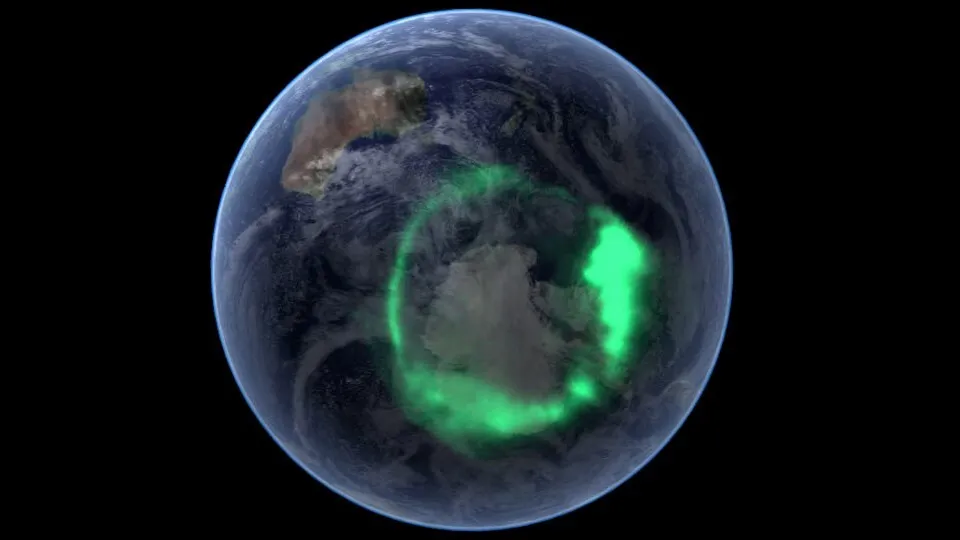
Earth may be swimming through an ocean of dark matter — and waves in that invisible ocean lapping against our planet's upper atmosphere may generate detectable radio waves that allow us to finally find this elusive component of the universe, according to new theoretical research.
A wealth of astrophysical and cosmological evidence points to the existence of dark matter, from the inexplicable rotation curves of certain galaxies to the growth of the largest structures in the universe. Attempts to explain this wide variety of observations with alternative formulations of gravity have failed, so the vast majority of astronomers think dark matter is some unknown form of matter that only rarely interacts with light or with normal matter.
But that is a very broad idea that encompasses a lot of possibilities. Dark matter may be made of massive particles, but searches for those kinds of particles have largely turned up empty. So an intriguing alternative is that dark matter is exceptionally light, either in the form of theoretical particles known as "axions" or as an exotic form of photon that carries a bit of mass.
With that incredible lightness — millions of times lighter than the lightest known particles — dark matter could act in very strange ways. In particular, instead of appearing as individual point-like bullets, the dark matter would behave more like large waves that slosh around the cosmos.
In a recent study published to the preprint server arXiv, physicists explored models of ultralight dark matter that wasn't entirely dark, allowing it to interact extremely rarely with normal matter. Most of the time, these interactions barely registered, producing nothing detectable. But in rare cases, the dark matter and normal matter interacted enough to produce a sizable amount of radio waves.
Related: There may be a 'dark mirror' universe within ours where atoms failed to form, new study suggests
This would occur when the dark matter encountered a plasma and when the frequency of dark matter waves lined up with the frequency of plasma waves. When this happened, a resonance would occur, amplifying the interaction and producing radiation in the form of radio waves, the team’s models suggested.
Get the world’s most fascinating discoveries delivered straight to your inbox.
The universe is no stranger to plasmas — all stars spew plasma into space in the form of stellar wind — so theorists had already explored the production of radio waves due to dark matter interacting with environments such as the solar corona or the interstellar medium. But in this new research, the scientists discovered an interaction point much closer to home: our planet's ionosphere.
Earth's ionosphere is the thin, hot layer of the upper atmosphere, and it consists of a loose collection of ionized (charged) particles — a plasma. It naturally has waves sloshing through it, and the researchers discovered that those waves can interact with waves of hypothetical dark matter that might be washing over Earth.
The radio waves produced by this interaction would be barely detectable. But the researchers found that by using a carefully tuned radio antenna to search for a specific frequency of radio waves over the course of a year, they might be able to detect these waves.
RELATED STORIES
This idea is especially promising because Earth's ionosphere offers several advantages over other sources of dark-matter-produced radio waves. For one, the ionosphere naturally reflects many radio waves from deeper space, making it relatively devoid of contaminating signals. Second, the ionosphere is right above us, easy to access, and already the subject of constant monitoring and study.
It's a long shot. This form of dark matter is highly theoretical, and it would take years, if not decades, to perfect the observation technique to search for these radio waves. But if it works, it would be a gold mine, allowing us to study one of the most mysterious elements in the universe right on our cosmic doorstep.

Paul M. Sutter is a research professor in astrophysics at SUNY Stony Brook University and the Flatiron Institute in New York City. He regularly appears on TV and podcasts, including "Ask a Spaceman." He is the author of two books, "Your Place in the Universe" and "How to Die in Space," and is a regular contributor to Space.com, Live Science, and more. Paul received his PhD in Physics from the University of Illinois at Urbana-Champaign in 2011, and spent three years at the Paris Institute of Astrophysics, followed by a research fellowship in Trieste, Italy.