















Unexpected cosmic clumping could disprove our best understanding of the universe
The tension, centered around a value for cosmic lumpiness known as S8, could join the Hubble tension in dethroning our best picture of how the universe evolved.

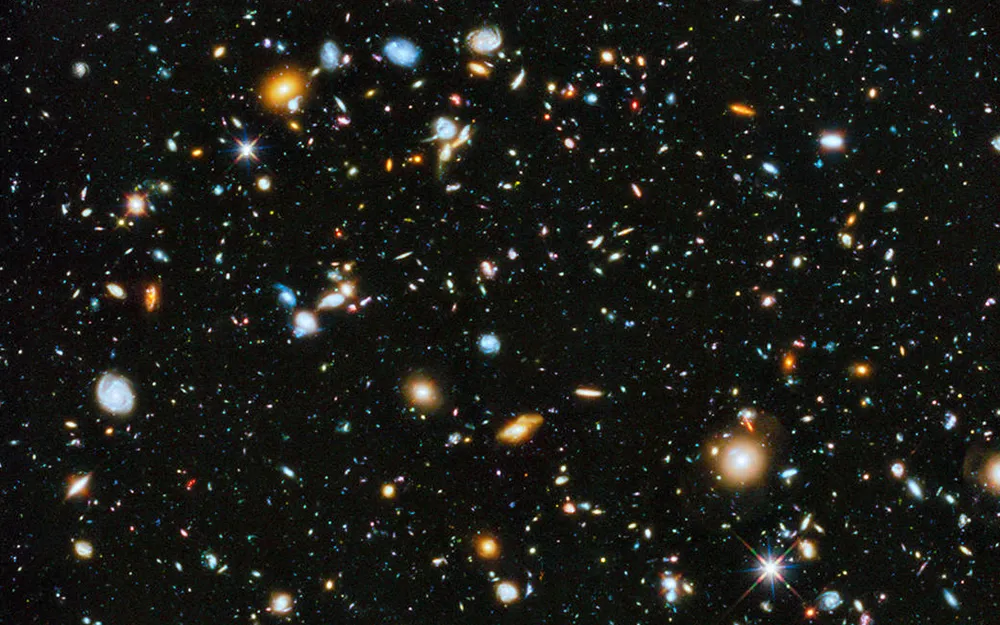
A survey of more than 25 million galaxies has found a strange contradiction in how astronomers measure the universe's clumpiness, and it could threaten the standard model of cosmology, which describes how the universe formed and evolved.
The discrepancy, found by measuring the warping of light by the powerful gravitational fields of distant galaxies, suggests that the cosmos is less packed-together than previously predicted.
If the measurement is accurate, it will join the Hubble tension as yet another significant challenge to our preconceptions of how the cosmos evolved — one that could give way to new physics or even an entirely different model of the universe. The researchers published their findings Dec. 11 in the journal Physical Review D.
Related: After 2 years in space, the James Webb telescope has broken cosmology. Can it be fixed?
"We're still being fairly cautious here," Michael Strauss, chair of Princeton University's Department of Astrophysical Sciences and one of the leaders of the team that made the discovery, said in a statement. "We're not saying that we've just discovered that modern cosmology is all wrong. The statistics show that there's only a one in 20 chance that it's just due to chance, which is compelling but not completely definitive. But as we in the astronomy community come to the same conclusion over multiple experiments, as we keep on doing these measurements, perhaps we're finding that it's real."
According to the standard model of cosmology, after the Big Bang the young cosmos was a roiling plasma broth that began to rapidly expand due to an invisible force known as dark energy. As the universe grew, ordinary matter, which interacts with light, congealed around clumps of invisible dark matter to create the first galaxies, connected together by a vast cosmic web. Nowadays, cosmologists think that ordinary matter, dark matter and dark energy make up about 5%, 25% and 70% of the universe, respectively.
Yet there are growing problems with this picture. To test their models, astronomers often compare the past to the present universe. Their past measurements are drawn from the cosmic microwave background (CMB), the static fizz of the universe's first light that left its source (recombining atoms) 380,000 years after the Big Bang.
Get the world’s most fascinating discoveries delivered straight to your inbox.
Yet the Hubble constant — a value that tracks the expansion rate of the universe — predicted from the CMB disagreed with the calculations derived from celestial objects in the contemporary cosmos. This discrepancy has led to a crisis in cosmology known as the Hubble tension.
The new discrepancy about the lumpiness of the universe centers around a number called S8, which measures how much matter clusters, or clumps together, across the universe. After using the Planck satellite to study the cosmic microwave background (CMB), astronomers previously plugged the data into the standard model of cosmology and got a predicted value for S8 of 0.83.
RELATED STORIES
This clashes with a new measurement of S8 using Japan's Subaru Telescope, which studied how much light is warped by the presence of matter in galaxies. Researchers took its results and produced a smaller value for S8 of 0.77. The new result was replicated by two other collaborations mapping the universe's matter with gravitational lensing — the Dark Energy Survey and the Kilo-Degree Survey — making an individual anomalous result unlikely.
"We're confirming a growing sense in the community that there is a real discrepancy between the measurement of clumping in the early universe (measured from the CMB) and that from the era of galaxies, 'only' 9 billion years ago," Arun Kannawadi, an associate research scholar at Princeton University who was involved in the analysis, said in the statement.
Though the problem points to yet another large hole in our understanding of the universe, cosmologists don't have great ways to fill it yet. It's possible that cosmologists are wrong about the amount of dark matter in the universe, or how it clumps together. Maybe dark energy changed over the course of the universe's life — an explanation that would resolve both the S8 and the Hubble tension with a tweak to the standard model of cosmology.
Or perhaps, most excitingly of all, it could mean that the standard model is broken and needs a total replacement. For scientists to know for certain, they will make more precise measurements from even more powerful telescopes. Two such contenders are the Vera C. Rubin Observatory in Chile and the Nancy Grace Roman Space Telescope, which are due to come online in 2025 and 2027, respectively.

Ben Turner is the features editor at Live Science. He covers physics and astronomy, among other topics such as tech and climate change. He graduated from University College London with a degree in particle physics before training as a journalist. When he's not writing, Ben enjoys reading literature, playing the guitar and losing at chess.