Get the world’s most fascinating discoveries delivered straight to your inbox.
You are now subscribed
Your newsletter sign-up was successful
Want to add more newsletters?
Join the club
Get full access to premium articles, exclusive features and a growing list of member rewards.
An account already exists for this email address, please log in.
There's a baby star 'sneezing' in the constellation Taurus — and it could solve a longstanding cosmic mystery
In a rare observation, scientists found a baby star "sneezing" gas, dust and magnetic energy out of its disk. This behavior could help solve a longstanding mystery about how stars form without tearing themselves apart.
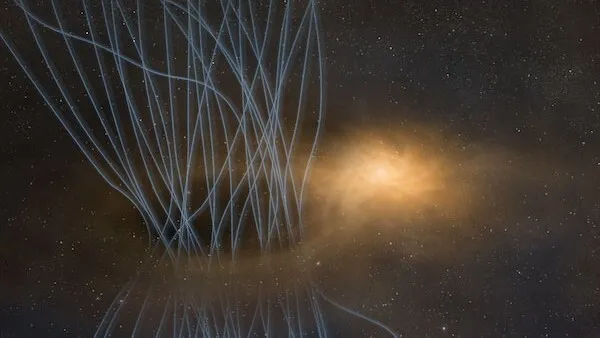
Astronomers have discovered the first known instance of a baby star "sneezing." The cosmic discharge, which may have occurred as recently as a few hundred years ago, reveals how infant stars expel most of their magnetic energy very early in their evolution — a shedding mechanism that stops their high-spinning profiles from breaking apart.
Researchers observed the cosmic sneeze in images captured by the Atacama Large Millimeter/submillimeter Array (ALMA) observatory, a set of radio telescopes located in Chile's Atacama Desert.
The star in question is a faint baby star embedded in a dense gas cloud named MC 27 roughly 450 light-years from Earth in the constellation Taurus. The cosmic cradle is a turbulent ring of gas and dust known as a protostellar disk, where unstable magnetic fields interact with gasses and intermittently blast out as spikes and arcs coated with gas and dust. This process, known as interchange instability, propels the leaked material away from the disk at roughly the speed of sound, the researchers reported in a study published Thursday (April 11) in The Astrophysical Journal.
"This discovery was unexpected," Kazuki Tokuda, an astronomer at Kyushu University in Japan and the lead author of the study, told Live Science. While previous telescope observations of the stellar nursery hadn't revealed the peculiar structures, ALMA spotted streamers not only escaping the disk but also much further away, revealing the baby star "sneezed" multiple times in the past. Such episodic behavior helps the baby star maintain a compact disk around it, the researchers say.
"It is not yet certain whether this process is universal," Tokuda said. Gas-packed, star-forming clouds that are riddled with magnetic fields increase the likelihood that a star sneezes, he said. Similar structures protruding out of protostellar disks elsewhere have been reported but remain unconfirmed, offering early hints that such expulsions of abundant magnetic fields could be a ubiquitous method by which stars evolve.
(Image credit: ESA/Herschel/NASA/JPL-Caltech, CC BY-SA 3.0 IGO; Acknowledgement: R. Hurt (JPL-Caltech))
Baby's first sneeze
Stars are born from the gravitational collapse of huge, opaque clouds of dust and gas. The newborns spin up as the collapse continues. Astronomers have long suspected that stars must somehow slow their rotation in their first 100,000 years, otherwise their high spin would break them apart.
Sign up for the Live Science daily newsletter now
Get the world’s most fascinating discoveries delivered straight to your inbox.
A leading theory posits they do this by ousting a considerable amount of magnetic energy. Previous telescope observations support the "magnetic braking" theory, because a star that held onto all its magnetic energy "would generate magnetic fields many orders of magnitude stronger than those observed in any known protostar," Tokuda said in a statement.
Interchange instability was theorized as one such method for magnetic braking in the late 1990s and has long been considered as a mechanism that could disrupt disks. "It has often been considered an undesirable mechanism and rarely discussed for the astronomical observing community," Tokuda told Live Science. The new observations suggest it's time to take the theory a bit more seriously.
Precisely what happens to the expelled gas, dust and magnetic energy is an open question. Tokuda suspects it remains in interstellar space for eons, although it's possible that the material would eventually make its way back to the star, he said.
In the coming months, Tokuda and his team plan to investigate the specific conditions and environments that trigger the "sneezes" and whether they affect planet formation. Given planets coalesce out of the same cloud of gas and dust as stars, Tokuda said it is possible that protoplanets also shed excess magnetic energy, but "there has been no theoretical and observational research to date that specifically addresses this possibility."
Sharmila Kuthunur is an independent space journalist based in Bengaluru, India. Her work has also appeared in Scientific American, Science, Astronomy and Space.com, among other publications. She holds a master's degree in journalism from Northeastern University in Boston. Follow her on BlueSky @skuthunur.bsky.social