


-
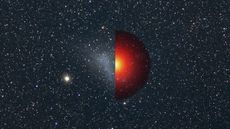 'Heavy' dark matter would rip our understanding of the universe apart, new research suggests
Because we haven't found anything yet, we've started to wonder if dark matter might be lighter or heavier than we thought.
cosmology -
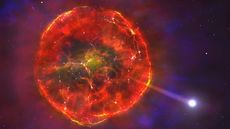 1st supernovas may have flooded the early universe with water — making life possible just 100 million years after the Big Bang
A new study suggests that the explosive deaths of the universe's earliest stars created surprising quantities of water that may have sparked extraterrestrial life in the very first galaxies.
cosmology -
 'A frankly embarrassing result': We still know hardly anything about 95% of the universe
"As yet, nobody has managed to understand what gives rise to this strange phenomenon, and explaining dark energy remains one of the most formidable challenges of modern science."
cosmology -
 Cosmic voids may explain the universe's acceleration without dark energy
New research suggests that dark energy isn't needed to explain the acceleration in the expansion of the universe — instead suggesting giant voids in space are creating an illusion.
cosmology -
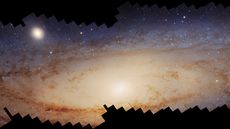 'Herculean' 2.5-billion-pixel mosaic shows our closest galactic neighbor like never before — and took more than a decade to create
The new composite image, which combines hundreds of photos from the Hubble Space Telescope, shows the Andromeda Galaxy with more than 200 million individually resolved stars.
cosmology -
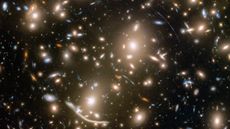 'Our model of cosmology might be broken': New study reveals the universe is expanding too fast for physics to explain
Astronomers have been confounded by recent evidence that the universe expanded at different rates throughout its life. New findings risk turning the tension into a crisis, scientists say.
cosmology -
 Rare string of 'cosmic pearls' dance together in the universe
A rare group of aligned, star-birthing dwarf galaxies resemble a cosmic string of pearls.
cosmology -
 Something invisible and 'fuzzy' may lurk at the Milky Way's center, new research suggests
The cores of galaxies may not be made of what we thought, new research suggests — they could hold one giant, invisible star made of mysterious "fuzzy" matter.
cosmology -
 Most of the atoms in your body left the Milky Way on a 'cosmic conveyor belt' long before you were born, new study reveals
New research suggests that most of the atoms within the human body likely spent part of their lives drifting beyond the Milky Way on a cosmic "conveyor belt," before eventually returning to our galaxy.
cosmology


