Get the world’s most fascinating discoveries delivered straight to your inbox.
You are now subscribed
Your newsletter sign-up was successful
Want to add more newsletters?
Join the club
Get full access to premium articles, exclusive features and a growing list of member rewards.
An account already exists for this email address, please log in.
'Herculean' 2.5-billion-pixel mosaic shows our closest galactic neighbor like never before — and took more than a decade to create
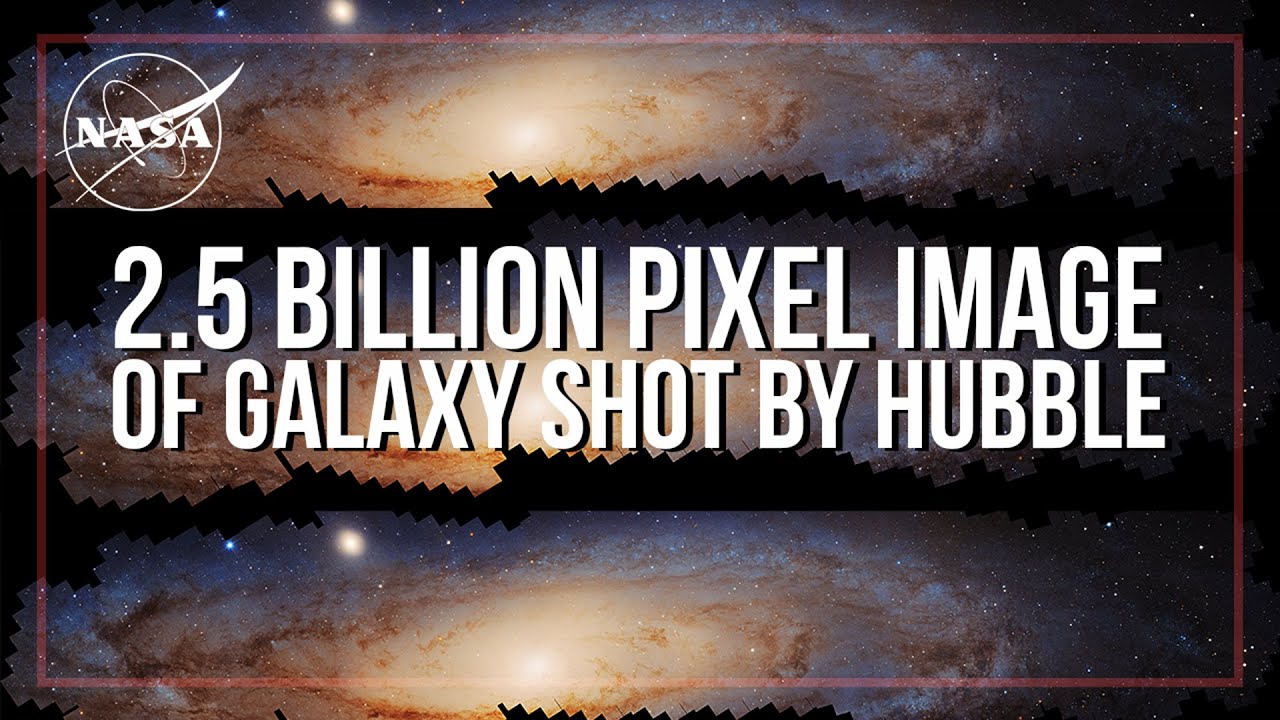
The new composite image, which combines hundreds of photos from the Hubble Space Telescope, shows the Andromeda Galaxy with more than 200 million individually resolved stars.
The Hubble Space Telescope has finally completed a stunning mosaic of the Milky Way's closest cosmic companion, the Andromeda Galaxy — having spent more than a decade snapping the spectacular image.
The new image, which was released Jan. 16 by the European Space Agency (ESA), is made up of approximately 600 different fields of view and shows the spiral galaxy "almost edge-on," or tilted 77 degrees compared to how we normally see it from Earth.
To do this, researchers ran two different observing programs to independently capture the northern and southern halves of the galaxy. It "was a herculean task" that required Hubble to orbit Earth more than 1,000 times, ESA representatives wrote in the statement.
The mosaic contains roughly 2.5 billion individual pixels — a new record for an image of Andromeda. This unprecedented level of detail has enabled researchers to resolve more than 200 million stars in the image, which start to "look like grains of sand across the beach" as you zoom in on different parts of the image, according to the statement.
"But that’s just the tip of the iceberg," the ESA representatives added. In total, scientists estimate that Andromeda could have as many as 1 trillion stars, which is up to 10 times more than the Milky Way, according to ESA.
As you zoom in on different sections of the mosaic you can see millions of individually resolved stars looking "like grains of sand across the beach."
(Image credit: NASA, ESA, B. Williams (University of Washington))
The new image will enable scientists to better understand Andromeda's past. Astronomers believe the galaxy once collided with one of its current satellite galaxies, Messier 32, and likely stole most of the latter's stars in the process. This means that comparing the distribution of the different stars within Andromeda can tell us more about this cosmic collision.
Sign up for the Live Science daily newsletter now
Get the world’s most fascinating discoveries delivered straight to your inbox.
The release of the new Hubble image coincides with the 100th anniversary of the discovery of Andromeda by the spacecraft's namesake, Edwin Hubble, according to Live Science's sister site Space.com.
Prior to that 1915 discovery, scientists believed that all the stars in the night sky belonged to a single galaxy, and they had no concept of the scale of the wider universe. But in the century since, telescopes like Hubble have helped to show us that there are more than 100 billion galaxies within the entire cosmos.
However, at a distance of around 2.5 million light-years from Earth, which is comparatively tiny on a cosmic scale, Andromeda is the most easily accessible galaxy to us — and has helped us learn a great deal about our own galaxy.
"Without Andromeda as a proxy for spiral galaxies in the universe at large, astronomers would know much less about the structure and evolution of our own Milky Way," the ESA representatives wrote.
Harry is a U.K.-based senior staff writer at Live Science. He studied marine biology at the University of Exeter before training to become a journalist. He covers a wide range of topics including space exploration, planetary science, space weather, climate change, animal behavior and paleontology. His recent work on the solar maximum won "best space submission" at the 2024 Aerospace Media Awards and was shortlisted in the "top scoop" category at the NCTJ Awards for Excellence in 2023. He also writes Live Science's weekly Earth from space series.