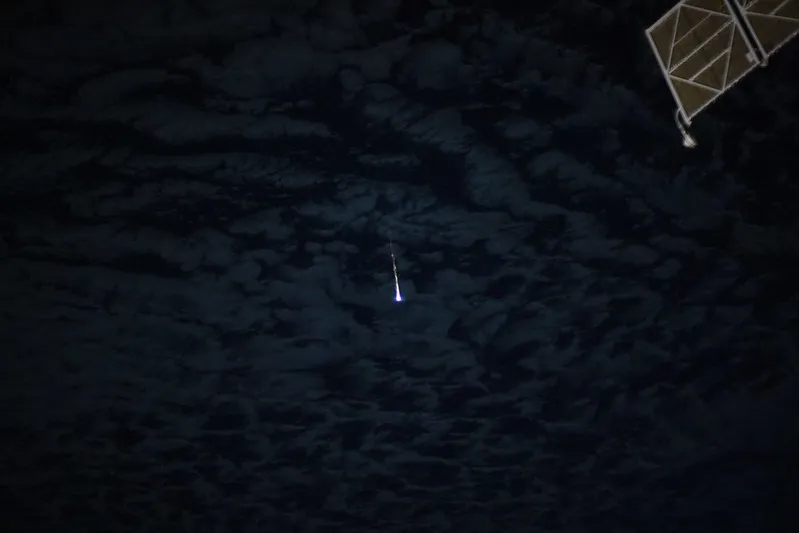
Images captured by European Space Agency astronaut Thomas Pesquet on July 26, 2021, show a Russian Progress capsule tugging the retired Pirs module to burn up in Earth's atmosphere.
On Monday (July 26), astronauts said goodbye to a cornerstone of the International Space Station and captured stunning images of the compartment burning up in Earth's atmosphere.
A Russian Progress cargo vehicle towed the module, called Pirs, away from the space station and down through Earth's atmosphere to ensure the module burned up completely and reduce the odds of any large chunks making it to Earth's surface.
"Quite a strange feeling to see a part of your ship fly away in mid-air (so to speak — no atmosphere here duh)," European Space Agency astronaut Thomas Pesquet wrote in a statement shared with the photographs on Monday.
"We clearly saw smaller pieces float away from the main fireworks, as the ship was being destructed by the heat of atmospheric friction," Pesquet added. "Quite the show!"
Russia had launched its Pirs module in 2001; since then, the module, which served as a port to the space station, hosted more than 70 different capsules and supported Russian cosmonauts conducting extravehicular activities, or spacewalks.
Image 1 of 4
Images captured by European Space Agency astronaut Thomas Pesquet on July 26, 2021, show a Russian Progress capsule tugging the retired Pirs module to burn up in Earth's atmosphere.
(Image credit: ESA/NASA–T. Pesquet)
Images captured by European Space Agency astronaut Thomas Pesquet on July 26, 2021, show a Russian Progress capsule tugging the retired Pirs module to burn up in Earth's atmosphere.
(Image credit: ESA/NASA–T. Pesquet)
Images captured by European Space Agency astronaut Thomas Pesquet on July 26, 2021, show a Russian Progress capsule tugging the retired Pirs module to burn up in Earth's atmosphere.
(Image credit: ESA/NASA–T. Pesquet)
Images captured by European Space Agency astronaut Thomas Pesquet on July 26, 2021, show a Russian Progress capsule tugging the retired Pirs module to burn up in Earth's atmosphere.
(Image credit: ESA/NASA–T. Pesquet)
To make room for Russia's new science module, dubbed Nauka, which launched on July 21 and will arrive at the station on Thursday (July 29), Pirs had to go. Yesterday's fiery retirement ceremony marks the first time a major component of the International Space Station has been discarded.
Sign up for the Live Science daily newsletter now
Get the world’s most fascinating discoveries delivered straight to your inbox.
The attached Progress vehicle, which had arrived at the space station in February, controlled Pirs' re-entry to ensure that the module was destroyed as thoroughly as possible.
Email Meghan Bartels at [email protected] or follow her on Twitter @meghanbartels. Follow uson Twitter @Spacedotcom and on Facebook.
Meghan is a senior writer at Space.com and has more than five years' experience as a science journalist based in New York City. She joined Space.com in July 2018, with previous writing published in outlets including Newsweek and Audubon. Meghan earned an MA in science journalism from New York University and a BA in classics from Georgetown University, and in her free time she enjoys reading and visiting museums. Follow her on Twitter at @meghanbartels.