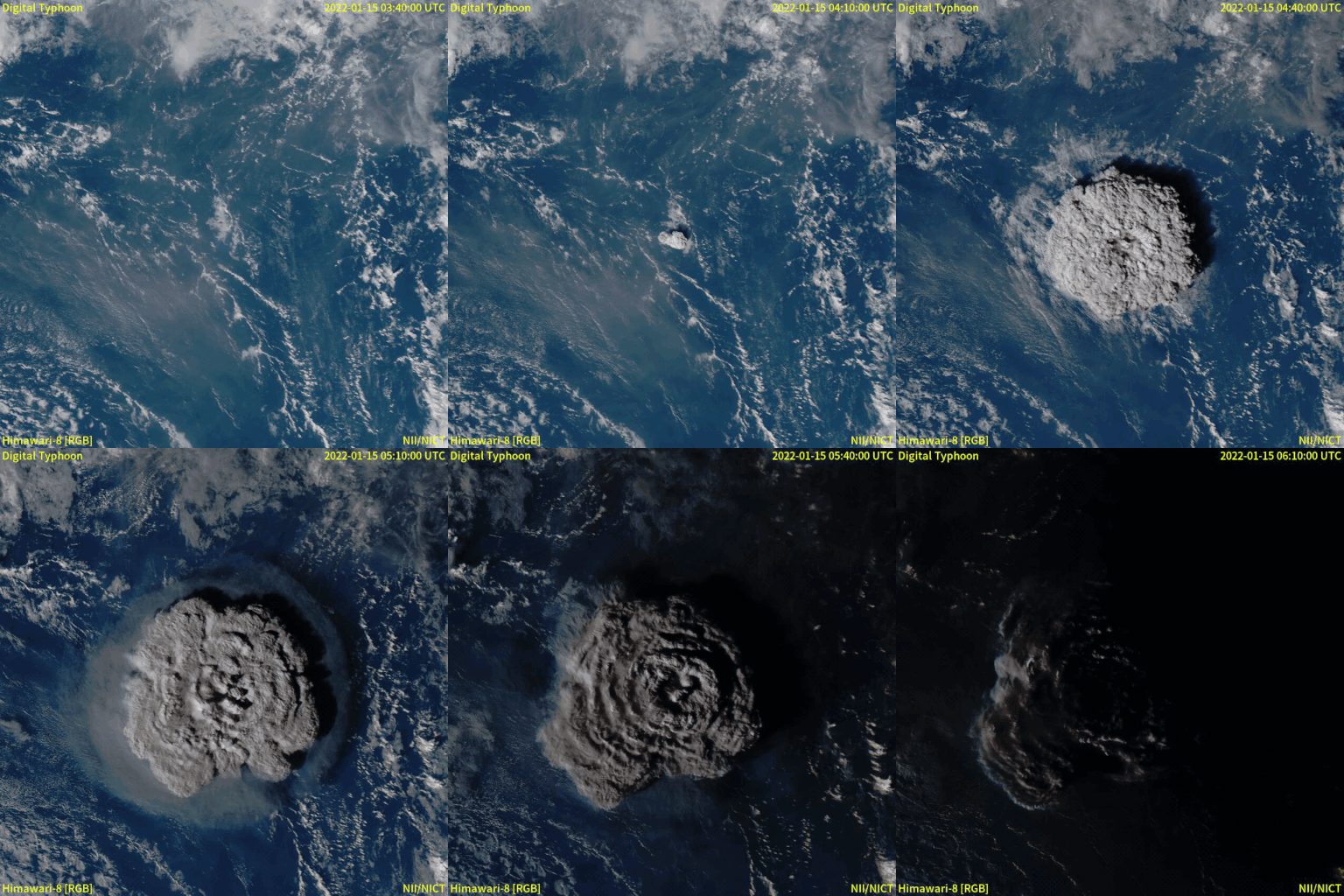
Schoeberl et al. examined how Hunga's eruption affected climate in the Southern Hemisphere over the following 2 years. They found that in the year following the eruption, the cooling effect from the volcanic aerosols reflecting sunlight into outer space was stronger than the warming caused by water vapors trapping heat in the atmosphere. But most of the volcano's effects had dissipated by the end of 2023.
The researchers used satellite data to examine how stratospheric aerosols, gases, and temperatures changed after the eruption. The Hunga eruption contributed about 150 metric megatons of water vapor into the stratosphere — an amount so high that it raised global levels of stratospheric water vapor by about 10%. This massive water injection cooled temperatures in the tropical stratosphere by 4°C in March and April of 2022. In turn, this temporary cooling created a secondary circulation pattern that led to reduced ozone levels throughout 2022.
The Hunga eruption also released between 0.5 and 1.5 metric megatons of sulfur dioxide into the stratosphere. Sulfur dioxide produces sulfate aerosols that reflect sunlight and can cause a reduction in surface radiative forcing, or the difference between incoming and outgoing radiation. This can lead to global cooling if the aerosol load is large enough, as it was in the 1991 eruption of Mount Pinatubo, which released about 20 metric megatons of sulfur dioxide. The Hunga aerosol load was not very large, and its effects were mostly confined to the Southern Hemisphere in 2022 and 2023.
The January 2022Hunga Tonga–Hunga Ha‘apai eruption was the largest underwater explosion ever recorded by modern scientific instruments.
Although the eruption did affect Earth's radiative balance briefly, that change was very small: a global decrease in radiative flux of less than 0.25 watt per square meter over the 2-year period before it returned to preeruption levels. (Globally, Earth's surface, oceans, and atmosphere absorb an average of about 240 watts of solar power per square meter over the course of a year.) This brief change means that Hunga's eruption may have caused slight cooling in the Southern Hemisphere, but the researchers say it would be challenging to glean that same information from meteorological observations alone. (Journal of Geophysical Research: Atmospheres, https://doi.org/10.1029/2024JD041296, 2024)