It's quick and easy to access Live Science Plus, simply enter your email below. We'll send you a confirmation and sign you up for our daily newsletter, keeping you up to date with the latest science news.
Get the world’s most fascinating discoveries delivered straight to your inbox.
You are now subscribed
Your newsletter sign-up was successful
Want to add more newsletters?
Join the club
Get full access to premium articles, exclusive features and a growing list of member rewards.
An account already exists for this email address, please log in.
Mystery of Siberia's giant exploding craters may finally be solved
Giant exploding craters only known to exist on Russia's permafrost-covered Yamal and Gydan peninsulas may result from a specific set of conditions not found elsewhere in the Arctic.
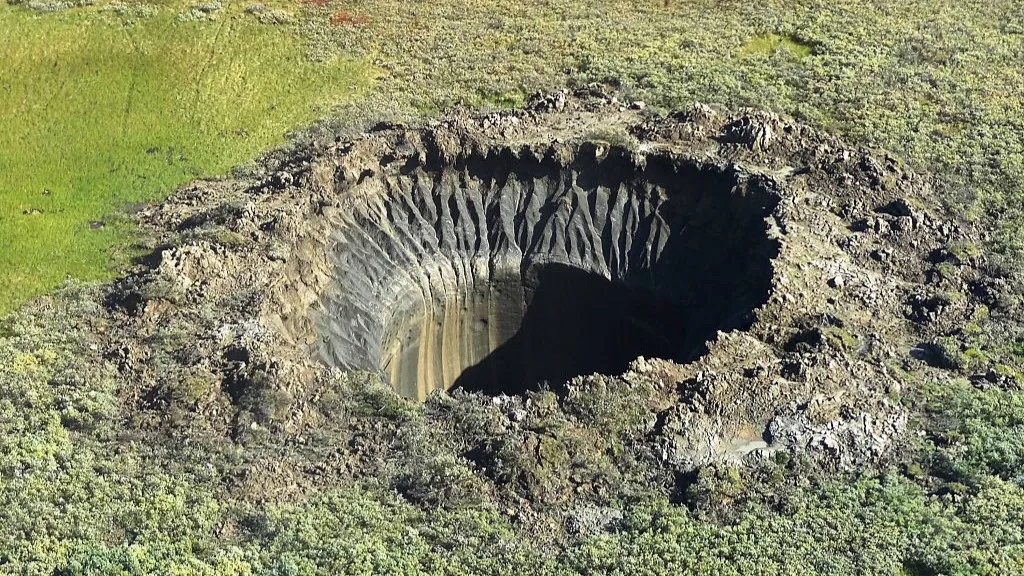
Eight giant, 160-foot-deep (50 meters) craters in the Siberian permafrost have baffled scientists since their discovery more than a decade ago — but a new theory may finally explain how they formed.
The craters are unique to Russia's northern Yamal and Gydan peninsulas and are not known to exist elsewhere in the Arctic, suggesting the key to this puzzle lies in the landscape, according to a preprint paper published Jan. 12 to the EarthArXiv database.
Researchers have proposed several explanations for the gaping holes over the years, ranging from meteor impacts to natural-gas explosions. One theory suggests the craters formed in the place of historic lakes that once bubbled with natural gas rising from the permafrost below. These lakes may have dried up, exposing the ground beneath to freezing temperatures that sealed the vents through which gas escaped. The resulting buildup of gas in the permafrost may eventually have been released through explosions that created the giant craters.
But the historic-lake model fails to account for the fact that these "giant escape craters" (GECs) are found in a variety of geological settings across the peninsulas, not all of which were once covered by lakes, according to the new preprint, which has not been peer reviewed.
Previousstudies have also linked the craters to accumulations of natural gas within the permafrost, but these can't explain why the holes are only found in northern Russia. "Thus, the formation of GECs points to conditions specific for the Yamal and Gydan peninsulas," researchers wrote in the preprint.
Image taken in 2014 showing one of the craters on Russia's Yamal peninsula.
(Image credit: VASILY BOGOYAVLENSKY/AFP via Getty Images)
Permafrost on the Yamal and Gydan peninsulas varies widely in its thickness, ranging from a few hundred feet to 1,600 feet (500 m). The soil likely froze solid more than 40,000 years ago, imprisoning ancient marine sediments rich in methane that gradually transformed into vast natural gas reserves. These reserves produce heat that melts the permafrost from below, leaving pockets of gas at its base.
Sign up for the Live Science daily newsletter now
Get the world’s most fascinating discoveries delivered straight to your inbox.
Permafrost in Russia and elsewhere is also thawing at the surface due to climate change. In places where it is already thin on the Yamal and Gydan peninsulas, melting from both ends and the pressure from the gas may eventually cause the remaining permafrost to collapse, triggering an explosion.
This "champagne effect" would explain the presence of smaller craters around the eight giant craters, as huge chunks of ice propelled out by the explosions may have severely dented the ground, according to the preprint.
There may also be more of these craters than we realize, the researchers added, as water and sediment likely filled some of the holes over time.
The release of natural gas and methane during these explosions could activate a climate feedback loop if global temperatures continue to creep up and accelerate permafrost melting.
"The formation of GECs has been connected to global climate change, with increasing summer and fall temperatures resulting in permafrost warming and degradation," the researchers wrote.
An estimated 1,900 billion tons (1,700 billion metric tons) of greenhouse gas, including carbon dioxide and methane, are stored in the Arctic permafrost, according to the preprint. Growing emissions from thawing permafrost "are of great concern," the authors added.
Sascha is a U.K.-based staff writer at Live Science. She holds a bachelor’s degree in biology from the University of Southampton in England and a master’s degree in science communication from Imperial College London. Her work has appeared in The Guardian and the health website Zoe. Besides writing, she enjoys playing tennis, bread-making and browsing second-hand shops for hidden gems.

 Live Science Plus