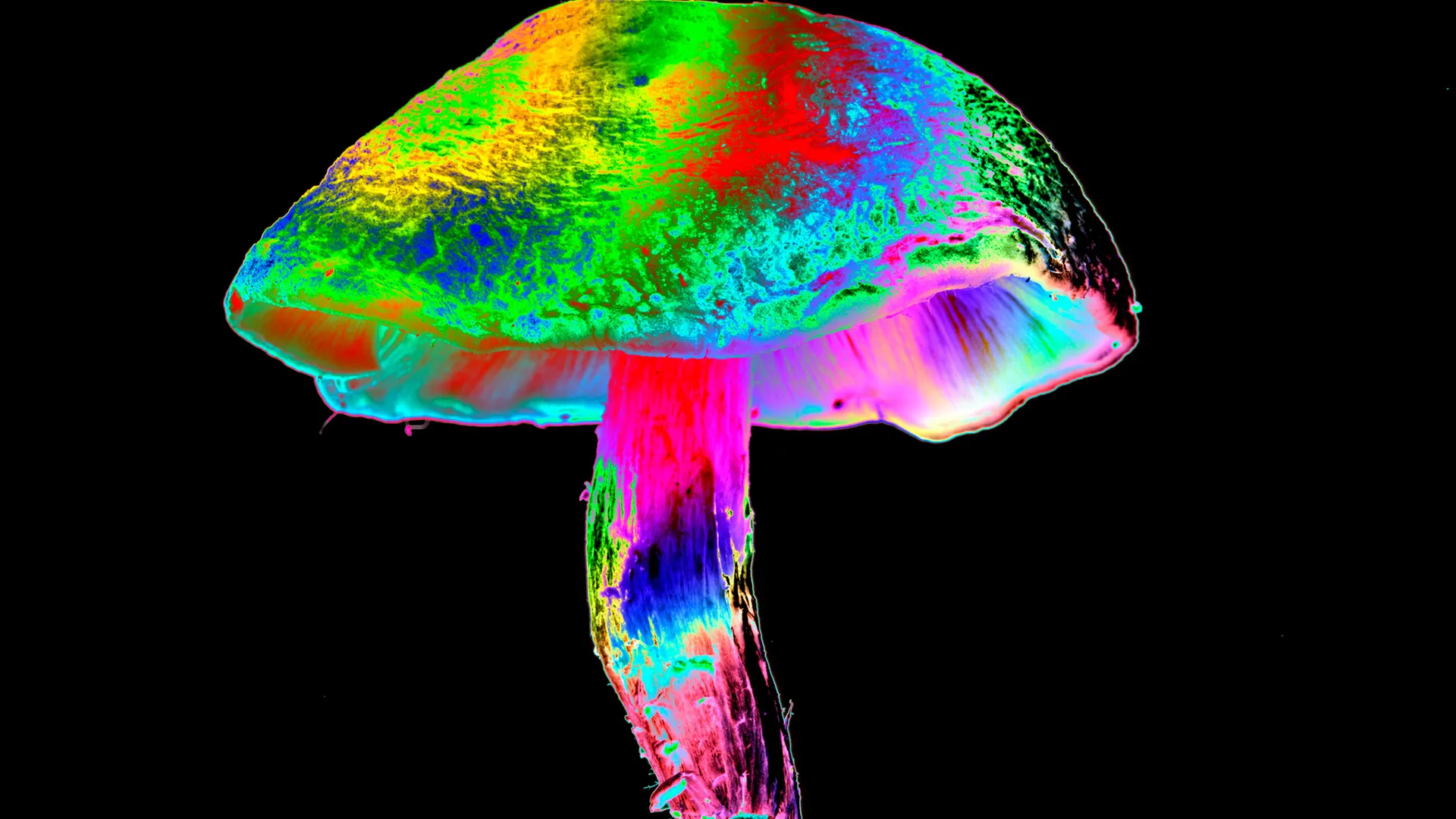
Chemotherapy can save lives, but for many cancer patients, it leaves behind a painful legacy: damaged nerves that burn, tingle or go numb. Now, researchers report that a psychedelic compound may protect those nerves — not through its mind-bending effects, but by helping neurons keep their internal power supplies moving.
A new mouse study, published Thursday (Sept. 3) in the journal Science, suggests that psilocybin, the psychedelic compound in "magic mushrooms," may help prevent this painful and sometimes permanent side effect of chemotherapy, known as chemotherapy-induced peripheral neuropathy (CIPN).
In experiments in mice, psilocybin prevented nerve damage from CIPN that can cause pain, numbness and heightened sensitivity to cold and touch. Two doses of the drug given prior to chemotherapy garnered protection that persisted through as many as six rounds of the cancer treatment, according to the study.
CIPN affects roughly one-third to one-half of people receiving certain chemotherapies, said Dr. Thomas Strouse, a professor of clinical psychiatry and a neuropathy researcher at UCLA who was not involved in the study. In severe cases, the neuropathy can force doctors to reduce or stop chemotherapy. It can also contribute to mobility problems, which raise the risk of falls and fractures.
"It's a big deal, big problem," Strouse said. Researchers have been searching for a way to prevent it for a long time, he added.
Keeping nerve cells fueled
Initially, the researchers weren't looking for a neuropathy treatment, said study co-author Dr. Moran Amit, a cancer surgeon and researcher at The University of Texas MD Anderson Cancer Center. His team was investigating whether compounds that promote neuroplasticity — the nervous system's ability to change and adapt — might protect nerves and improve existing cancer treatments.
After testing several psychedelic compounds, they "very early on focused on psilocybin because this was the most effective one" for relieving neuropathy symptoms, Amit told Live Science. The psychedelic has been explored as a treatment for psychiatric disorders such as depression, in which it might promote "hyperconnectivity" between certain brain regions.
Sign up for the Live Science daily newsletter now
Get the world’s most fascinating discoveries delivered straight to your inbox.
In the new study, protection against CIPN emerged as an unexpected effect of the drug.
To investigate how that protection worked, the researchers studied mice treated with cisplatin, a chemotherapy drug known to frequently cause neuropathy. Two doses of psilocybin — given nine days and two days before the first chemotherapy session, respectively — completely prevented the mice from developing hypersensitivity, and it also reduced cold sensitivity and preserved nerve endings in the skin.
The team then ran experiments using human sensory neurons and peripheral nerves that had been removed during surgery. These analyses pointed to a possible explanation: a process called mitochondrial trafficking.
Mitochondria generate the energy that cells need, but neurons present an unusual logistical challenge. Some peripheral nerves extend over enormous distances, so their mitochondria must be transported along structural tracks, called microtubules, to reach far-flung nerve endings. That in itself is an energy-intensive process.
Amit compared those microtubules to a railroad system: Chemotherapy can damage both the mitochondria themselves and the tracks they travel along.
In further experiments with human neurons, the team found that cisplatin depleted mitochondria and ATP (adenosine triphosphate) — cells' main energy currency — from the wires that extend from nerves. Psilocybin didn't restore the mitochondria's overall energy-producing capacity. Instead, it preserved their ability to travel and maintained their normal levels of ATP production, specifically within the nerve projections. That suggests the drug may help keep energy supplies where they're needed most.
The effect depended on the serotonin receptor 5-HT2A, which is responsible for many of psilocybin's psychedelic effects as well. Intriguingly, a compound called TBG — designed to activate 5-HT2A without causing hallucinations — also protected mice from neuropathy.
However, Amit cautioned that psilocybin's psychedelic effects may also be playing a neuroprotective role that we have yet to understand, so it's unclear if the effect should be avoided in humans.
Chemotherapy can have a wide range of side effects, including nerve damage.
(Image credit: Fly View Productions via Getty Images)
A long way from patients
Strouse noted that mitochondrial damage in CIPN isn't a new idea. "What's novel is looking at psilocybin as a protectant," he said.
He also cautioned that different chemotherapy drugs may cause neuropathy through distinct mechanisms, so the protection demonstrated against one chemotherapy drug may not translate broadly.
Most importantly, the researchers have not shown that psilocybin prevents neuropathy in humans yet.
"The main thing is that it was never tested for this indication specifically in a systematic way in humans," Amit said. His team is now preparing a clinical trial at MD Anderson to test the approach. The research is part of MD Anderson's Cancer Neuroscience Program, a multidisciplinary effort that studies interactions between cancer and the nervous system, with an emphasis on improving patients' quality of life.
Human trials will need to establish both the effectiveness and safety of using psilocybin for this purpose, Strouse said, particularly before oncologists would consider giving a psychedelic drug alongside cancer treatment.
Disclaimer
This article is for informational purposes only and is not meant to offer medical advice.
Article Sources
Heles, M., Pasvolsky, L., Sathishkumar, H., Naara, S., Vu, Y., Stewart, C. L., Xie, T., Gleber-Netto, F. O., McCarthy, W., Yaniv, D., Kamal, S. S., Elahi, H., Zhu, P., Uhelski, M. L., Chatwin, J., Lara, A., Stolley, D. L., Migden, M. R., Lee, Z.-H., … Amit, M. (2026). Psilocybin prevents chemotherapy-induced peripheral neuropathy through mitochondrial trafficking preservation. Science, 393(6815). https://doi.org/10.1126/science.aec6116
Jennifer Zieba earned her PhD in human genetics at the University of California, Los Angeles. She is currently a project scientist in the orthopedic surgery department at UCLA where she works on identifying mutations and possible treatments for rare genetic musculoskeletal disorders. Jen enjoys teaching and communicating complex scientific concepts to a wide audience and is a freelance writer for multiple online publications.
You must confirm your public display name before commenting
Please logout and then login again, you will then be prompted to enter your display name.