

-
 Microplastics absorb heat in the atmosphere and contribute to global warming — as if they weren't bad enough
Climate scientists have discovered that microplastics and nanoplastics are helping to drive global warming by absorbing sunlight and radiation in the atmosphere.
climate-change -
 'Food insecurity is no longer just about low-income countries': Environmental economist explains how climate change is pushing agricultural systems to the brink
INTERVIEW As a U.N. report warns that extreme temperature swings are disrupting crops and endangering agricultural workers, we spoke with environmental economist Shouro Dasgupta about farming in an overheating world.
8 CommentsINTERVIEW -
 Scientists spot object beyond Pluto with an atmosphere that shouldn't exist
Observations suggest there's a small, icy object with an atmosphere beyond Pluto, challenging assumptions about which bodies can sustain atmospheres.
space -
 Artemis moon landing could face long delay while NASA waits for next-generation spacesuits
Delays in next-generation spacesuits could push back Artemis moon landings to 2031, an audit by the NASA Office of Inspector General claims.
space-exploration -
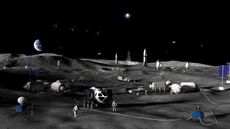 73 moon landings? NASA's 'Moon Base User's Guide' reveals the agency's 'most ambitious space project' will be fraught with challenges
NASA has released a 'Moon Base User's Guide' that reveals the major gaps the agency and its partners must fill in to land and live on the moon.
2 Commentsspace-exploration -
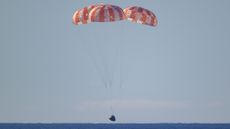 'Welcome home, Integrity': Artemis II crew return to Earth after 'bullseye landing' caps historic moon mission
Live Blog The Artemis II crew have safely landed in the Pacific Ocean after a historic flight around the moon. Take a look back at our live blog's launch coverage from the hours and seconds until splashdown.
2 CommentsLive Blog -
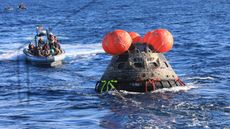 There are 'reasons to be confident' about faulty Artemis II heat shield ahead of 25,000 mph reentry, space expert Ed Macaulay says
NASA's Artemis II heat shield is about to face its ultimate test as the Orion crew prepares for reentry. Physics and data science lecturer Ed Macaulay tells Live Science reasons to be confident ahead of today's historic splashdown.
6 Commentsspace-exploration -
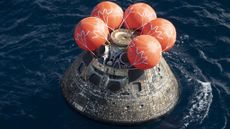 There's an issue with the Artemis II heat shield, but NASA isn't worried. Here's why.
The Artemis II astronauts are about to fall to Earth at the fastest speed humans have ever travelled inside a spacecraft with a compromised heat shield. But NASA remains confident they will be safe.
16 Commentsspace-exploration -
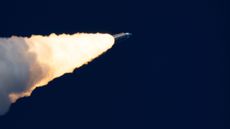 'We go for all of humanity': Artemis II rocket lifts off to the moon — look back at our live coverage
Live Blog The Artemis II crew have left Earth and are bound for the moon. Take a look back at our live blog's launch coverage from the days, hours and seconds until takeoff.
168 CommentsLive Blog -
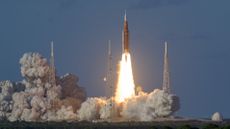 Artemis II blasts off: Humans are on their way back to the moon
NASA's Artemis II rocket has taken off in a historic launch on Florida's Space Coast, sending humans back to the moon for the first time in more than 50 years.
2 Commentsspace-exploration -
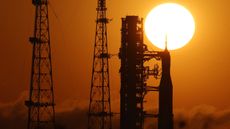 Astronauts can face 'nearly lethal doses' of solar radiation — so why launch Artemis II during the sun's peak of activity? Space scientist Patricia Reiff explains.
NASA's Artemis II flight around the moon will expose astronauts to space weather. Space scientist Patricia Reiff tells Live Science how solar flares and radiation will impact the lunar mission.
2 Commentsspace-exploration -
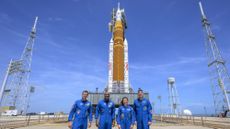 How to watch NASA's historic Artemis II launch for the moon
NASA's Artemis II mission is set to take four astronauts on a record-breaking spaceflight around the moon, bringing humans farther into space than ever before. Here's how to watch it.
2 Commentsspace-exploration -
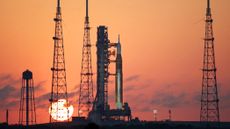 'We are getting very, very close': NASA makes final Artemis II preparations as expectation grows for Wednesday launch
NASA's Artemis II crew is ready to fly around the moon, with promising weather forecasts for a Wednesday launch.
4 Commentsspace-exploration -
NASA announces 'near‑impossible' space plans, including $20B moon base and humanity's first nuclear-powered interplanetary spacecraft
NASA's Gateway lunar space station won't launch next year in new changes to the Artemis program, which include ramping up development of a $20 billion moon base and a nuclear-powered 'Freedom' spacecraft.
9 Commentsspace-exploration -
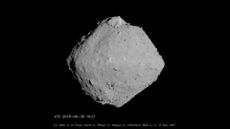 All 5 'letters' of DNA found on an asteroid speeding through our solar system. What do they tell us about the origins of life?
JAXA samples reveal that asteroid Ryugu has a complete set of nucleobases, the building blocks of DNA, suggesting these ingredients of life may be common in the solar system.
4 Commentsasteroids -
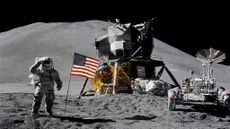 Artemis II: NASA is preparing for a return to the moon, but why is it going back?
NASA's Artemis II mission is sending humans back to the moon for the first time since the Apollo era. Here are the reasons why the U.S. wants to return.
8 Commentsspace-exploration -
 'Super El Niño' could push global temperatures to unprecedented highs, forecasters say
A "super El Niño" could emerge by the end of the 2026 hurricane season, with forecasters predicting that the ongoing La Niña is about to finish.
5 Commentsweather -
 'Interstellar messenger' 3I/ATLAS could be nearly as old as the universe itself, James Webb telescope observations reveal
The comet formed in a cold and distant part of the early Milky Way up to 12 billion years ago, potentially putting it just under 2 billion years the age of the universe.
2 Commentscomets -
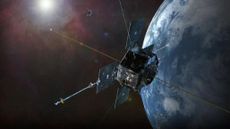 1,300-pound spacecraft will crash to Earth today following intense solar activity, NASA warns
NASA's Van Allen Probe A is falling to Earth much sooner than expected, though the spacecraft's reentry poses a low risk to humans.
space-exploration -
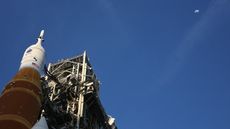 NASA fixes Artemis II rocket for April launch to take astronauts around moon
NASA's Artemis II is on track to shoot for the moon in April after engineers fixed the helium issue that grounded the mission's rocket last month.
10 Commentsspace-exploration -
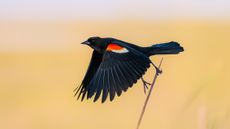 Birds are declining faster and faster in 3 US hotspots, new study finds
Researchers have revealed that North American birds are declining at an accelerating rate in three regional hotspots associated with intense agriculture.
28 Commentsbirds -
 Chinese astronauts describe moment a crack was discovered on Shenzhou-20 spacecraft
Taikonauts from the ill-fated Shenzhou-20 mission have described what happened when they discovered cracks on their spacecraft as they prepared to depart China's Tiangong space station last year.
7 Commentsspace-exploration -
 Kazakhstan plants tens of thousands of trees in giant effort to reintroduce tigers
Kazakhstan planted 37,000 seedlings and cuttings in South Balkhash last year to prepare for the return of its tigers, which disappeared more than 70 years ago.
cats -
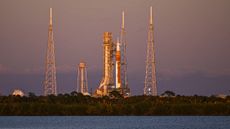 NASA set to roll Artemis rocket back for urgent repairs after yet another delay
NASA is about to roll its Artemis II moon rocket back to the Vehicle Assembly Building to fix a helium flow issue that guarantees astronauts won't fly around the moon in March.
space-exploration


