















Earth's cryosphere loses enough ice to cover Lake Superior every year
The planet is melting at a fast clip.

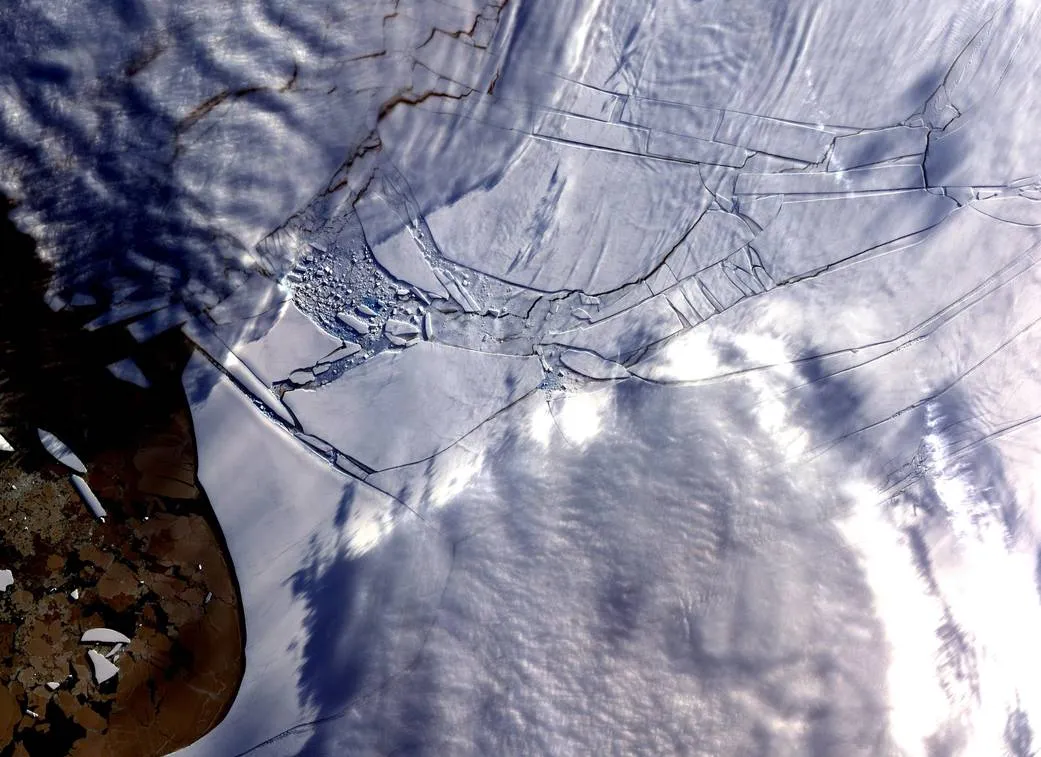
Earth is losing ice at a rapid rate, with a frozen area the size of Lake Superior melting every year.
It's no surprise that the planet is melting, of course. Researchers have been documenting losses in the polar ice sheets, in glaciers and in seasonal snow cover for years. They've also found that ice on rivers and lakes is melting earlier in the spring as temperatures warm, driven by climate change. But a new study out May 16 in the open-access journal Earth's Future is the first to put all the frozen bits of Earth together and measure their melting in one fell swoop. The collective ice on the planet is known as the cryosphere.
Led by Xiaoqing Peng, a geographer at Lanzhou University in China, the new study finds that the planet has lost about 33,000 square miles (87,000 square kilometers) of ice cover each year since 1979.
Related: Images of melt: Earth's vanishing ice
"The cryosphere is one of the most sensitive climate indicators and the first one to demonstrate a changing world," Peng said in a statement. "Its change in size represents a major global change, rather than a regional or local issue."
The researchers pulled together data on snow cover, sea-ice extent and frozen soil, which includes the extent of the ice sheets in polar regions. Many of the measurements were made by satellite and collected by the National Snow and Ice Data Center (NSIDC). For snow cover, the researchers used data on snow depths from the European Centre for Medium-Range Weather Forecasts. They then validated these datasets by comparing the numbers to data from 28,000 local weather stations around the globe.
They found that the Northern Hemisphere dominated the ice loss, with coverage shrinking by 39,300 square miles (102,000 square km) a year. This ice loss was slightly offset by smaller gains in the Southern Hemisphere of 5,400 square miles (14,000 square km). Most of that gain was in sea ice on the Ross Sea in Antarctica, which likely grew due to freshwater runoff from the continent, which can change ocean current patterns in complex ways, and also changes in wind patterns, according to the researchers.
Get the world’s most fascinating discoveries delivered straight to your inbox.
Related content
The researchers also found evidence of a shorter frozen season each year. The first freeze of winter now occurs 3.6 days later on average than it did in 1979, and the first thaw of spring happens 5.7 days earlier.
The cryosphere holds three-quarters of the world's fresh water, and the loss of ice is affecting water supplies in many mountainous regions that depend on snowmelt each spring to fill rivers and reservoirs. The researchers next want to use the global cryosphere data to learn how ice changes alter ecosystems. They also want to use the data to compare peak brightness, or albedo, to seasonal and long-term climate change, Shawn Marshall, a glaciologist at the University of Calgary in Canada, who was not involved in the research, said in the statement. Bright white snow and ice reflect sunlight away from Earth's surface, helping to cool it; when melt exposes darker ground that absorbs heat more readily, it can exacerbate warming.
"This kind of analysis is a nice idea for a global index or indicator of climate change," Marshall said.
Originally published on Live Science

Stephanie Pappas is a contributing writer for Live Science, covering topics ranging from geoscience to archaeology to the human brain and behavior. She was previously a senior writer for Live Science but is now a freelancer based in Denver, Colorado, and regularly contributes to Scientific American and The Monitor, the monthly magazine of the American Psychological Association. Stephanie received a bachelor's degree in psychology from the University of South Carolina and a graduate certificate in science communication from the University of California, Santa Cruz.