













Spooky Quantum Entanglement Disturbed

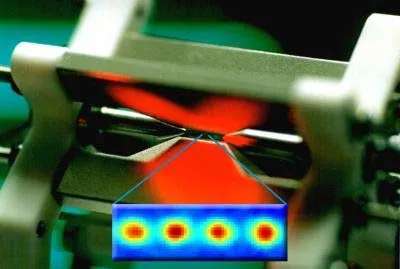
Physicists have long been puzzled over a mystical link between particles called entanglement – and now they've established this bizarre connection in a new experiment.
When two or more particles are entangled, they retain a connection even if separated across an entire galaxy. If an action is performed on one particle, its linked partner will also respond.
Amazingly, entanglement has actually been proven to occur, though lab tests haven't established it out to anything like galactic distances, yet. (When Albert Einstein's calculations suggested the theoretical possibility of entanglement, he was so alarmed he dubbed it "spooky action at a distance.")
In a recent study, a research team entangled four particles together under disturbing conditions to see whether they would keep that connection or break loose.
Probing entanglement like this will not just provide scientists with more information about the freaky ways our world works, but also help them understand behavior of entangled particles as ingredients for superfast quantum computers.
In the new study, researchers entangled four calcium ions (atoms with one missing electron, leaving them positively charged). They did this by exposing the ions to specially calibrated laser light while the ions were moving in a particular pattern. The light imparts a small blast of energy to the ions, causing their electrons to jump from one energy level to the next, leaving all the atoms in a matching entangled state.
Then the entangled particles were exposed to a "noisy" environment, where laser light was present that could potentially disturb their connections.
Get the world’s most fascinating discoveries delivered straight to your inbox.
"We found that as you introduce noise there is a point where you can still have entanglement, but noise interferes with the useful properties of entanglement," said lead author Julio Barreiro of the Institute of Experimental Physics of the University of Innsbruck in Austria. "The environment causes these correlations to decay."
This is useful knowledge for designing quantum computers, he said, because such laser noise would likely be present.
"This is relevant because for many calculations that rely on entanglement, they rely on it being robust against noise," Barreiro told LiveScience. "But there are other approaches that will avoid these problems. There are other ways of programming a quantum computer that make it resistant to sources of noise."
Given recent advances in entanglement science, Barreiro said it may be as little as 10 or 20 years before scientists can create a functional quantum computer able to process many times more information at significantly faster speeds than normal computers.
"Right now for example we are building one that will factorize 15 – 3 times 5," he said. "That's how basic we are. But of course if you prove you can do this in a scalable system, then it can be extended to bigger numbers."
The researchers reported their findings online in the journal Nature Physics.
- Twisted Physics: 7 Recent Mind-Blowing Findings
- Album - Behind the Scenes at the Largest U.S. Atom Smasher
- Einstein's 'Spooky Physics' Gets More Entangled
