














Asteroid Will Buzz Earth This Week Inside the Moon's Orbit

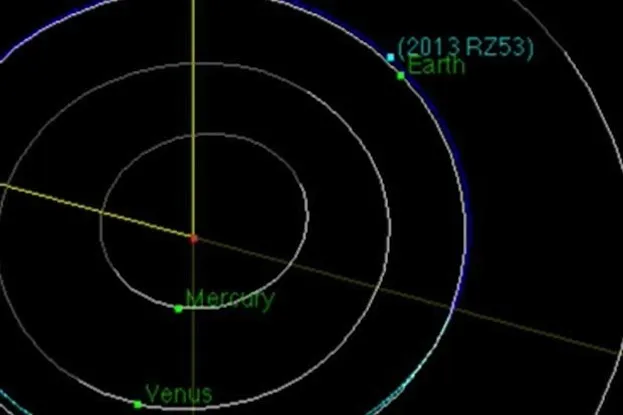
A tiny asteroid discovered just last week is set to zip by Earth on Wednesday (Sept. 18), passing between our planet and the moon. It is small enough and distant enough that it poses no threat to people, scientists say.
Astronomers first observed the space rock, named 2013 RZ53, on Friday (Sept. 13), according to data from the Minor Planet Center, a clearinghouse of information on comets and asteroids based in Cambridge, Mass.
The asteroid measures only 3 to 10 feet (1 to 3 meters) across, and it is expected to pass at a safe distance of more than 148,000 miles (230,800 kilometers) away from Earth when it makes its closest approach on Wednesday at 6:20 p.m. EDT (22:20 GMT). (The moon orbits Earth at an average distance of 239,000 miles, or 384,600 km.)
Even if it were aimed directly at our planet, the newly discovered space rock is so small that it would likely burn up in the atmosphere before it could hit the ground.
By observing the asteroid over several days, researchers pieced together its trajectory. They also put together an animation of asteroid 2013 RZ53's path, showing that it comes relatively close to Earth's orbit.
The space rock belongs to the Apollo family of near-Earth asteroids — the same group from which the meteor that exploded over the Russian city of Chelyabinsk in February 2013 is thought to have originated. The Russian meteor was much larger than the newly discovered asteroid, estimated to have been about 56 to 66 feet wide (17 to 20 m) before it exploded.
The discovery of 2013 RZ53 was made by researchers with the Mount Lemmon Survey at the University of Arizona. The project is part of a larger, NASA-sponsored program called the Catalina Sky Survey, which scans the cosmos for potentially dangerous asteroids.
Get the world’s most fascinating discoveries delivered straight to your inbox.
NASA and its partners keep tabs on asteroids and comets that fly near the planet as part of the Near-Earth Object Observations program, which uses a network of ground-based and space telescopes to monitor potential threats.
This story was provided by SPACE.com, a sister site to LiveScience. Follow Megan Gannon on Twitter and Google+. Follow us @SPACEdotcom, Facebook or Google+. Originally published on SPACE.com.
