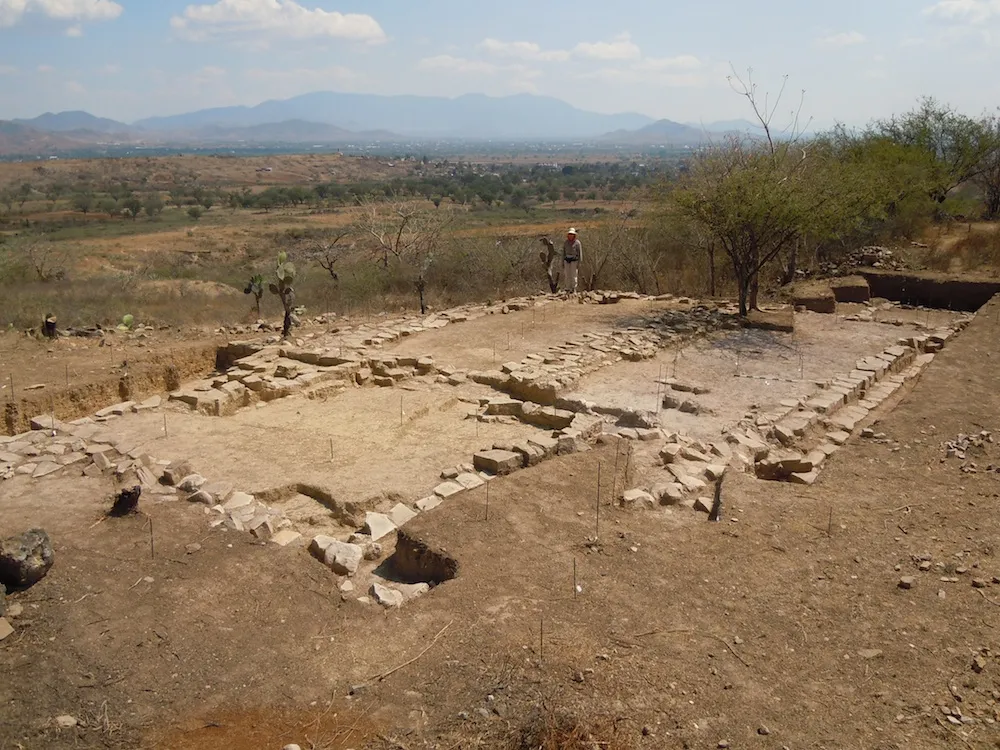
Archaeologists figure out the layout of a temple building at El Palenque. A staircase from the public plaza (right) led to the temple's front hall. The temple's inner room is a step higher than the main entrance.
A newly discovered temple complex in the Valley of Oaxaca, Mexico, reveals hints of a specialized hierarchy of priests — who may have committed human sacrifice.
The evidence of such sacrifice is far from conclusive, but researchers did uncover a human tooth and part of what may be a human limb bone from a temple room scattered with animal sacrifice remains and obsidian blades. The temple dates back to 300 B.C. or so, when it was in use by the Zapotec civilization of what is now Oaxaca.
Archaeologists have been excavating a site in the valley called El Palenque for years. The site is the center of what was once an independent mini-state. Between 1997 and 2000, the researchers found and studied the remains of a 9,150-square-foot (850 square meters) palace complex complete with a plaza on the north side of the site. Radiocarbon dating and copious ash reveal that the palace burned down sometime around 60 B.C. or so. [See Images of the Ancient Temple Site]
Now, the archaeologists have unearthed an even larger complex of buildings on the east side of El Palenque. The walled-off area appears to be a temple complex, consisting of a main temple flanked by two smaller temple buildings. There are also at least two residences, probably for priests, as well as a number of fireboxes where offerings may have been made.
Sacrificial site
The whole complex measures almost 54,000 square feet (5,000 square meters), and the main temple alone has a 4,090-square-foot (380 square meters) footprint.
A view of structures 28 (left) and 27 (right), the buildings archaeologists believe were two priestly homes. The trench in the foreground exposes the original ground surface between the main temple and the homes.
(Image credit: Charles Spencer and Elsa Redmond)
The main room of the main temple was scattered with artifacts, including shell, mica and alabaster ornaments, researchers report Monday (April 22) in the journal Proceedings of the National Academy of Sciences. The archaeologists also found ceramic vessels and whistles, as well as incense braziers. Obsidian blades and lances suggest that the priests engaged in ritual bloodletting and animal sacrifice, as did the remains of turkeys, doves and other animals in the temple hearth.
Sign up for the Live Science daily newsletter now
Get the world’s most fascinating discoveries delivered straight to your inbox.
It was in this room that the human tooth and possible human limb bone were discovered, though researchers can't say for certain whether those bones were a sign of human sacrifice at the temple.
The main temple also contained a kitchen much larger than those found in households in El Palenque, suggesting that cooks whipped up meals for large groups in this spot. Behind the temple were several cell-like rooms, perhaps places for priests-in-training or low-ranking priests to sleep.
Hierarchy of priests
Also behind the temple, archaeologists turned up two buildings that appear to be priestly residences. These buildings were earthen-floored and thick-walled, with firepits inside that are characteristic of El Palenque homes. Unlike other homes in the city, though, these probably priestly digs revealed few utilitarian jars, griddles and grinding stones — but there were many serving plates. The artifacts suggest that priests didn't cook their own food, but were served meals in their quarters by temple servants or staff.
Like the palace, the temple complex has been burned and appears to have fallen out of use by the end of the first century B.C or the first century A.D., making it the oldest temple discovered yet in the Valley of Oaxaca. Among the remaining mysteries of the site is a hastily buried body found in one of the temple's fireboxes.
According to the researchers, the skeleton was found "in a cramped position that resulted in the skull resting at the firebox's southeast corner and a knee poking about its northwest corner."
Stephanie Pappas is a contributing writer for Live Science, covering topics ranging from geoscience to archaeology to the human brain and behavior. She was previously a senior writer for Live Science but is now a freelancer based in Denver, Colorado, and regularly contributes to Scientific American and The Monitor, the monthly magazine of the American Psychological Association. Stephanie received a bachelor's degree in psychology from the University of South Carolina and a graduate certificate in science communication from the University of California, Santa Cruz.