














Friday Flyby May Trigger 'Asteroid-Quake' on Space Rock

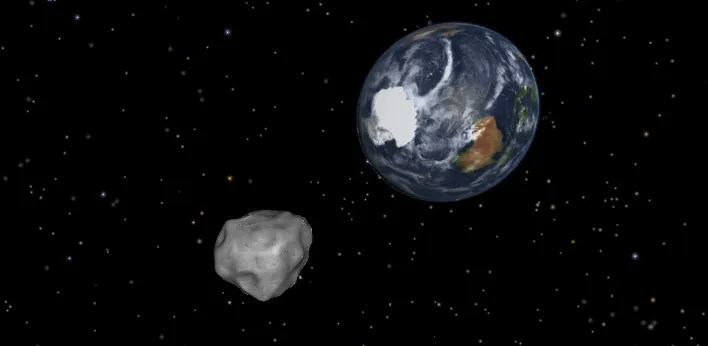
The close flyby of Earth by asteroid 2012 DA14 on Friday (Feb. 15) could trigger a quake on the space rock, scientists say.
"We are going to be looking closely for evidence of seismic activity on 2014 DA14 as it passes by," Richard Binzel, a professor of planetary science at MIT, said in a statement. "This is the first case of an object coming close enough to experience quakes and where we have enough notice to plan observations."
During the unprecedented close approach, 2012 DA14, which is about half the size of a football field, will cruise within 17,200 miles (27,700 kilometers) of the planet. It poses no threat to Earth, but the flyby marks the first time scientists like Binzel have had the chance to observe such a big space rock this close-up.
Binzel believes many near-Earth asteroids get shaken up when they fly too closely to our planet's gravitational field, which could help explain why some space rocks seem to shed a worn-looking outer coating caused by "space weathering." [Asteroid 2012 DA14's Flyby: Complete Coverage]
"As asteroids move through space, they slowly turn dark red," Binzel said. "This phenomenon, called space weathering, is caused by long exposure to cosmic rays and solar radiation. For decades, however, we have known about a handful of small asteroids that looked [light and fresh]; they were not space-weathered."
Binzel and his colleagues calculated the orbits of those squeaky-clean asteroids and found out what they all had in common: close encounters with Earth in the past million years.
"Gravitational forces during the flybys can stretch, rattle and torque these asteroids, causing dark, space-weathered material on the surface to be overturned, revealing the fresh stuff underneath," Binzel said.
Get the world’s most fascinating discoveries delivered straight to your inbox.
Compared to quakes on Earth, asteroid-quakes would look quite minor. Binzel said an astronaut floating next to an asteroid during a tremor might notice its surface sway by a few centimeters or spot "gentle avalanches" on the space rock's steepest crater slopes.
"These asteroids experience [seismic activity] in the milli- to micro-g range," he said. "That might not sound like much, but remember these are small bodies. Gravity is not very strong, so just a little shaking or stretching goes a long way."
Binzel and his colleagues will be looking for changes in the color, spin, shape and reflectivity of asteroid 2012 DA14 as it passes by.
SPACE.com is providing complete coverage of asteroid 2012 DA14's flyby. Visit SPACE.com on Friday for day-long coverage as the asteroid buzzes Earth.
This story was provided by SPACE.com, a sister site to Live Science. Follow SPACE.com on Twitter @Spacedotcom. We're also on Facebook and Google+.
