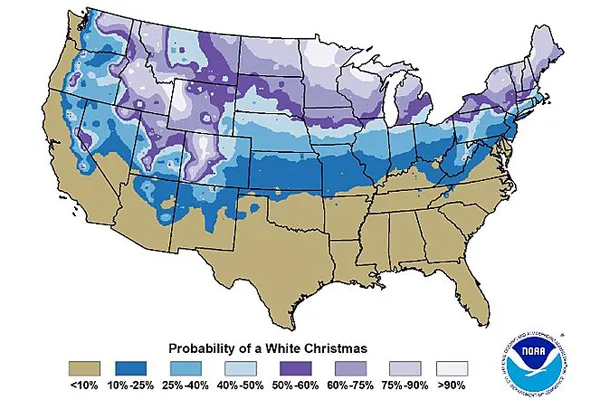
From Charles Dickens' "A Christmas Carol" to Bing Crosby's "White Christmas," Christmas is portrayed as a snowy time. However, many areas of the U.S. do not necessarily have a high probability of a white Christmas*.
* - Since many people may have a different idea of what constitutes a white Christmas, it is being defined in this story as a snow depth of an inch or more on Christmas Day.
Normal December snowfall and temperatures are both critical factors that play a role in who gets a white Christmas. This is due to the fact that snow needs to fall and stay put on the ground to meet the definition.
Based on data from 1981 to 2010, northern New England, the Upper Midwest, Rocky Mountains and Intermountain West have the highest chance, more than 75 percent, of a white Christmas.
Minneapolis, Minn., Green Bay, Wis., Buffalo, N.Y., and Burlington, Vt., are among the cities in the U.S. that have the highest chance for a white Christmas.
"It tends to stay colder across the northern tier during the day and night, so when snow falls, it's less likely to melt," AccuWeather Expert Senior Meteorologist Alex Sosnowski said.
Farther south, Chicago has less than a 40 percent chance of having a white Christmas.
"By the time Christmas comes around, there is a pronounced temperature difference from north to south [across the Midwest]," AccuWeather Senior Meteorologist Jim Andrews said. "The 'refrigeration' needed to keep the snow from melting is less reliable in Chicago compared to somewhere like International Falls, Minn."
While December is not typically the snowiest month for Denver, it is the month with the lowest average high temperature. This means that any snow that falls may be less likely to melt. Denver has nearly a 50 percent chance of a white Christmas.
Meanwhile, New York City, Philadelphia and Washington, D.C., have less than a 25 percent chance of having a white Christmas. Mild air from the Atlantic Ocean plays a role in the low probability.
In the West, Seattle also has less than a 25 percent chance at a white Christmas due to the influence of milder air from the Pacific Ocean. However, snow can still often be seen by Seattle residents, since the Washington Cascades have more than a 75 percent chance of a white Christmas.
There is a very low chance of a white Christmas in San Francisco to Los Angeles as well as across central and southern Florida.
The weather is getting stranger, right? Well, for the most part no, scientists say, but humans often think so when a strange event does occur. So here’s your chance to prove how much you known about weather oddities.