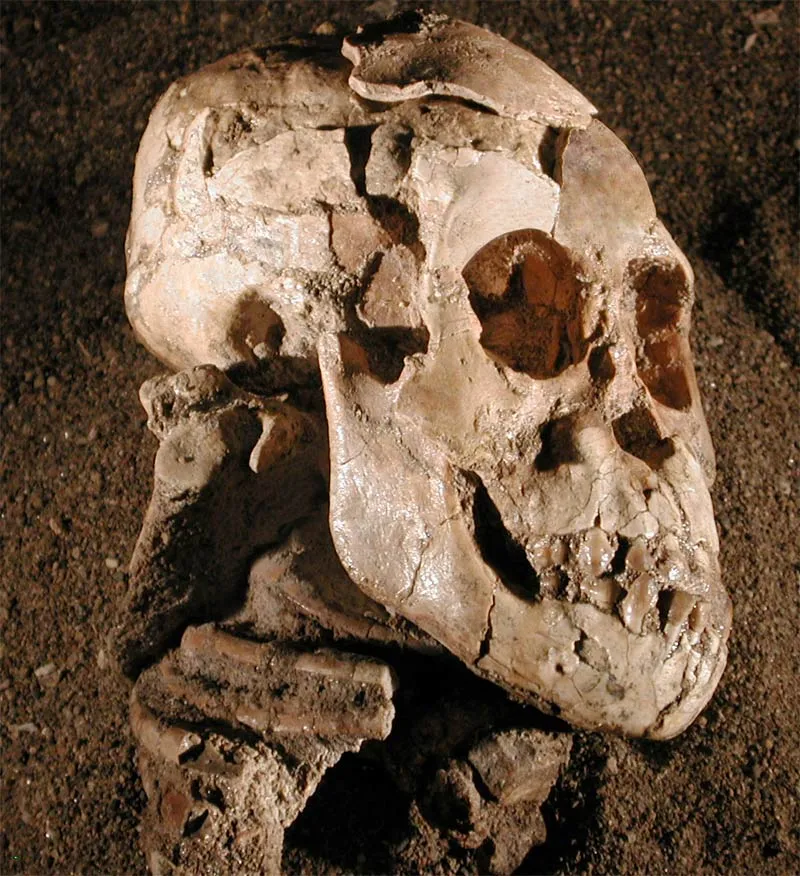
To help resolve this controversy, scientists looked at two complete shoulder blades from the fossil "Selam," an exceptionally well-preserved skeleton of a 3-year-old A. afarensis girl dating back 3.3 million years from Dikika, Ethiopia. The arms and shoulders can yield insights on how well they performed at climbing. (Shown here, Selam's cranium, face and mandible.)
(Image credit: Image courtesy of Zeray Alemseged / Dikika Research Project)
Despite the ability to walk upright, early relatives of humanity represented by the famed "Lucy" fossil likely spent much of their time in trees, remaining very active climbers, researchers say.
Humans are unique among living primates in that walking bipedally — on two feet — is humans' chief mode of locomotion. This upright posture freed their hands up for using tools, one of the key factors behind humans' domination of the planet.
Among the earliest known relatives of humanity definitely known to walk upright was Australopithecus afarensis, the species including the famed 3.2-million-year-old "Lucy." Australopithecines are the leading candidates for direct ancestors of the human lineage, living about 2.9 million to 3.8 million years ago in East Africa.
A view of 3-year-old human ancestor Selam's cranium and mandible, with the vertebrae and complete right scapula visible.
(Image credit: Image courtesy of Zeray Alemseged / Dikika Research Project)
Although Lucy and her kin were no knuckle-draggers, whether they also spent much of their time in trees was hotly debated. Uncovering the answer to this question could shed light on the evolutionary forces that shaped the human lineage.
"When looking at how we became human, an important moment in our history was abandoning a lifestyle in the trees, and when that happened is a big question," researcher Zeresenay Alemseged, a paleoanthropologist at the California Academy of Sciences, told LiveScience.
To help resolve this controversy, scientists have for the first time comprehensively analyzed two complete shoulder blades from the fossil "Selam," an exceptionally well-preserved skeleton of a 3-year-old A. afarensis girl dating back 3.3 million years from Dikika, Ethiopia. The arms and shoulders can yield insights on how well they performed at climbing. [See Photos of Early Human 'Selam' Fossils]
"This study moves us a step closer toward answering the question 'When did our ancestors abandon climbing behavior?'" said Alemseged, who discovered Selam in 2000. "It appears that this happened much later than many researchers have previously suggested."
Sign up for the Live Science daily newsletter now
Get the world’s most fascinating discoveries delivered straight to your inbox.
Researchers spent 11 years carefully extracting Selam's two shoulder blades from the rest of the skeleton, which was encased in a sandstone block. "Because shoulder blades are paper-thin, they rarely fossilize, and when they do, they are almost always fragmentary," Alemseged said. "So finding both shoulder blades completely intact and attached to a skeleton of a known and pivotal species was like hitting the jackpot."
The researchers found these bones had several details in common with those of modern apes, suggesting they lived part of the time in trees. For instance, the socket for the shoulder joint was pointed upward in both Selam and today's apes, a sign of an active climber. In humans, these sockets face out to the sides.
The tiny right fossil shoulder blade of a 3-year-old Australopithecus afarensis female discovered in Dikika, Ethiopia who died 3.3 million years ago is held by lead author David J. Green of Midwestern University.
(Image credit: Image courtesy of David J. Green)
Lucy's adult shoulder sockets also faced upward, suggesting that, like modern apes, her species was equipped for tree-climbing throughout its life span. Humans, on the other hand, are born with a somewhat downward-facing socket that gradually moves to face outward as people mature.
"The question as to whether Australopithecus afarensis was strictly bipedal or if they also climbed trees has been intensely debated for more than 30 years," researcher David Green at Midwestern University in Downers Grove, Ill., said in a statement. "These remarkable fossils provide strong evidence that these individuals were still climbing at this stage in human evolution."
At the same time, most researchers agree that many traits of the A. afarensis hip bone, lower limb, and foot are unequivocally humanlike and adapted for upright walking.
"This new find confirms the pivotal place that Lucy and Selam's species occupies in human evolution," Alemseged said. "While bipedal like humans, A. afarensis was still a capable climber. Though not fully human, A. afarensis was clearly on its way."
"The skeleton of Selam is a goldmine of scientific information," Alemseged added. "We think it will continue to be so as we go further with preparation and cleaning work."
Green and Alemseged detailed their findings in the Oct. 26 issue of the journal Science.
Charles Q. Choi is a contributing writer for Live Science and Space.com. He covers all things human origins and astronomy as well as physics, animals and general science topics. Charles has a Master of Arts degree from the University of Missouri-Columbia, School of Journalism and a Bachelor of Arts degree from the University of South Florida. Charles has visited every continent on Earth, drinking rancid yak butter tea in Lhasa, snorkeling with sea lions in the Galapagos and even climbing an iceberg in Antarctica.