













The Elusive Particle: 5 Implications of Finding Higgs

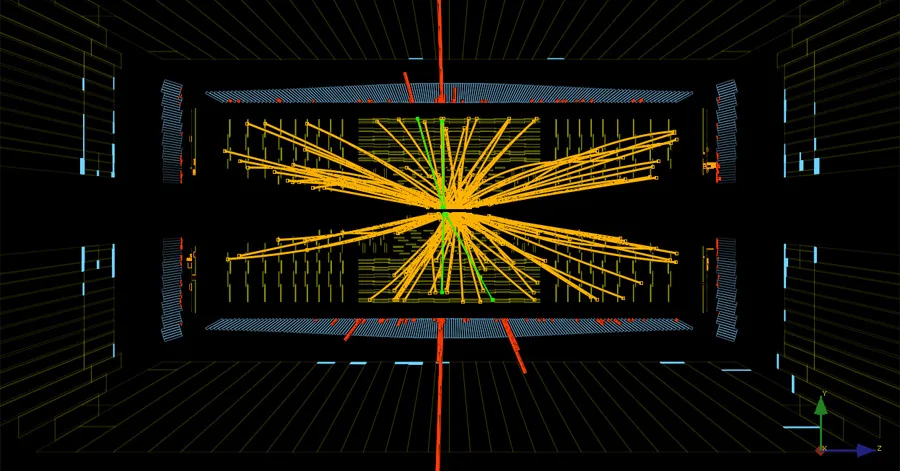
Physicists at the world's largest atom smasher announced today (July 4) that they are more than 99 percent sure they've found a new, and heavy, boson particle, that may be the Higgs boson.
Two experiments at the Large Hadron Collider (LHC) in Geneva, Switzerland, show this new particle has a mass of about 125 GeV, with 1 gigaelectron volt about the mass of a proton. The LHC is the most powerful machine on Earth, capable of producing huge explosions of energy that generate new and exotic particles inside the 17-mile (27 kilometer) loop underneath Switzerland and France. [New Particle Is Likely the Higgs Boson]
If the discovery can be confirmed as the Higgs boson, it will have wide wide-reaching implications. Here are five of the biggest.
1. The origin of mass
The Higgs boson has long been thought the key to resolving the mystery of the origin of mass. The Higgs boson is associated with a field, called the Higgs field, theorized to pervade the universe. As other particles travel though this field, they acquire mass much as swimmers moving through a pool get wet, the thinking goes.
"The Higgs mechanism is the thing that allows us to understand how the particles acquire mass," said Joao Guimaraes da Costa, a physicist at Harvard University who is the Standard Model Convener at the LHC's ATLAS experiment. "If there was no such mechanism, then everything would be massless."
If physicists confirm that the detection of the new elementary particle is indeed the Higgs boson, and not an imposter, it would also confirm that the Higgs mechanism for particles to acquire mass is correct. "This discovery bears on the knowledge of how mass comes about at the quantum level, and is the reason we built the LHC. It is an unparalleled achievement," Caltech professor of physics Maria Spiropulu, co-leader of the CMS experiment, said in a statement. And, it may offer clues to the next mystery down the line, which is why individual particles have the masses that they do. "That could be part of a much larger theory," said Harvard University particle physicist Lisa Randall."Knowing what the Higgs boson is, is the first step of knowing a little more about what that theory could be. It's connected."
Get the world’s most fascinating discoveries delivered straight to your inbox.
2. The Standard Model
The Standard Model is the reigning theory of particle physics that describes the universe's very small constituents. Every particle predicted by the Standard Model has been discovered — except one: the Higgs boson.
"It's the missing piece in the Standard Model," said Jonas Strandberg, a researcher at CERN working on the ATLAS experiment. "So it would definitely be a confirmation that the theories we have now are right." If the newly detected particle turns out not to be the Higgs boson, it would mean physicists made some assumptions that are wrong, and they'd have to go back to the drawing board.
While the discovery of the Higgs boson would complete the Standard Model, and fulfill all its current predictions, the Standard Model itself isn't thought to be complete. It doesn't encompass gravity (so don't count on catching that fly ball), for example, and leaves out the dark matter thought to make up 98 percent of all matter in the universe. [6 Weird Facts About Gravity]
"The Standard Model describes what we have measured, but we know it doesn’t have gravity in it, it doesn't have dark matter," said CERN physicist William Murray, the senior Higgs convener at ATLAS and a physicist at the U.K.'s Science and Technology Facilities Council. "So we're hoping to extend it to include more."
3. The Electroweak Force
A confirmation of the existence of the Higgs boson would also help explain how two of the fundamental forces of the universe — the electromagnetic force that governs interactions between charged particles, and the weak force that's responsible for radioactive decay — can be unified. [9 Unsolved Physics Mysteries]
Every force in nature is associated with a particle. The particle tied to electromagnetism is the photon, a tiny, massless particle. The weak force is associated with particles called the W and Z bosons, which are very massive.
The Higgs mechanism is thought to be responsible for this.
"If you introduce the Higgs field, the W and Z bosons mix with the field, and through this mixing they acquire mass," Strandberg said. "This explains why the W and Z bosons have mass, and also unifies the electromagnetic and weak forces into the electroweak force."
Though other evidence has helped buffer the union of these two forces, the discovery of the Higgs would seal the deal. "That's already pretty solid," Murray said. "What we're trying to do now is find really the crowning proof."
4. Supersymmetry
Another theory that would be affected by the discovery of the Higgs is called supersymmetry. This idea posits that every known particle has a "superpartner" particle with slightly different characteristics.
Supersymmetry is attractive because it could help unify some of the other forces of nature, and even offers a candidate for the particle that makes up dark matter. The newly detected particle is in the low-mass range, at 125.3 or so GeV, something that lends credence to supersymmetry.
"If the Higgs boson is found at a low mass, which is the only window still open, this would make supersymmetry a viable theory," Strandberg said."We'd still have to prove supersymmetry exists."
5. Validation of LHC
The Large Hadron Collider is the world's largest particle accelerator. It was built for around $10 billion by the European Organization for Nuclear Research (CERN) to probe higher energies than had ever been reached on Earth. Finding the Higgs boson was touted as one of the machine's biggest goals.
Finding the Higgs would offer major validation for the LHC and for the scientists who've worked on the search for many years.
"This discovery bears on the knowledge of how mass comes about at the quantum level, and is the reason we built the LHC. It is an unparalleled achievement," Spiropulu said in a statement. "More than a generation of scientists has been waiting for this very moment and particle physicists, engineers, and technicians in universities and laboratories around the globe have been working for many decades to arrive at this crucial fork. This is the pivotal moment for us to pause and reflect on the gravity of the discovery, as well as a moment of tremendous intensity to continue the data collection and analyses."
The discovery of the Higgs would also have major implications for scientist Peter Higgs and his colleagues who first proposed the Higgs mechanism in 1964.
And a Nobel Prize may be another result: "If it is found there are several people who are going to get a Nobel prize," said Vivek Sharma, a physicist at the University of California, San Diego, and the leader of the Higgs search at LHC's CMS experiment.
Follow Clara Moskowitz on Twitter @ClaraMoskowitz or LiveScience @livescience. We're also on Facebook & Google+.
