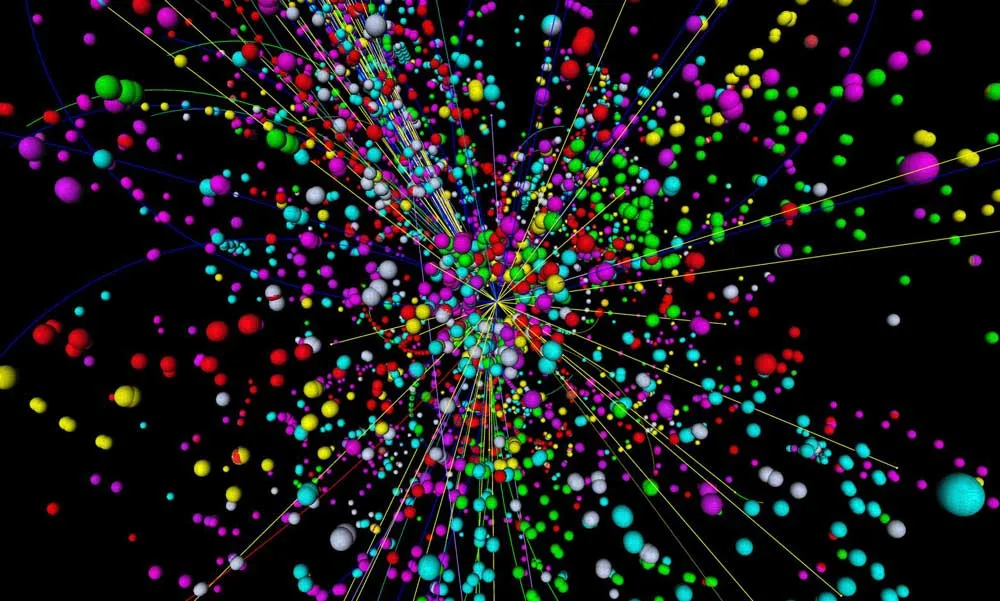
We'll have to take physicists' word for it that "one inverse femtobarn" is a lot. That's the milestone recently reached by the world's largest atom smasher, the Large Hadron Collider.
Inside the circular machine, which is buried 574 feet (175 meters) underground near Geneva, Switzerland, scientists accelerate protons to speeds approaching that of light, and then crash them into each other to produce energetic wrecks that can give rise to new and exotic particles.
The Large Hadron Collider (LHC) at the CERN physics lab began operating in 2008, and has been ramping up its power levels and the intensity of its particle beams. Today (June 17) at 4:50 a.m. ET (10:50 a.m. local time), the amount of data accumulated by two LHC experiments called ATLAS and CMS clicked over from 0.999 to 1 inverse femtobarn.
Latest Videos From
A "barn" is a unit of area, approximately equal to the cross-sectional area of the nucleus of a uranium atom. The prefix "femto" means 10−15 or 0.000000000000001, and an inverse femtobarn is a measurement of particle collisions per area — in other words, how many atoms actually smash together inside the machine.
The more particle collisions that LHC creates, the better its chances of discovering new physics. [Infographic: Nature's Tiniest Particles Dissected]
"This is a superb achievement, which demonstrates the outstanding performance of the accelerator and of the operation team," Fabiola Gianotti, spokeswoman for the ATLAS experiment, said in a statement. "The ATLAS physicists, in particular students and postdocs, are working hard and with great enthusiasm to produce exciting results, from precise measurements of the known particles to searches for the Higgs boson and other new phenomena. It's really a gorgeous moment!"
The Higgs boson is one of the atom smasher's most prized targets. Physicists think this theoretical particle, also dubbed the God particle, might be responsible for giving other particles mass. Though the Higgs has long been predicted to exist, it has never been seen. Many researchers are holding out hope that LHC will finally be powerful enough to create it.
"With the LHC running at much higher intensity than initially foreseen, signals of new physics might appear any moment in our data," said CMS spokesman Guido Tonelli. "Hundreds of young researchers all over the world are actively searching for new particles such as the Higgs boson, supersymmetric particles or new exotic states of matter. If nature is kind to us, we could have major breakthroughs even before the end of this incredibly exciting year."
You can follow LiveScience senior writer Clara Moskowitz on Twitter @ClaraMoskowitz. Follow LiveScience for the latest in science news and discoveries on Twitter @livescience and on Facebook.

 Live Science Plus