













Tech Turns Sketches into Working Synthesizer

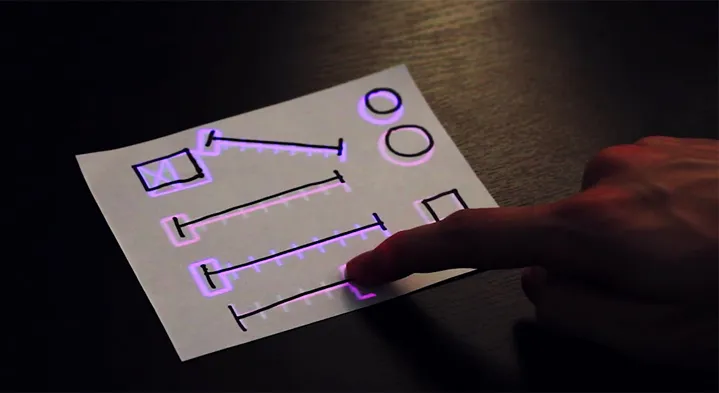
Like many kids, Billy Keyes loved buttons and switches when he was little. He and a neighbor would play by drawing control panels on cardboard and pretending to operate them. Now, as a digital arts student at Carnegie Mellon University, he's putting his skills to work to turn sketched control boards into real ones.
Keyes developed a system, called SketchSynth, that lets users draw buttons, switches and sliders on a piece of paper, then push and drag the paper-and-ink buttons to control a synthesizer. "It's a fun toy that also demonstrates the possibilities of adding digital interaction to sketched or otherwise non-digital interfaces," he wrote on a class website.
For now, SketchSynth recognizes just three shapes: circles, rectangles and tall, skinny capital I's. The circles represent buttons to push, the rectangles turn into switches with "on" and "off" positions and the I's turn into sliders, such as volume bars, which can sit in a variety of positions. Users can draw the shapes anywhere and at any angle on their paper.
Then a webcam set up above the paper detects the buttons while a projector next to the camera projects a few extras onto the draw buttons, such as tick marks along the I for the sliders. The camera also uses its green setting to detect a human hand hovering over the paper. As users press buttons and slide sliders, the webcam detects the person's movements and sends messages to a simple synthesizer, to make the buttons work.
Watch a demo of SketchSynth Keyes made:
Follow InnovationNewsDaily on Twitter @News_Innovation, or on Facebook.
Get the world’s most fascinating discoveries delivered straight to your inbox.
