













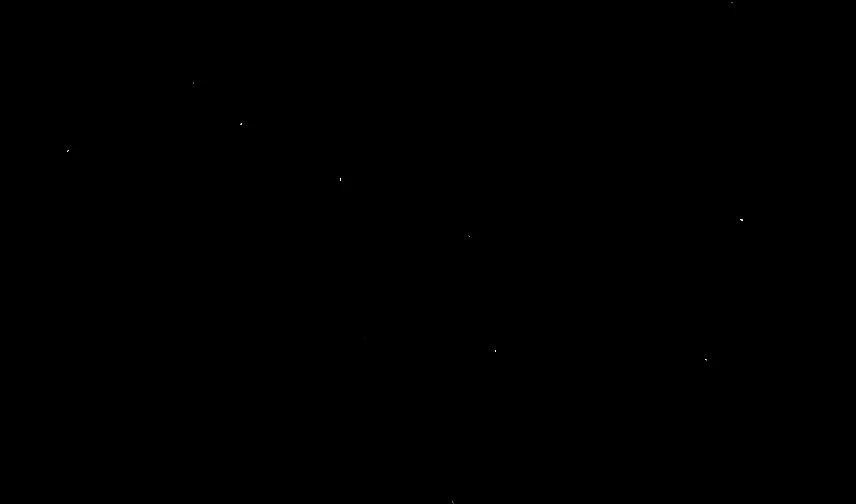
A NASA spacecraft on its way to Jupiter has snapped what may be the farthest-flung photo ever of the famed Big Dipper star pattern.
The Juno probe was already beyond the orbit of Mars when it took the photo of the iconic Big Dipper, which is part of the well-known constellation Ursa Major (the Big Bear), to test out its JunoCam instrument on March 21, NASA officials said. NASA released the image on Thursday (May 10).
"I don't know if it's the first space-based image of the Big Dipper but, as it was taken when we were well beyond Mars orbit, it's probably from the farthest out," Scott Bolton, Juno principal investigator from the Southwest Research Institute in San Antonio, said in a statement.
The Big Dipper is one of the Northern Hemisphere's best-known celestial landmarks. The seven-star pattern is also known as the "Plough" in England and the "Great Cart" in Germany, NASA officials said.
"I can recall as a kid making an imaginary line from the two stars that make up the right side of the Big Dipper's bowl and extending it upward to find the North Star," Bolton said. "Now, the Big Dipper is helping me make sure the camera aboard Juno is ready to do its job."
JunoCam's job is to take close-up shots of the atmosphere of Jupiter. The mission team wanted to test the camera out and certify it in flight, so they decided to train it on the Big Dipper. The resulting photo shows the instrument works just fine, researchers said.
The $1.1 billion Juno spacecraft launched on Aug. 5, 2011, on a mission to study Jupiter's atmosphere and composition, as well as map its magnetic and gravitational fields. The probe is slated to arrive at the solar system's largest planet in July 2016, after a journey of about 1.9 billion miles (3.1 billion kilometers).
Get the world’s most fascinating discoveries delivered straight to your inbox.
Once there, Juno will orbit Jupiter's poles 33 times over the course of one Earth year, using its nine instruments to peer beneath the gas giant's obscuring cloud cover. The mission aims to learn more about Jupiter's origins, structure, atmosphere and magnetosphere, and to look for a potential solid planetary core.
The spacecraft is named after the goddess Juno in Greek and Roman mythology. In the myth, the god Jupiter used clouds to hide his acts of mischief, but his wife Juno was able to peer through the veil to see her husband's antics, according to a NASA description.
As of May 10, the Juno spacecraft has spent 279 days cruising toward Jupiter and traveled about 380 million miles (612 million km).
This story was provided by SPACE.com, a sister site to Live Science. Follow SPACE.com for the latest in space science and exploration news on Twitter @Spacedotcom and on Facebook.
