How much Earth has warmed since 1850: about 2 degrees Fahrenheit (1.1 degrees Celsius)
What causes climate change: Gases trapping heat in the atmosphere
The effects of a warming planet: Increased heat waves, flooding, wildfires, hurricanes and more
Climate change is any long-term shift in average weather patterns. Climate change has occurred many times in Earth's history, and for many different reasons. The changes in global temperature and weather patterns seen today, however, are caused by things humans do, like driving cars or burning coal. And today's climate change is happening much faster than natural climate variations that occurred in the past.
Scientists have many ways to track the climate over time. These methods have made it clear that today's climate change is linked to the emission of greenhouse gases, such as carbon dioxide (CO2) and methane.
On average, greenhouse gases increase global temperatures. This is why climate change is sometimes called global warming. However, most researchers today prefer the term "climate change" because weather and climate vary around the globe, so even if the world is hotter overall, some regions may actually get colder. For example, warming global average temperatures might alter the flow of the jet stream, the major air current that affects the weather in North America. This could lead to periods of extreme cold in some areas.
5 fast facts about climate change
Since 1982, Earth has warmed 0.36 F (0.20 C) every decade.
About 3.6 billion people live in areas that make them highly vulnerable to the effects of climate change.
Scientists say that if Earth warms by more than 3.6 F (2 C), there will be disastrous outcomes.
Developing and low-income countries will be hit the hardest by climate change.
Everything you need to know about climate change
Is climate change real?
Scientists agree that climate change is real and caused by human activity. We can measure the effects of global warming because the climate of the past is recorded in ice, sediments, cave formations, coral reefs and even tree rings. Researchers can look at chemical signals — such as the CO2 trapped inside glaciers — to determine what atmospheric conditions were like in the past. They can study microscopic fossilized pollen to learn what vegetation used to thrive in any given area. Scientists can also measure tree rings to get a season-by-season record of temperature and moisture. Sediments in the ocean can even provide a window into what the climate was like millions of years ago.
Humans started keeping their own detailed records of the climate during the industrial revolution, a period of rapid technological advancement beginning in the late 18th century. Measures of things like land temperature began to improve in the late 1800s, and ship captains started keeping a wealth of ocean-based weather data in their logs. The development of satellite technology in the 1970s provided an explosion of data, including how much ice there is at the poles, the temperatures at the ocean's surface, and cloud coverage.
All in all, these records show that Earth's global average temperature has increased by about 1.8 F (1 C) since the industrial revolution. Climate change has sped up in the past few decades, with the planet warming about 0.36 F (0.2 C) every 10 years.
Earth's average temperature has been increasing since the industrial revolution.
(Image credit: NOAA Climate.gov graph, based on data from the National Centers for Environmental Information.)
What causes climate change?
Climate change is caused by greenhouse gases trapping heat in Earth's atmosphere. Greenhouse gases include CO2, methane and nitrous oxide. They are called greenhouse gases because they trap heat from the sun's rays near Earth's surface, much like the glass walls of a greenhouse keep heat inside. Small changes in the amounts of greenhouse gases in the air can add up to major changes on a global scale.
The burning of fossil fuels — such as coal, oil and natural gas — is the biggest source of greenhouse gas emissions. Livestock, like cows and sheep, are also a source of greenhouse gases. Plants help scrub greenhouse gases from the air, so when people cut down trees across a large area, greenhouse gas emissions rise.
Before the industrial revolution, there were about 280 CO2 molecules for every million molecules in the atmosphere, or 280 parts per million (ppm). As of 2021, the global average level of CO2 was 419 ppm — more than 100 ppm higher than the level has been in the past 800,000 years. Carbon is also building up in the atmosphere faster than in the past. The heat-trapping ability of all that extra carbon has translated to rising global average temperatures. And the world is getting hotter, faster: Two-thirds of the warming that's taken place since 1880 has occurred since 1975.
The burning of fossil fuels emits greenhouse gases, which trap heat in the atmosphere.
(Image credit: Dmitrii Marchenko via Getty Images)
What are the effects of climate change?
Climate change is creating a warmer world with rising sea levels and more dangerous weather. It is also messing up ecosystems around the world.
Some of the most dramatic changes can be seen in the Arctic, where sea ice is melting. Even the oldest sea ice, which usually sticks around year after year, is getting thinner. Global sea ice levels hit a low in 2025, and scientists now think we could see the first summer with no ice in the Arctic sometime between 2040 and 2060.
Melting ice has already caused seas to rise. The global average sea level has risen by 8 to 9 inches (21 to 24 centimeters) since 1880. For coastal areas of the U.S., this sea level rise has resulted in three to nine times more flooding when tides are high.
Climate change is affecting the oceans, too. Ocean water absorbs CO2 from the atmosphere, which creates a chemical reaction that causes ocean acidification. Ocean surface waters have become 30% more acidic since the beginning of the industrial revolution. When water is too acidic, corals can't build their carbonate skeletons, and shelled animals — such as clams and some types of plankton — can die.
Climate change is even affecting when spring weather appears. Spring is arriving earlier in the United States. Climate models now suggest that early springs could be the norm by 2050. But late freezes will likely still occur, creating conditions in which plants could sprout leaves early in the season and then be damaged by cold temperatures.
Droughts and wildfires will also likely become more common. Extreme wildfires have more than doubled worldwide, and fire seasons are getting longer and more intense. Climate models predict that droughts will become more frequent and last longer.
When oceans absorb CO2 from the atmosphere, they become more acidic, which causes coral reefs like the one above to die.
(Image credit: Brett Monroe Garner via Getty Images)
If all human greenhouse gas emissions stopped immediately, Earth would likely continue to warm, because CO2 remains in the atmosphere for hundreds of years. Some scientists have proposed a system called carbon capture and storage — a method that removes CO2 from the atmosphere — to fix this issue. Carbon capture and storage may be possible, but it's so expensive that it's currently unlikely to happen.
Even if we could remove the carbon that's already in the atmosphere, preventing future warming requires humans to stop spewing greenhouse gases now. Slowing climate change is a collective effort that will require collaboration among countries, states and cities, as well as major adjustments to the way the world operates. The most ambitious effort to stop global warming so far is the Paris Agreement. This international treaty between 195 countries aims to keep warming below 3.6 F (2 C). So far, however, most countries are not meeting the goals they set for themselves. The U.S. withdrew from the Paris Agreement in 2025, when Donald Trump began his second term as president.
Climate change pictures
Image 1 of 4
(Image credit: PATRICK T. FALLON via Getty Images)
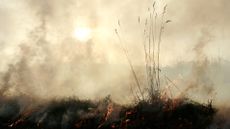
Wildfires
Climate change is causing wildfire season to become longer and more intense.
(Image credit: Anadolu via Getty Images)
Melting glaciers
Glaciers, such as this one in Iceland, are melting, which is contributing to sea level rise.
(Image credit: LUIS ACOSTA via Getty Images)
Rising sea levels
Rising sea levels, a major consequence of climate change, are already affecting Tierra Bomba Island, Colombia.
(Image credit: Mario Tama via Getty Images)
Extreme weather
Climate change is making extreme weather events such as hurricanes, flooding and heat waves more common.
Stephanie Pappas is a contributing writer for Live Science, covering topics ranging from geoscience to archaeology to the human brain and behavior. She was previously a senior writer for Live Science but is now a freelancer based in Denver, Colorado, and regularly contributes to Scientific American and The Monitor, the monthly magazine of the American Psychological Association. Stephanie received a bachelor's degree in psychology from the University of South Carolina and a graduate certificate in science communication from the University of California, Santa Cruz.
Written by
Written by
Marilyn Perkins
Marilyn Perkins is the former content manager at Live Science. She is a science writer and illustrator based in Los Angeles, California. She received her master’s degree in science writing from Johns Hopkins and her bachelor's degree in neuroscience from Pomona College. Her work has been featured in publications including New Scientist, the Johns Hopkins Bloomberg School of Public Health magazine and Penn Today, and she was the recipient of the 2024 National Association of Science Writers Excellence in Institutional Writing Award, short-form category.
Climate change will fundamentally challenge the world's urban centers. Three cities — San Diego, Milan and Jakarta — offer lessons for how to adapt to a warming planet.





 China reaches solar energy milestone — what does this mean for the world's largest greenhouse gas emitter?
 'Everything is connected': Readers share their concerns about extreme heat's health impacts
 'This is such a clear story': Climate change is supercharging El Niño to unprecedented strengths, study finds
 'Wildfire smoke is the fastest-growing environmental threat in the US': How a warming world will poison the air we breathe
 Ocean 'under unprecedented strain' as El Niño helps supercharge warming to record levels
 The pace of climate change matters more than overall heat in the race to save key Atlantic currents, study finds
 'They don't deserve this beauty and this breathtaking fragility'
 'If this is the new normal, then we are in very deep trouble': Brazil's drying aquifers could have ripple effects across the world
 Super El Niño may push an already stressed climate ecosystem across a critical threshold, climate change researcher says


